
Last Updated on October 13, 2026
Clinically Reviewed By: Mansi More Nopany, RCI Clinical Psychologist
Parents often become concerned when a child lies about something that seems unnecessary: unfinished homework, screen use, marks, money, a sibling conflict or something the parent directly witnessed.
You may wonder why your child is doing this despite understanding right and wrong, having clear rules at home and receiving a good education.
Children can lie for several reasons. The meaning usually depends less on the lie itself and more on what the child is trying to avoid, gain or manage in that situation.
Why Does My Child Lie Even About Small Things?
A small lie can serve a real purpose for a child even when it makes little sense to an adult.
The reason can also change from one situation to another.
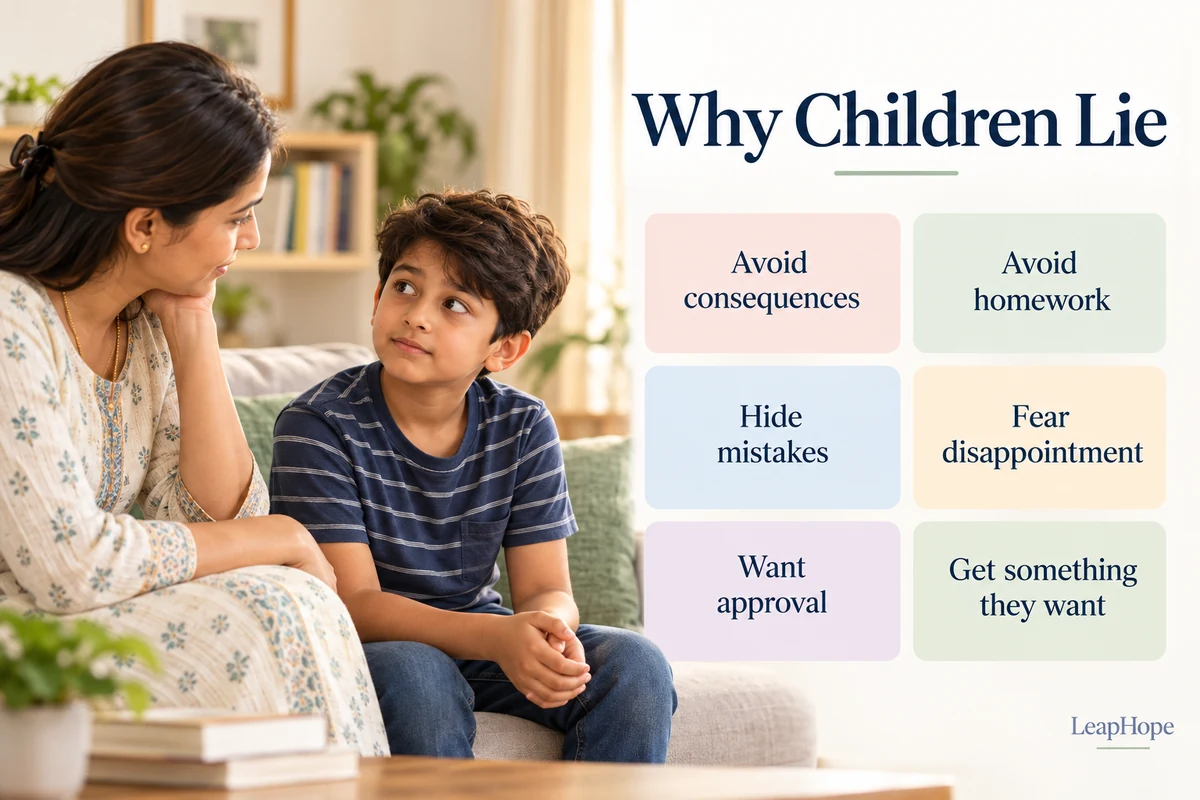
1. Your Child May Be Trying to Avoid Consequences
Children often hide the truth when admitting it would mean taking responsibility.
Your child may deny damaging something, breaking a rule, hurting a sibling or doing something without permission because they expect a consequence.
That consequence does not need to be severe. Losing a privilege, having to apologise, being corrected or seeing a parent disappointed can be enough.
This also explains why a child may deny something you personally saw.
The denial may not be a realistic attempt to convince you. Your child may simply be trying to avoid the uncomfortable moment of admitting what happened.
Children can understand that lying is wrong and still conceal the truth when something important feels at stake.
2. Your Child May Be Avoiding Something Difficult or Unpleasant
Lying often appears around tasks children would rather escape.
Your child may say homework is complete, there was no schoolwork, tuition work is finished or a chore has already been done.
Sometimes the reason is simple: they do not want to do it.
But repeated lying around the same demand can also point to another difficulty.
You may notice that your child struggles to begin work, loses track of assignments, becomes frustrated with one subject or repeatedly says they “forgot.”
In these cases, the problem may involve attention, organisation, academic difficulty or fear of making mistakes as well as avoidance.
If this is happening alongside reduced concentration or increasing study avoidance, it may be useful to look at the academic difficulty separately.
3. Your Child May Be Trying to Avoid Shame or Disappointment
Some children find admitting a mistake emotionally harder than dealing with the mistake itself.
Your child may hide a poor result, deny losing something important or change the story about something that went wrong.
For one child, the main concern may be criticism.
For another, it may be embarrassment.
A child who normally performs well may be particularly uncomfortable showing a poor mark. Another may hide something because they do not want to disappoint a parent whose approval matters greatly to them.
Once the first denial has been made, admitting the truth can also become more difficult because the child now has two things to acknowledge: the original behaviour and the false answer.
When lying repeatedly appears around performance, mistakes or expectations, pay attention to whether your child is also becoming unusually self-critical or afraid of failure. Overthinking and loss of confidence can sometimes appear in the same broader pattern.
4. Your Child May Want Approval or to Protect Their Image
Some children exaggerate rather than deny.
They may make marks sound better, exaggerate praise from a teacher, claim they were selected for something or make friendships seem more impressive than they are.
Parents should not read too much into one exaggerated story.
But repeated exaggeration around the same area can be informative.
A child who frequently changes stories about academic success may be especially sensitive to achievement. Another who exaggerates friendships may be more concerned about social acceptance.
The question here is not simply whether the story is true.
It is what image the child seems to be trying to protect or create.
5. Your Child May Lie to Get Something They Want
Some lies have an immediate reward.
Your child might say one parent already gave permission, claim homework is finished before asking for screen time or change a story to obtain money, food or access to an activity.
This type of lying does not always need a complicated psychological explanation.
Children learn from outcomes.
If changing the truth has helped them get something they wanted before, they may try the same approach again.
6. Your Child May Repeat a Denial Because It Has Worked Before
A child can also learn that denying something changes the situation.
The parent may become uncertain.
A consequence may be delayed.
The conversation may move elsewhere.
The child may receive another chance.
Your child does not need to consciously plan this as a strategy. Behaviours that sometimes change an outcome can become more likely to occur again.
This is why some apparently ineffective lies continue.
If lying is occurring alongside frequent conflict, rule-breaking or other behaviour concerns, it may help to look at what the behaviour may be communicating rather than treating each incident as an isolated problem.
7. Your Child May Respond Before Thinking Through the Lie
Some children deny something almost immediately.
“No.”
“I didn’t.”
“I already did it.”
The first response may come quickly, with the explanation developing only after the parent challenges it.
This can happen more often in children who tend to act or speak impulsively, but one quick denial does not establish ADHD or any other diagnosis.
Parents also sometimes interpret an obvious lie as a sign that the child “doesn’t understand” or has poor judgment.
Lying is not a useful measure of intelligence.
A child can make an easily disproved statement simply because the immediate response was aimed at escaping the situation rather than carefully planning a believable story.
8. Your Child’s Age Can Change Why They Lie
A false statement from a preschooler does not always mean the same thing as concealment by an older child.
Younger children may mix imagination, wishes, inaccurate recall and deliberate attempts to hide something.
As children grow, they become better at understanding what another person knows and at keeping their own story consistent.
The American Psychological Association discusses research showing how children’s ability to deceive develops alongside their understanding of other people’s thoughts and beliefs.
Parents can also look at how children’s emotional understanding changes with age when deciding how much intent to attach to a particular statement.
With older children, privacy becomes more important too.
A preteen or teenager may hide conversations, friendships, online activity or personal experiences partly because they want greater independence.
That does not remove the need for honesty, especially where safety is concerned. But the motivation may be different from that of a younger child hiding unfinished homework.
If secrecy is happening alongside increasing emotional distance, why children stop talking to parents may be worth considering separately.
Why Does My Child Lie Even Though We Give Them a Good Life?
A child can have supportive parents, a good school, financial security and clear family values and still lie.
Good parenting does not remove normal childhood avoidance, embarrassment, temptation or the wish to escape responsibility.
Your child may still hide a mistake, avoid a difficult task, exaggerate an achievement or deny something because admitting it feels uncomfortable.
Rather than asking why a child with “everything” would ever lie, it is usually more useful to notice which situations make dishonesty more likely.
That gives parents something concrete to work with.
What Can Parents Do When a Child Keeps Lying?
No single response works for every child. Parents can consider:
- State what you already know. If you saw what happened, repeated questioning may not help.
- Deal with the original behaviour separately. Homework, a broken rule or damaged property still needs to be addressed.
- Avoid calling your child a liar. Describe the behaviour rather than defining the child by it.
- Keep consequences proportionate. Very harsh reactions can make some children more motivated to conceal mistakes.
- Allow your child to correct an immediate denial.
- Recognise honesty without removing responsibility. Telling the truth does not have to erase a reasonable consequence.
- Notice where lying happens most often. Schoolwork, marks, screens, money, friendships and mistakes can point to different concerns.
- Look beyond honesty when another difficulty is obvious. Academic struggles, anxiety or family conflict may need attention of their own.
Parents do not need to analyse every small lie. Repeated behaviour in the same situations is usually more useful than one isolated incident.
When Should Parents Speak With a Child Psychologist About Lying?
Parents may want professional guidance when lying becomes frequent, serious or begins affecting the child’s everyday functioning.
Consider an assessment when:
- your child lies across many different situations
- serious or unsafe behaviour is repeatedly concealed
- school, friendships or family relationships are being affected
- lying occurs alongside stealing, aggression or significant rule-breaking
- your child repeatedly avoids tasks they appear unable to manage
- you also notice attention, learning or anxiety concerns
- the behaviour changes suddenly or becomes substantially more severe
- trust at home has deteriorated significantly
A child psychologist can look at what is happening around the behaviour and whether the lying is mainly behavioural or connected with another emotional, developmental or learning difficulty.
Parents concerned about persistent behaviour problems can also explore LeapHope’s child behaviour counselling.
Families in India, the USA, UAE and Canada can access LeapHope’s child counselling support online.
Final Thoughts
Your child’s lying should not be judged only by how obvious or unnecessary the lie appears.
The more important clues are what was happening at the time, what telling the truth would have required from your child, and whether the same behaviour keeps returning in similar situations.
Those details can help parents decide whether the child needs a clearer boundary, help with a specific difficulty or further psychological assessment.