Last Updated on October 14, 2026
Clinically Reviewed By: Mansi More Nopany, RCI Clinical Psychologist
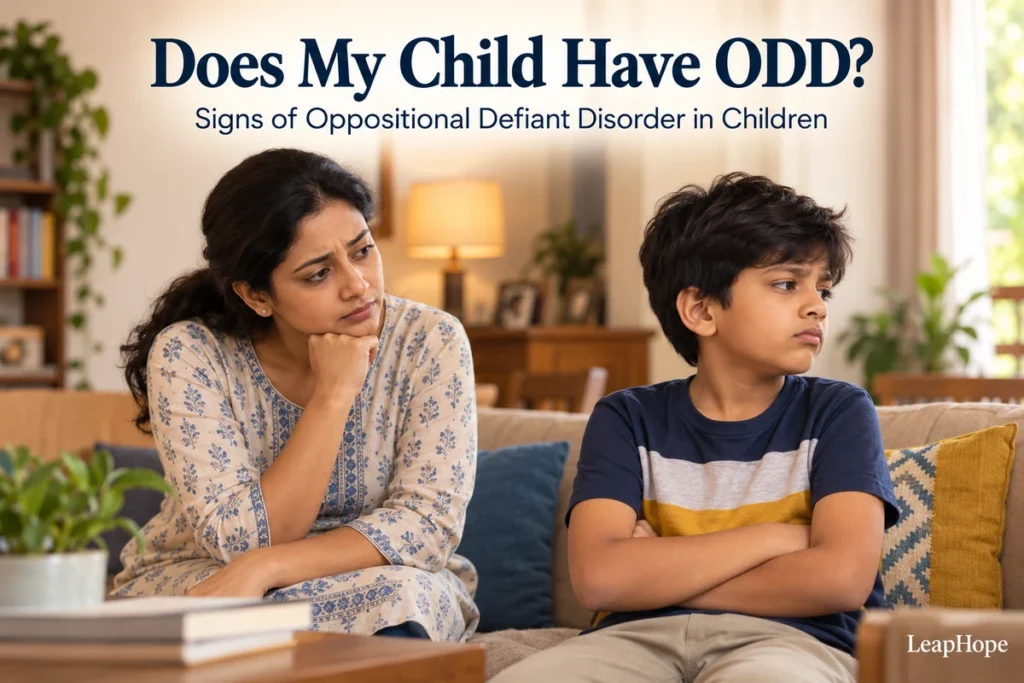
Your child may argue over ordinary instructions, refuse rules they understand, lose their temper quickly or turn small requests into repeated conflict.
Parents searching these behaviours online often come across Oppositional Defiant Disorder (ODD). But an online article cannot tell you whether your child has ODD.
Similar behaviour can appear with ADHD, anxiety, learning difficulties, developmental differences, stress and other emotional or behavioural concerns. A diagnosis requires the child’s behaviour to be understood in the context of their age, development and everyday functioning.
What Is Oppositional Defiant Disorder (ODD)?
Oppositional Defiant Disorder is a behavioural disorder involving a persistent pattern of angry or irritable mood, argumentative or defiant behaviour, and sometimes vindictiveness.
It goes beyond occasional stubbornness, arguing or saying “no.”
Clinicians consider how long the pattern has continued, how often it happens, whether it is unusual for the child’s developmental level and whether it is affecting family, school or social functioning.
The diagnostic pattern is generally present for at least six months. This does not mean parents need to wait six months before seeking professional guidance if the behaviour is already causing significant difficulty.
What Are the Signs of ODD in Children?
ODD can involve several types of behaviour, but individual signs should not be interpreted in isolation.
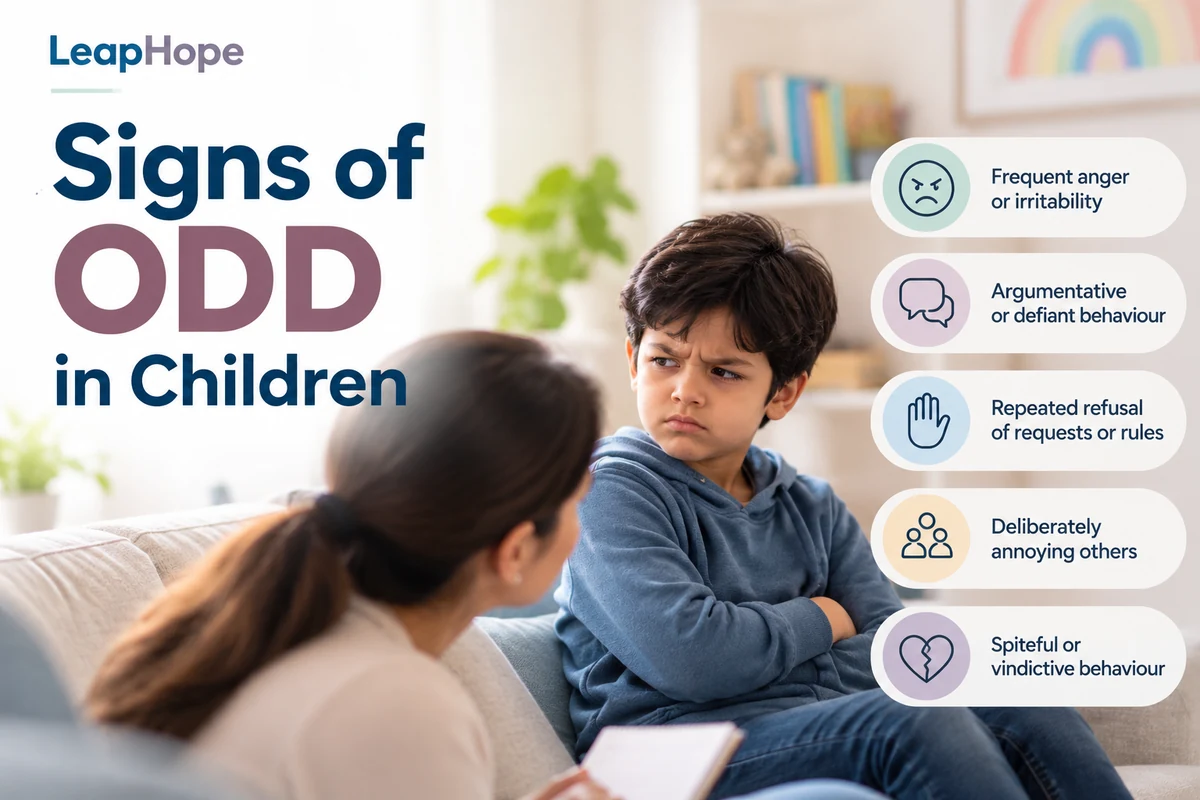
Frequent Anger or Irritability
A child may:
- lose their temper often
- become easily annoyed
- appear frequently angry or resentful
- react strongly to relatively small frustrations
What matters clinically is whether this has become a persistent pattern rather than an occasional reaction.
Argumentative or Defiant Behaviour
Parents may notice:
- frequent arguments with parents, teachers or other authority figures
- repeated refusal of reasonable requests or rules
- deliberately annoying other people
- blaming others for mistakes or behaviour
In everyday life, even ordinary instructions such as starting homework, turning off a screen or getting ready for bed may repeatedly become prolonged conflicts.
However, similar behaviour can have different explanations.
For example, a child with attention difficulties may forget instructions or struggle to complete tasks. A child who repeatedly avoids homework may be struggling with the work rather than deliberately refusing it.
If the difficulty appears mainly around schoolwork, problems with concentration or increasing study avoidance may need to be considered separately.
Spiteful or Vindictive Behaviour
ODD can also include repeated spiteful or vindictive behaviour.
This is different from a child saying something unkind during one angry argument. Clinicians consider whether this behaviour forms part of a broader and recurring pattern.
Some children showing oppositional behaviour may also have ADHD, anxiety, learning difficulties, developmental concerns or another emotional or behavioural condition.
The NICE guidance on antisocial behaviour and conduct disorders in children and young people recommends considering coexisting mental-health, neurodevelopmental and learning difficulties when children present with persistent behavioural problems.
ODD can also occur alongside other conditions, which is one reason diagnosis should not be based on a symptom checklist alone.
What If My Child Is Defiant Only at Home or With One Parent?
Oppositional behaviour can sometimes be much stronger in one setting or relationship.
A child may behave well at school but argue frequently at home, or show much more conflict with one parent than another.
This alone does not confirm or rule out ODD.
A clinician would consider where the behaviour occurs, the situations in which it appears, what other adults observe and whether another difficulty may be contributing.
Parents seeing a large difference between behaviour at home and elsewhere may also find why some children behave well outside but break down at home useful.
How Is ODD Treated in Children?
Treatment can vary according to the child’s age, the difficulties identified and whether other conditions are present.
Some children and families may be offered parent management training or other parent-focused behavioural approaches.
Depending on the child’s needs, individual or parent-child therapy may also focus on areas such as frustration, problem solving, communication or emotional regulation.
School involvement may be useful when behaviour is affecting classroom functioning.
If ADHD, anxiety, a learning difficulty or another condition is also present, that may need separate attention. Child ADHD counselling may be relevant when attention, impulsivity and behavioural concerns appear together.
Medication is not routinely used solely for the behavioural symptoms of ODD. Decisions about medication belong with an appropriate medical professional and depend on the child’s individual clinical picture.
When Should Parents Speak With a Child Psychologist?
Parents may want professional guidance when oppositional behaviour becomes persistent, intense or begins affecting everyday life.
Consider speaking with a qualified child mental-health professional when:
- everyday requests regularly become major conflicts
- anger or defiance seems unusually intense for the child’s age
- family relationships are being affected
- school or friendships are being affected
- aggression or serious rule-breaking is appearing
- ADHD, anxiety, learning or developmental concerns may also be present
- the behaviour has changed substantially
- parents cannot understand what may be contributing to the behaviour
An assessment can help explore whether the behaviour is consistent with ODD or whether another difficulty may better explain what is happening.
Parents looking for broader support can explore LeapHope’s online child and teen counselling or, for persistent behavioural concerns, child behaviour counselling.
Families in India, the USA, the UAE and Canada can access LeapHope’s child counselling support online.
Final Thoughts
Frequent arguing, anger or refusal does not by itself tell parents whether a child has Oppositional Defiant Disorder.
What matters is the wider pattern: how long the behaviour has been happening, how intense it is for the child’s age, where it occurs and how much it is affecting daily life.
If the behaviour is becoming difficult to understand or manage, professional assessment can help clarify whether ODD, another difficulty or a combination of factors needs attention.