

Last Updated on October 27, 2026
Clinical Reviewer: Mohit Yadav, RCI-Registered Clinical Psychologist
Your child has ADHD. They know the house rules, understand why hitting is wrong and can explain what happens when they interrupt someone. Yet the next time they’re frustrated, the same behaviour happens again.
You’ve tried reminders, taking away privileges and talking about the consequences afterwards. Sometimes things improve for a few days, only for the arguments to return.
Does ADHD make it harder for your child to control their behaviour? And when they continue breaking rules they already understand, what should you do differently?
Why Do Some Children With ADHD Have Behaviour Problems?
ADHD affects attention regulation and impulse control. Some children also have difficulty managing frustration and calming down after upsetting situations.
These problems may appear in different ways:
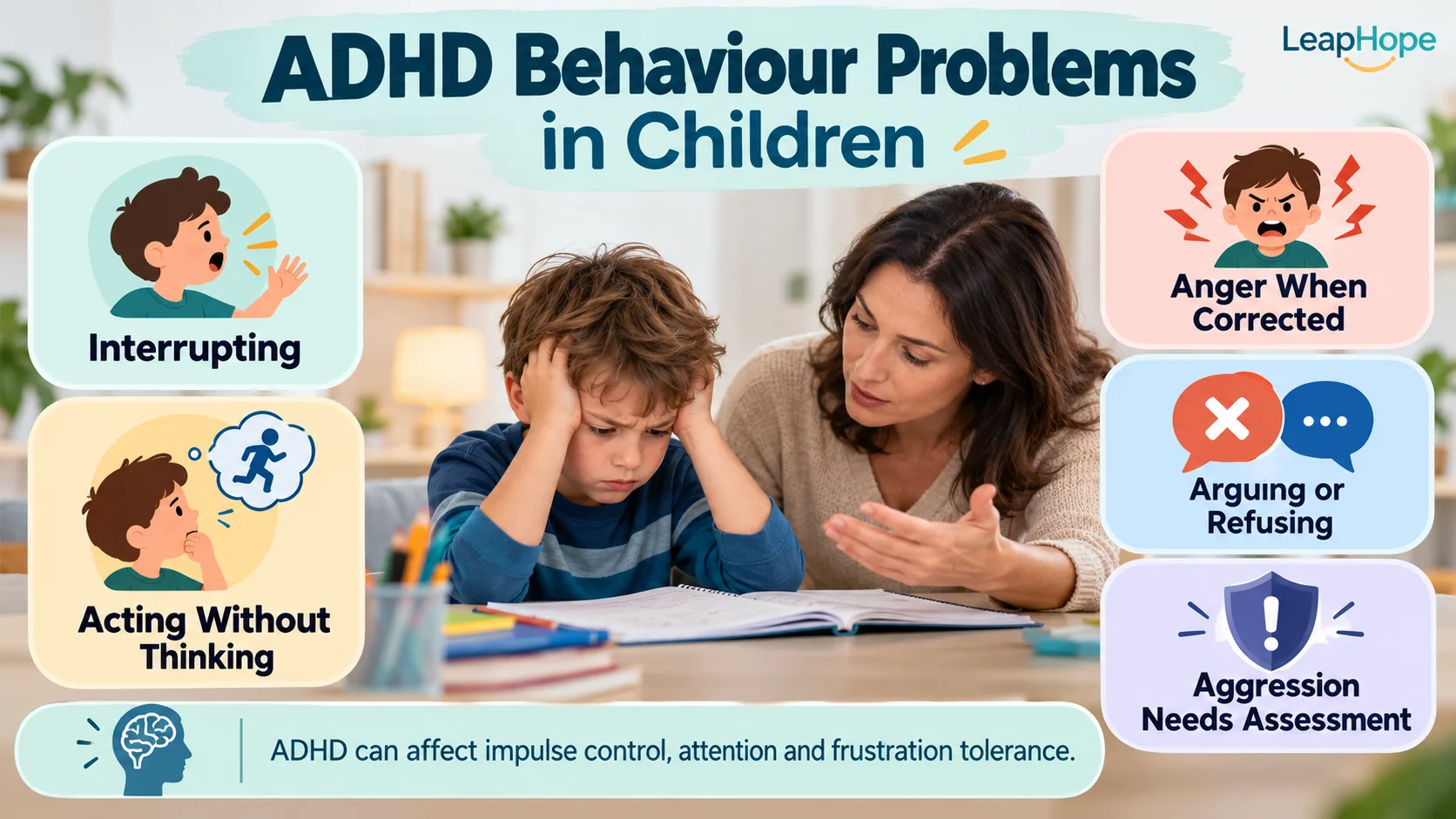
- Impulsivity: A child may shout an answer, grab something or interrupt before considering the consequences.
- Inattention: A child may hear an instruction but lose track of it, become distracted or struggle to complete the requested steps.
- Emotional regulation: Some children with ADHD react strongly to disappointment or correction and take longer to settle. Emotional dysregulation is associated with ADHD but is not a core diagnostic criterion.
ADHD doesn’t explain every behaviour problem. Learning difficulties, anxiety, sleep problems and other conditions may also contribute.
Repeated conflicts can also become established patterns. For example, a child resists homework, an argument begins and the assignment gets delayed. If avoiding the task repeatedly follows the argument, that outcome may unintentionally reinforce the behaviour, even if the child isn’t deliberately trying to manipulate anyone.
For a broader explanation of recognised symptoms, read LeapHope’s guide to signs of ADHD in children.
Which Behaviour Problems Are Common in Children With ADHD?
| Behaviour | What it may indicate |
|---|---|
| Interrupting or acting before thinking | Recognised ADHD symptoms involving impulsivity |
| Repeatedly leaving activities unfinished | Inattention, distractibility or difficulty sustaining effort |
| Becoming angry when corrected | Frustration or emotional regulation difficulties, which may accompany ADHD |
| Arguing or refusing instructions | May involve frustration, task demands or oppositional behaviour; not a core ADHD symptom |
| Hitting, threatening or damaging things | Aggression is not an ADHD diagnostic symptom and may indicate an additional concern |
A child’s refusal may have different explanations, including task difficulty, frustration, impulsivity or deliberate noncompliance. The pattern and circumstances matter more than any single incident.
Problems with impulse control and completing tasks can also involve executive function difficulties in children, which are not exclusive to ADHD.
For persistent arguing, hostility or refusal, read LeapHope’s guide to oppositional defiant disorder in children.
Why Does My Child With ADHD Behave Well at School but Struggle at Home?
Some children with ADHD follow classroom expectations reasonably well but become argumentative, frustrated or upset after returning home.
School may provide predictable routines, immediate feedback and clear transitions. At home, the child may face different demands or less structure.
Fatigue, hunger and the effort of managing school expectations may contribute too.
For example, a child who follows their teacher’s routine may struggle when asked to stop playing and begin homework immediately after school.
Ask the teacher what helps your child succeed. Notice whether difficulties at home occur mainly during particular activities or times of day.
This doesn’t automatically mean your child is masking ADHD at school or deliberately behaving badly at home. Differences in expectations, support and demands may affect how behaviour appears.
How Should Parents Respond to ADHD-Related Behaviour Problems?
Your response should depend on what happened before the behaviour and what your child was being asked to do.
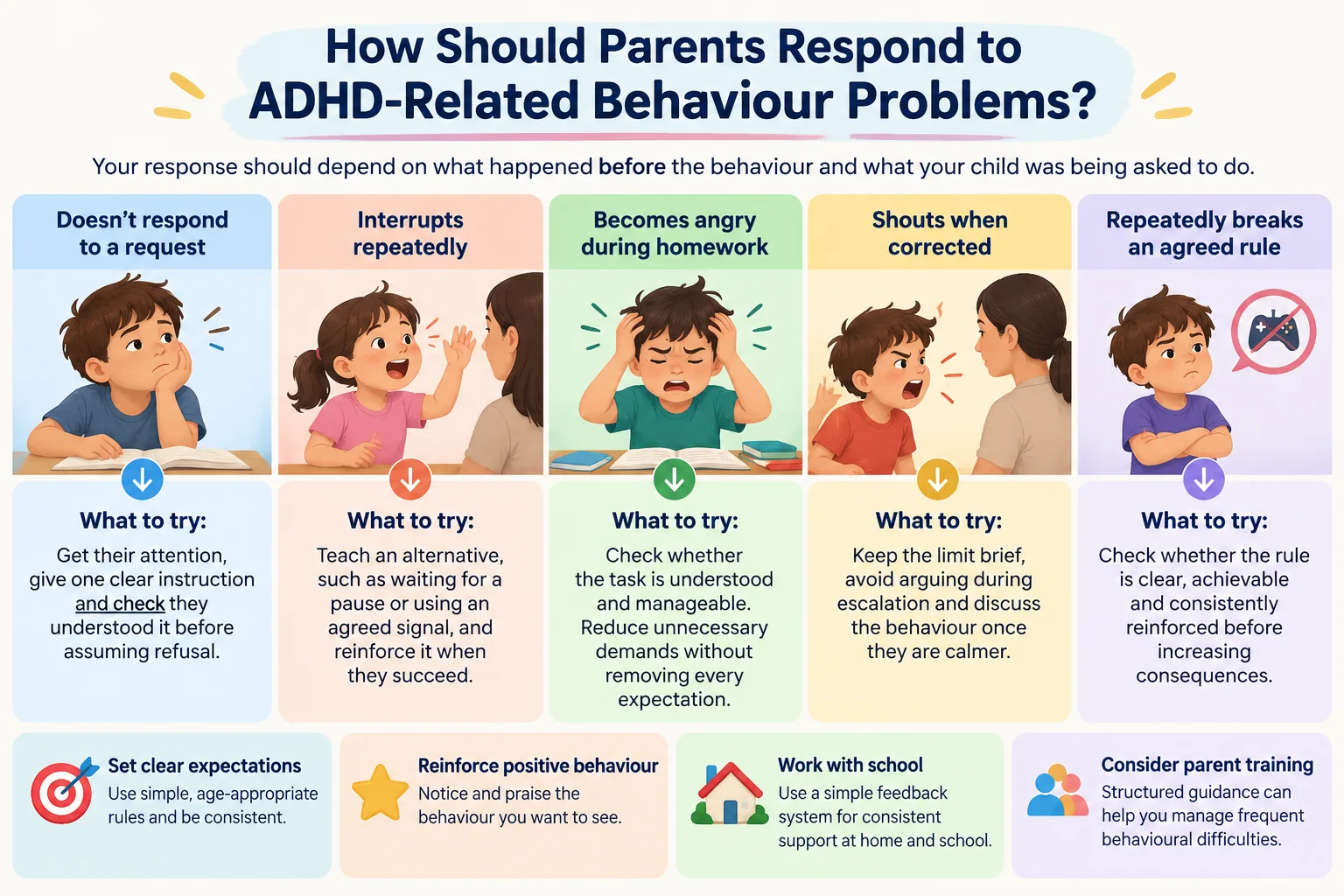
A missed instruction, an impulsive interruption and an angry refusal may look equally frustrating, but repeating the same warning may not address the problem.
Match Your Response to the Behaviour
| What happens | What to try |
|---|---|
| Your child doesn’t respond to a request | Get their attention, give one clear instruction and check they understood it before assuming refusal. |
| Your child interrupts repeatedly | Teach an alternative, such as waiting for a pause or using an agreed signal, and reinforce it when they succeed. |
| Your child becomes angry during homework | Check whether the task is understood and manageable. Reduce unnecessary demands without removing every expectation. |
| Your child shouts when corrected | Keep the limit brief, avoid arguing during escalation and discuss the behaviour once they are calmer. |
| Your child repeatedly breaks an agreed rule | Check whether the rule is clear, achievable and consistently reinforced before increasing consequences. |
Make a Simple Behaviour Plan
Suppose your eight-year-old repeatedly interrupts family conversations.
You’ve reminded them countless times to stop. They promise to wait, but the behaviour continues.
Instead of another warning, try a structured approach.
Define the behaviour. Focus on waiting before speaking rather than the vague goal of “behaving properly.”
Teach an alternative. Agree that your child can place a hand on your arm or use another signal when they want attention. Practise when everyone is calm.
Acknowledge the signal. Respond briefly to show you’ve noticed, then give attention when possible. Start with short waiting periods and increase expectations gradually.
Reinforce success. When your child uses the agreed method, give specific praise: “You used our signal instead of interrupting.”
Review progress. Notice whether interruptions become less frequent and adjust the plan if necessary.
This example illustrates behavioural management principles, not a guaranteed treatment. Expectations should match the child’s age, communication abilities and capacity for self-control.
Set Limits Without Relying on Punishment
Children with ADHD still need clear rules and boundaries.
Repeated scolding or removing privileges long after an incident may do little to teach the behaviour a child is struggling to manage.
Keep expectations clear, consequences proportionate and non-physical, and reinforce appropriate behaviour consistently.
For example, if your child throws a toy, stop the unsafe behaviour and remove the toy temporarily if needed. Once they’re calm, practise what they can do when frustrated. If someone was hurt, address the harm and appropriate repair.
Coordinate Behaviour Support With School
If similar difficulties occur in the classroom, ask the teacher whether one or two specific behaviours can be monitored using a simple daily feedback sheet.
For example, the teacher might record whether your child waited for their turn or began an assigned activity with agreed support.
Parents and teachers can then recognise progress using consistent expectations and reinforcement. A clinician can help design or adjust the plan when needed.
The goal is to monitor specific behaviours rather than label the child as good or bad.
When Parent Training May Help
If behavioural difficulties are frequent, parents may benefit from behavioural parent training, rather than trying isolated strategies without guidance.
These structured programmes teach parents to identify target behaviours, reinforce desired responses, set limits and review progress. Parent training is not simply individual counselling for the child.
For children aged 4–5, evidence-based parent training and/or behavioural classroom interventions are recommended first. Medication may be considered by an appropriate prescriber when significant impairment continues despite behavioural treatment.
For children aged 6–11, clinical guidelines recommend ADHD medication alongside parent training and/or behavioural classroom interventions. For adolescents, treatment should be individualised and involve their participation.
What If Behaviour Strategies Aren’t Working?
Before increasing punishments or adding more rewards, examine what happens around the behaviour.
| Pattern | What to investigate |
|---|---|
| Your child refuses homework but cooperates with other requests | Is the work too difficult, lengthy or frustrating? Could a learning difficulty be contributing? |
| Arguments happen mainly after school | Are fatigue, transitions or competing demands making behaviour harder to manage? |
| A reward system works briefly and then stops | Is the goal achievable? Is reinforcement prompt and meaningful? Does the plan need adjusting? |
| Your child understands rules but repeatedly acts impulsively | Are expectations realistic for their current self-control abilities? Does ADHD treatment need review? |
| Aggression or severe defiance continues | Could coexisting behavioural, emotional or developmental concerns require assessment? |
Record what happened immediately before the behaviour, what your child did and what followed.
For example:
“Every evening when homework starts, my child shouts and leaves the table. It happens less often when the teacher has already explained the assignment.”
When refusal or distress occurs mainly in situations that make your child worried, LeapHope’s guide to ADHD vs anxiety in children explains how these concerns can overlap.
For a child receiving ADHD treatment, the clinician may also need to review symptom control, medication timing or side effects, sleep and school support.
When Should Behaviour Problems in a Child With ADHD Be Reassessed?
Seek professional advice if behavioural problems persist despite appropriate support, interfere with learning or family life, or involve frequent aggression, significant distress or serious rule-breaking.
Repeated hitting, threats or destructive behaviour warrant professional assessment. If your child is at immediate risk of seriously hurting themselves or someone else, seek emergency assistance.
A qualified clinician may reassess ADHD symptoms, treatment response and coexisting conditions such as oppositional defiant disorder, anxiety, learning disorders or sleep difficulties.
When persistent oppositional or conduct problems accompany ADHD, structured parent training may be recommended specifically to address those behaviours.
LeapHope offers child ADHD counselling and online child and teen counselling for families dealing with ADHD-related behaviour and emotional concerns. Specialised behavioural treatment or medical review may also be needed.
Clinical Resources
- American Academy of Pediatrics — ADHD Clinical Practice Guideline — ADHD assessment, coexisting conditions and age-specific treatment.
- CDC — Parent Training in Behaviour Management — Evidence-based parent training and behavioural support.
- NICE — ADHD Diagnosis and Management — Parent training, school interventions and coexisting disruptive behaviour.
- Child Mind Institute — ADHD and Behavior Problems — Behavioural difficulties and treatment.
- CHADD — Parent Training and Education — Structured behavioural parent-training approaches.


