At LeapHope, we work with people dealing with exactly this kind of situation.
“My partner cheated within a few weeks of our marriage, how am I supposed to take this?”
“We just got married and I found out they’ve been cheating for months, what does this even mean?”
“My husband cheated less than a month after the wedding, I don’t know what to do.”
“My wife confessed they loved someone else, how do I get past that?”
“Why would someone cheat when married life had just started?”
After something like this, people don’t just feel hurt, it can feel like everything has shifted suddenly. They question why it happened, why someone would marry without commitment, and what they should do next. Most feel stuck between staying and leaving, emotionally overwhelmed and unsure of the next step.
In this article, our therapists break down what this situation actually means and how to approach it clearly.
When People Discover Infidelity in the First Year of Marriage (Psychologist Insight)
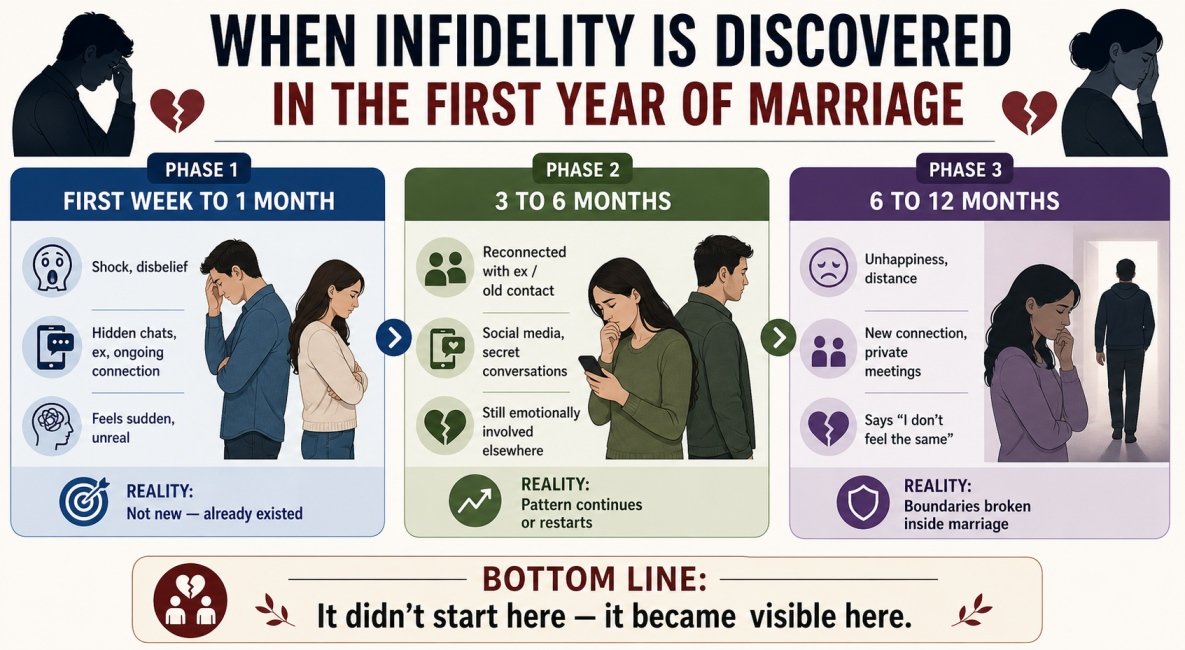
Within the First Month of Marriage
People who come to counselling often say they caught their partner through hidden chats, social media messages, call logs, or even photos, and on looking closer, it was usually an ex, a colleague, or someone they were already involved with. In many cases, this comes out very early, sometimes within a week, and often within the first month.
At this stage, it is rarely new behaviour. It reflects unresolved attachments, boundary issues, or connections that were never fully closed before marriage. Whether it is an ex, a previous partner, a coworker, or someone within their social circle, the pattern is the same — the behaviour existed before marriage and simply continued.
In some cases, it is more impulsive, a hookup, a party situation, or behaviour tied to what they still see as the “end of single life.” But even then, the issue is not just the act itself, it is the lack of internal shift. The commitment changed on paper, but the behaviour did not.
Within 3 to 6 Months of Marriage
In some cases, infidelity is discovered within three to six months of marriage, often after the honeymoon phase ends. People report that their partner was still continuing old connections, an ex, a previous boyfriend or girlfriend or had kept those connections hidden during the initial months.
Some find their partner talking to random people on social media, often sharing dissatisfaction about married life. Others realise their partner returned to old patterns, late-night parties, hookups, or similar behaviour, which eventually comes out after being kept secret for some time.
Within 6 to 12 Months of Marriage
In some cases, infidelity is discovered between six to twelve months of marriage, when dissatisfaction starts showing.
People report their partner expressing unhappiness, losing interest, or saying they don’t feel the same. Along with this, they find boundary-crossing behaviour, reconnecting with an ex, starting a new connection, flirting or talking to others on social media, or meeting someone privately.
In many cases, it also involves sexual or emotional involvement outside, with some partners openly saying they no longer feel attracted or in love.
Before You Decide Anything, Understand Your Psychological State
Shock and Emotional Overload
When people find out their partner cheated early in marriage, the reaction is immediate shock. It feels sudden and difficult to process, especially because it happens at a stage where expectations of commitment are highest.
For many, this is not just about the act of cheating, it disrupts the image they had of their married life. What they imagined as stable, committed, and secure feels broken very early. The gap between what they expected and what they are now seeing creates confusion and mental overload.
Most people struggle to think clearly in this phase. Their mind keeps going back to what they believed about the relationship and what they are now facing. It feels like something important has been shaken, making it hard to process, trust, or decide what to do next.
Self-Doubt and Questioning Your Worth
After the initial shock, many people start comparing themselves. They think, maybe I’m not attractive enough, not good enough financially, not from the right background, or not what they really wanted.
It turns into questions like, what was lacking in me that they chose someone else? why was I not enough for my own partner? Some even feel replaced and start measuring themselves against the other person.
This kind of thinking feels real in the moment, but it is coming from the hurt. Their behaviour is not a measure of your worth.
Love vs Hurt Conflict
Even after finding out, many people realise they still love their partner. They have built a bond, care for them, have shared years, and have been present in the relationship.
At the same time, they feel deeply hurt, angry, and broken. This creates a conflict, how can I still love someone who did this to me? Why do I still care when I feel so disrespected?
This is common. Emotional attachment does not switch off instantly just because something painful happened.
Feeling both love and pain at the same time is normal.
Overthinking and Mental Exhaustion
After finding out, many people say they can’t stop thinking about partner infidelity. The same scenes, messages, and questions keep repeating in their mind. Sleep gets disturbed, and even small things bring the situation back again.
The mind keeps trying to figure out what happened, why it happened, and what it means, going over details again and again.
Not every thought you have right now is reliable.
Before deciding what to do next, understand this: You’re not just reacting to cheating, you’re trying to process something your mind was not prepared for.
Why People Cheat Even in the First Year of Marriage (Therapist Perspective)
In this section, a therapist explains why some men and women choose to cheat even in the early phase of marriage, when things are expected to feel stable, committed, and emotionally secure.
This is not about the marriage suddenly going wrong. It reflects how a person handles commitment, boundaries, and attraction, patterns that often exist before marriage and continue into it.
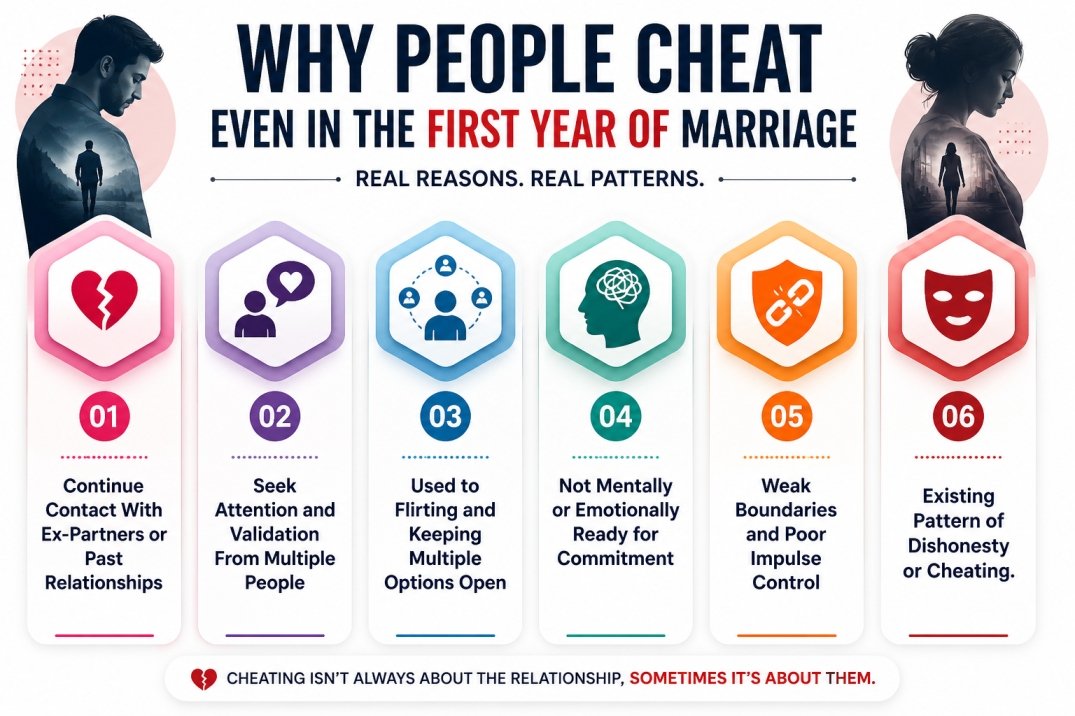
They Continue Contact With Ex-Partners or Past Relationships
Some men or women marry for personal or family reasons while still being in a relationship with their boyfriend or girlfriend. After marriage, they continue that connection, talking, calling, and meeting in private.
This creates emotional overlap and unfinished connections. The previous relationship is not fully closed, so it continues alongside the marriage and becomes a primary reason for cheating early on.
In many cases, the marriage is not treated as a priority, attention, time, and emotional focus go to the other person, while the partner is ignored or kept unaware.
They Seek Attention and Validation From Multiple People
Some people are used to getting attention from more than one person and find it hard to rely on just one partner after marriage. One person’s attention does not feel enough, so they continue looking for validation from others.
This shows through social media conversations, flirting, and maintaining multiple chats at the same time. In many cases, they hide these interactions, delete messages, or keep things secret while continuing the behaviour.
The need for attention does not stop after marriage, which leads to boundary crossing early on.
They Are Used to Flirting and Keeping Multiple Options Open
Some people enter marriage without letting go of a lifestyle where they keep multiple options. They are used to flirting, casual conversations, and staying connected with different people at the same time.
This shows in how they continue engaging with others, replying to messages, entertaining interest, and keeping conversations open instead of shutting them down. In many cases, they don’t see this as wrong and treat it as normal behaviour.
Marriage does not change this pattern, it just adds secrecy to it.
They Are Not Mentally or Emotionally Ready for Commitment
Some men and women enter marriage for reasons like money, status, stability, looks, lifestyle, or due to family and social pressure. The decision to marry is made, but the intention to commit fully is not.
They may see the marriage as security, financial comfort, social acceptance, or a stable setup, while still wanting emotional or physical experiences outside. In some cases, they never intended to limit themselves to one person; in others, they agree to the marriage without resolving what they actually want.
As a result, they stay in the relationship, but continue seeking connection, attraction, or involvement outside it.
They Have Weak Boundaries and Poor Impulse Control
Some people don’t stop when things start crossing the line. They keep replying to late-night messages, continue private chats, agree to meet one-on-one, or stay in situations where attraction is already clear.
They don’t step back early. What could have been a simple interaction turns into regular talking, then meeting, and then involvement because they keep going instead of setting limits.
In many cases, it’s not planned cheating. It builds step by step because they don’t control their behaviour when the situation starts changing.
There Is an Existing Pattern of Dishonesty or Cheating
Some people have a history of dating a lot, changing partners frequently, or cheating multiple times during their dating phase. They are used to managing more than one connection, hiding conversations, and moving between partners.
After marriage, this pattern does not stop. They continue talking to multiple people, keeping things hidden, and repeating the same behaviour.
This is not a one-time situation. It reflects a pattern that carries into the marriage.
Should You Stay If Your Partner Cheated In Early Marriage?
When people come to marriage counselling after facing infidelity early in marriage, they feel stuck between staying and leaving. If they stay, they question trust, love, and whether they are accepting something they shouldn’t. If they leave, they struggle with letting go, starting over, and whether they are giving up too quickly.
That’s why the decision feels unclear, staying feels painful, with emotional investment and family expectations, and leaving feels just as heavy, with legal, emotional, and practical consequences.
Stay only if:
- There is full honesty without being forced
- No excuses, minimising, or blame shifting
- You see consistent, visible behaviour change
- They cut off all contact with the other person completely
- There is transparency (phone, communication, whereabouts) without resistance
- They take responsibility without shifting it onto you or the relationship
- They are willing to work on the issue (therapy, open conversations)
- The behaviour does not repeat, even in small ways
Consider leaving if:
- The behaviour shows a clear pattern (serial cheating or repeated dishonesty)
- They refuse to cut off contact with the other person or keep reconnecting
- They lie, change details, or hide information even after being caught
- They shift blame onto you or make you question your reality and reactions
- You feel like a third person in your own marriage, not a priority
Can You Trust a Partner Who Cheated Within the First Year of Marriage?
Trust can be rebuilt, but not in the same way as before. When cheating happens this early, it disrupts the basic sense of safety and predictability in the relationship. What gets damaged is not just trust in the person, but your ability to rely on their words and behaviour.
Rebuilding requires observing consistent actions over time, not reassurance, but evidence. Transparency, accountability, and stable behaviour are essential, but even then, trust becomes more cautious and conditional rather than automatic.
When to Seek Professional Help
- You feel constantly confused, anxious, or emotionally stuck
- Conversations keep repeating without any resolution
- You are unable to decide whether to stay or leave
- Trust feels broken beyond what you can handle alone
If you’re struggling with emotional distress, consider speaking with an online clinical psychologist. For clarity in your relationship and decision-making, online marriage counselling can help you think and move forward more clearly.
The Bottom Line
Cheating this early in marriage, whether by a husband or a wife, is rarely something that develops over time, it reveals behaviour, boundaries, and commitment from the very beginning.
For both men and women, the situation is not just about the act of cheating, but about what it shows: how the person handles relationships, responsibility, and limits.
The real decision is not just whether to stay or leave, but whether this is something you can realistically accept and live with moving forward.