
If you masturbate frequently and have recently noticed weaker erections, difficulty staying hard or trouble getting an erection at all, it is easy to assume you have damaged yourself.
You may start searching whether too much masturbation causes erectile dysfunction, stop masturbating for a few days, test your erection again and panic when it still does not feel the way it used to.
The first thing to know is that masturbation itself is not an established cause of erectile dysfunction. How often you masturbate, whether porn is involved, what happens when you are with a partner, whether you can still get erections when alone, your anxiety level and your physical health all matter when trying to understand what is actually happening.
So instead of asking only, “Have I masturbated too much?”, ask a better question:
What pattern am I actually experiencing with my erections?
That will tell you much more about what to do next.
Does Masturbation Cause Erectile Dysfunction?
For most men, masturbation does not cause erectile dysfunction.
There is no clinically accepted number of times per week after which masturbation suddenly becomes harmful to erections. A man masturbating several times a week is not automatically doing anything unhealthy, and a high sex drive by itself is not a disorder.
Research examining masturbation frequency and erectile function has also failed to show a simple relationship where more masturbation reliably produces worse erections. Anxiety, depression, physical health, sexual desire and relationship satisfaction have shown stronger relationships with erectile function than masturbation frequency alone.
This is why telling every young man with erection problems to simply “stop masturbating for 90 days” is too simplistic.
The more useful question is what happens before, during and after masturbation and partnered sex.
My Erection Feels Weaker After Masturbating – Is That ED?
Not necessarily.
After ejaculation, the male body normally goes through a recovery phase called the refractory period. During this period, getting another strong erection may be difficult or impossible for a while.
The length of that recovery period varies between men and can also vary for the same person depending on sleep, stress, age, how recently he ejaculated and other factors.
So if you masturbate and then notice that your erection is weaker later the same evening, that alone does not show that masturbation has caused erectile dysfunction.
It becomes more useful to investigate when erection difficulties are repeated and persistent, rather than appearing mainly soon after ejaculation.
I Can Get Hard While Masturbating but Not With My Partner
This pattern deserves a different explanation.
If you can regularly get a firm erection alone but lose it during sex, your body is demonstrating that erections are possible. That does not completely rule out a physical contribution, but it makes the sexual situation itself important to examine.
Performance anxiety is common here. One bad experience can turn the next sexual encounter into a test: Will I get hard? Am I hard enough? What if I lose it again? Is my partner noticing?
The more closely you monitor the erection, the further your attention moves away from arousal, touch and pleasure.
This can create a loop in which you become anxious about losing the erection, the anxiety interferes with arousal, the erection becomes less reliable and the experience then gives you even more reason to worry next time.
If this describes you, our guide to getting hard alone but not with your partner looks specifically at this pattern.
It is also worth remembering that attraction is not the only thing controlling an erection. Stress, fear of disappointing someone, relationship tension, body-image concerns, previous sexual experiences and pressure around penetration can all change how your body responds in the moment.
What If I Cannot Get Fully Hard Even During Masturbation?
This deserves more attention.
The old assumption that “I masturbated too much and overloaded my system” is not a good clinical explanation. If erections have become persistently weak even when you are alone, do not automatically blame masturbation or porn.
Erectile difficulties can involve vascular health, hormones, neurological factors, medications, alcohol or drug use, sleep, depression, anxiety and other health conditions. In many men, more than one factor is involved.
Current European Association of Urology guidance on erectile dysfunction recommends assessing medical, sexual and psychological factors rather than assuming a single cause.
Consider speaking with a doctor or urologist if the change is persistent, particularly if erections have become unreliable in most situations rather than only during sex with a partner.
Can Too Much Porn and Masturbation Affect Erections?
This needs a more careful answer than much of the internet gives it.
Research does not support a simple rule that watching porn causes erectile dysfunction. A 2026 systematic review found mixed results and concluded that pornography viewing by itself did not appear to be a major predictor of sexual dysfunction. Problematic use, insecurities and other psychological factors appeared more relevant than simply how often someone watched porn.
That does not mean your personal porn habits are irrelevant.
Suppose masturbation nearly always involves long porn sessions, repeated searching for increasingly specific material or a very particular routine that is difficult to reproduce with a partner. It may be useful to change that pattern and see how your sexual experience changes.
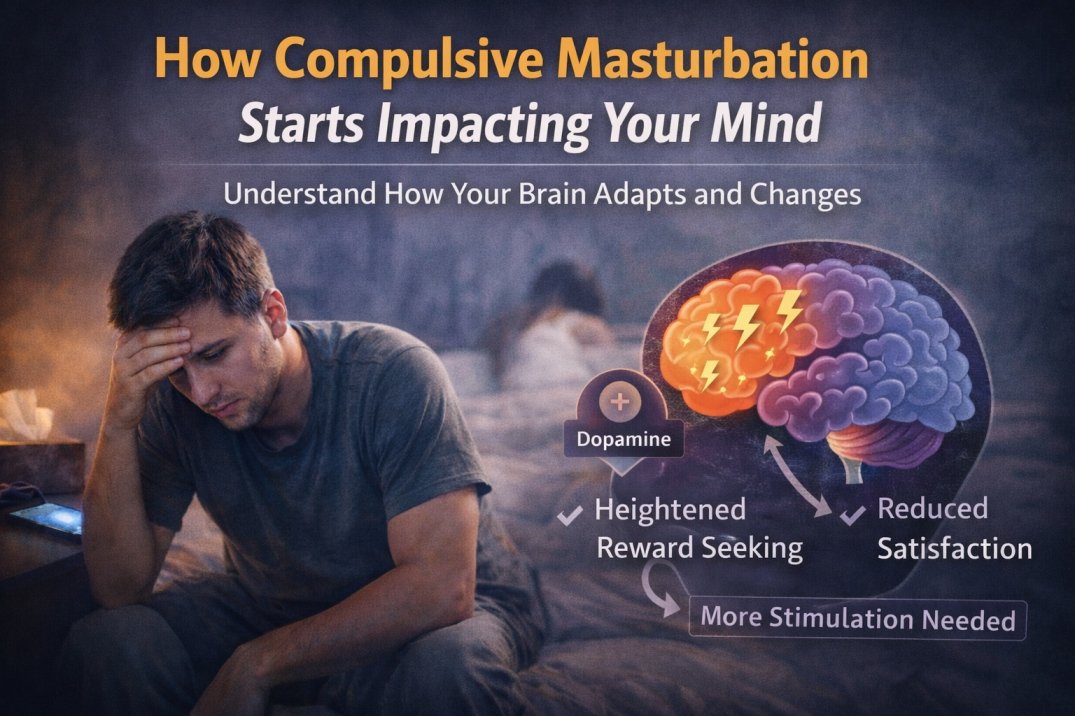
But this should not be explained as your brain being permanently damaged, your dopamine being “depleted” or your penis forgetting how erections work. Those explanations go beyond what the evidence supports.
If porn use feels automatic rather than chosen, repeatedly interferes with partnered intimacy or is becoming harder to control despite wanting to reduce it, then the behavioural pattern deserves attention.
What About a Very Specific Masturbation Technique?
Some men notice that they can become aroused only under very specific conditions: a particular grip, speed, position, pressure, type of porn or long masturbation routine.
If partnered stimulation feels very different, sex may initially feel less predictable or less stimulating than the routine your body is accustomed to.
That does not mean you have permanently caused erectile dysfunction.
Instead of repeatedly testing whether your penis “still works,” it may be more useful to vary the routine, use less intense pressure, avoid rushing to orgasm and allow sexual arousal to develop under different conditions.
The goal is not to perform a magical reset. It is to make sexual response less dependent on one highly specific situation.
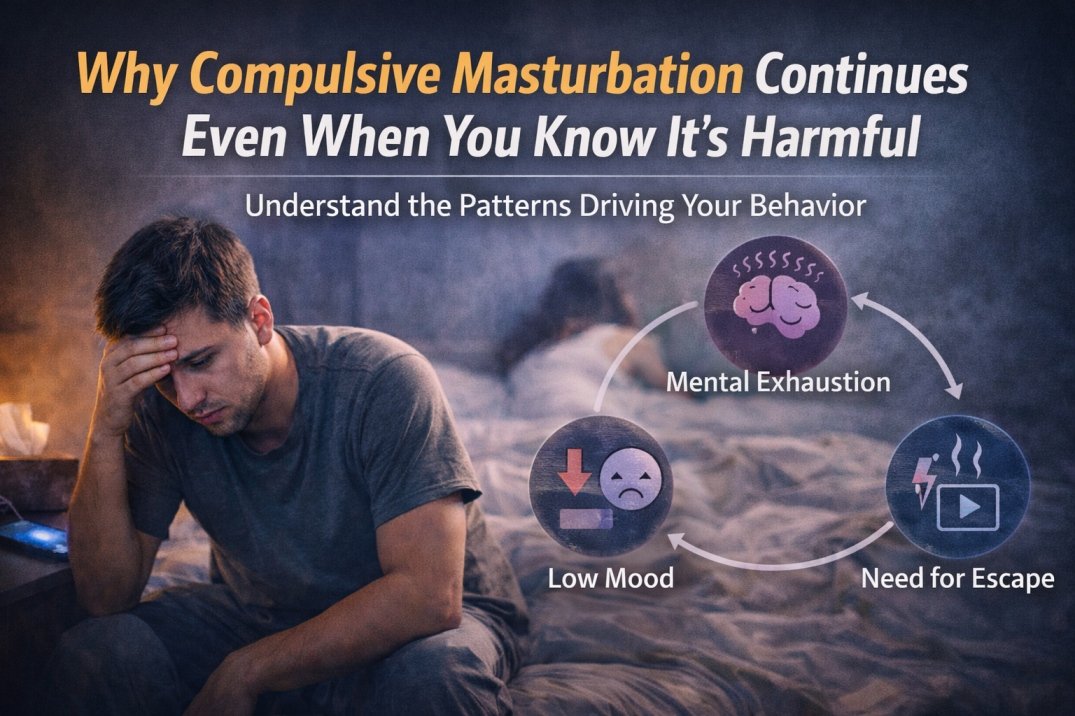
How Do I Know If Masturbation Has Become Compulsive?
How often you masturbate is not the best test.
Someone may masturbate frequently because they have a high sex drive and still feel completely in control. Another person may masturbate less frequently but repeatedly feel unable to stop despite serious consequences.
Clinically, concern rises when there is a persistent pattern of loss of control and meaningful impairment.
Look more closely at the behaviour if several of these are happening:
- You repeatedly decide to reduce or stop but feel unable to follow through.
- Masturbation or sexual content is taking substantial time away from sleep, work, study, relationships or other responsibilities.
- You continue despite clear negative consequences.
- The behaviour often feels automatic rather than chosen.
- You sometimes continue even when it is no longer particularly satisfying.
- You use masturbation repeatedly to escape difficult emotional states and feel increasingly dependent on it as your main coping strategy.
- Attempts to control the behaviour have continued for a long period without improvement.
Importantly, guilt alone does not prove that you have a compulsive sexual behaviour disorder. A person may feel enormous shame about normal sexual behaviour because of religious beliefs, cultural expectations or fear created by misinformation online.
The clinical question is not simply, “Do I feel bad after masturbating?”
It is, “Have I genuinely lost control of this behaviour, and is it interfering with my life?”
Anxiety Can Make a Mild Erection Problem Much Bigger
This is where psychology becomes especially important.
Imagine that you lose your erection once.
The next day, you masturbate specifically to test whether you can still get hard. You watch the erection closely. It feels slightly weaker because you are anxious, so you become more concerned.
Later you test it again.
Now sex is no longer simply sexual. Your erection has become something you monitor.
This is sometimes called spectatoring: instead of being absorbed in the sexual experience, you mentally stand outside it and evaluate your own performance.
The more sex becomes a test, the harder spontaneous arousal can become.
Repeatedly checking your erection, comparing today’s hardness with yesterday’s or forcing yourself to masturbate just to prove that everything still works can therefore keep anxiety going even when the original erection difficulty was temporary.
What Should You Actually Do?
First, stop treating every erection as a medical examination.
If an erection is weaker once or twice, particularly after recent ejaculation, poor sleep, stress or alcohol, that does not automatically mean you have ED.
If you masturbate very frequently and feel physically tired, irritated or simply have little time between ejaculations, give your body some space. You do not need an extreme abstinence challenge or a fixed number of days.
If porn has become automatic, reduce it because you want more control over your sexual habits—not because you have been told your brain is permanently damaged.
If your masturbation style is extremely specific, experiment with less pressure, different stimulation and less reliance on one exact routine.
If erection problems mainly happen with a partner, work on the anxiety and sexual context rather than repeatedly testing yourself alone.
And if erection problems are persistent across masturbation, partnered sex and other situations, get medically assessed rather than assuming masturbation is the cause.
When You Should See a Doctor
Do not spend months trying internet “resets” if your erections have clearly and persistently changed.
A medical assessment becomes especially important when erection difficulties occur repeatedly across different situations, have developed without an obvious situational explanation, or occur alongside other physical or sexual changes.
Tell the doctor about when the problem started, whether you still have erections during masturbation or sleep, changes in sexual desire, medications or supplements you take, alcohol or recreational drug use, existing medical conditions and your general mental health.
That information is useful because erectile dysfunction is often multifactorial.
A doctor may decide that no extensive investigation is needed, or may recommend checking factors such as cardiovascular health, blood glucose, lipids or hormones depending on your situation.
When Sex Therapy or Psychological Support Makes Sense
Medical assessment and psychological support are not competing explanations.
You can have normal medical results and still have a very real erection problem driven or maintained by anxiety, sexual pressure, relationship factors or compulsive patterns. You can also have a physical contributor and develop performance anxiety on top of it.
Psychological or sex therapy may be particularly useful when you repeatedly monitor erections, avoid intimacy because you are frightened of losing your erection, depend heavily on one sexual routine, feel unable to control masturbation or porn use, or have started associating sex with shame and failure.
LeapHope’s online sex therapy focuses on the psychological, relational and behavioural factors surrounding sexual difficulties. It does not replace medical treatment when a physical condition needs assessment.
For many men, the useful question in therapy is not simply “How do I stop masturbating?”
It is understanding what the behaviour is doing for you, what happens when you try to control it, what triggers anxiety around erections and what needs to change for sex to stop feeling like a performance test.
Can Compulsive Masturbation and Erectile Problems Reinforce Each Other?
They can become connected psychologically without masturbation necessarily being the original physical cause of ED.
For example, stress may lead you to masturbate more often. One inconsistent erection then makes you anxious. You start testing erections more frequently, searching online and watching your body closely.
The fear itself increases.
Masturbation may then become both a way to reduce anxiety and a way to check whether your erection still works.
That creates a difficult cycle: anxiety leads to checking, checking creates more pressure and every imperfect erection seems like evidence that something is wrong.
Breaking that cycle is different from simply banning masturbation.
The aim is to restore control over the behaviour and reduce the fear surrounding erections.
Will Stopping Masturbation Fix Erectile Dysfunction?
There is no clinical rule that a certain period of abstinence will cure ED.
If masturbation has become so frequent that you are repeatedly trying to have sex shortly after ejaculation, spacing it out may obviously change how responsive you feel.
If porn or masturbation has become compulsive, reducing the behaviour may improve your sense of control and may help you understand your arousal patterns better.
But if you have persistent erectile dysfunction because of anxiety, medication, low testosterone, vascular problems, diabetes or another medical issue, simply avoiding masturbation does not treat the underlying cause.
This is why the diagnosis matters more than the internet challenge.
Final Thoughts
If you are asking, “Can too much masturbation cause erectile dysfunction?”, do not begin with the assumption that you have damaged yourself.
Masturbation itself is not established as a cause of ED, and frequency alone does not tell you whether your sexual behaviour is healthy or compulsive.
Instead, look at the pattern.
If erections are strong alone but unreliable with a partner, anxiety and sexual context deserve attention. If the problem appears mainly shortly after ejaculation, normal recovery may explain part of it. If porn or masturbation feels genuinely out of control, address that behaviour without turning normal sexuality into a disease.
And if erections have become persistently weak even when you are alone, do not keep blaming masturbation and waiting for a “reset.” Get the physical side properly assessed as well.
The goal is not to stop being sexual.
It is to understand why your erections have changed, whether masturbation is actually part of the problem, and what kind of help will address the cause rather than the fear.