
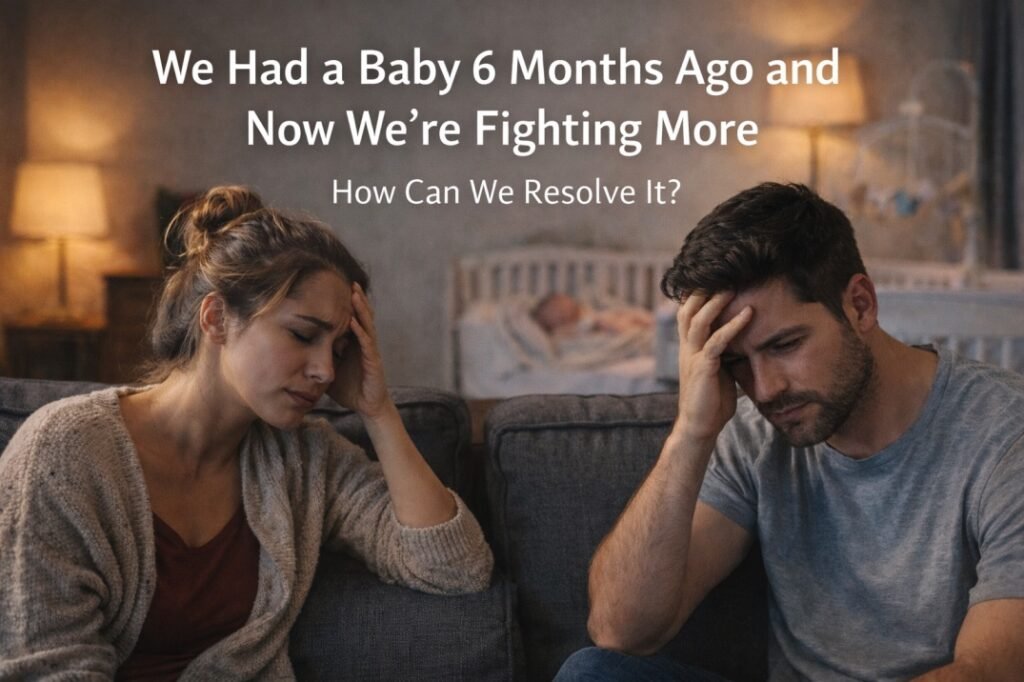
A woman recently brought this concern into counselling six months after having her first baby. Before becoming parents, she and her husband had disagreements, but they rarely became serious. Now they were fighting about feeding, sleep, housework, relatives, money and things that would hardly have mattered before.
What frightened her was how quickly the marriage seemed to have changed. If this sounds familiar, it does not automatically mean having a baby has damaged your relationship.
The first year with a baby can expose expectations, inequalities and frustrations that were either not there before or did not matter as much before parenthood. The important question is not simply why you are fighting more. It is what you are actually fighting about underneath the small arguments.
Is It Normal to Fight More After Having a Baby?
It is common for couples to experience more relationship strain after becoming parents. A longitudinal study following couples through the transition to parenthood found deterioration in several areas of relationship functioning after the first child’s birth, although couples varied considerably in how much their relationships changed.
Broken sleep, constant responsibility and less time to recover emotionally can make both partners more reactive. But exhaustion is only part of it.
A baby also changes how responsibilities are divided, how much personal freedom each person has, what each partner expects from the other, how intimacy feels, how involved parents and in-laws become, and how appreciated each person feels inside the marriage.
That is why an argument about one bottle, one night waking or one family visit can become much bigger than the incident itself.
One Person May Feel They Have to Notice Everything
One of the biggest sources of resentment after a baby is not simply doing more tasks. It is feeling responsible for remembering that the tasks exist.
One parent may constantly be thinking about when the baby last fed, medicines, nappies, sleep routines, doctor visits, washing, supplies and what will be needed tomorrow. The other parent may genuinely be helping, but mainly after being asked.
This creates a frustrating difference. One person thinks, “I help whenever you tell me what needs doing.” The other thinks, “Why do I have to notice everything before you act?”
So the fight may appear to be about one unfinished task, while the real problem is feeling alone with responsibility.
The Other Partner May Start Feeling That Nothing They Do Is Right
Another pattern develops when one parent has become much more familiar with the baby’s routine.
They may correct how the baby is held, settled, fed or put to sleep because they know what usually works. But repeated correction can slowly affect the other parent’s confidence.
They may start thinking, “If everything I do is wrong, you do it.”
Then they withdraw or stop taking initiative. The first parent ends up carrying even more, becomes angrier, and feels even less supported.
Both people can become trapped in the same cycle without either of them deliberately creating it. If something is safe but simply done differently from how you do it, try not to correct every difference. Parenting together requires both people to develop confidence.
You May Have Expected Very Different Things From Each Other
Many expectations about parenting are never actually discussed before the baby arrives.
One person assumed nights would be shared. The other assumed the parent on leave would manage most of them. One expected grandparents to help. The other did not want family involved. One expected their partner to take over as soon as they came home from work. The other believed working all day was already their main contribution.
Neither expectation necessarily sounded unreasonable inside that person’s head.
The conflict begins when an unspoken expectation starts feeling like a broken promise. Instead of only arguing about what happened today, talk about what each of you thought parenthood would look like.
You may discover that both of you have been judging the other against agreements that were never actually made. Our guide on aligning expectations in marriage can help when this mismatch exists beyond parenting too.
Sleep Deprivation Can Make Small Problems Feel Much Bigger
There is a reason couples who would normally resolve something quickly can have a major argument at 3 a.m.
Both may be exhausted. One has already been awake several times. The other has work in a few hours. The baby will not settle. At that point, patience and emotional control are much lower.
A neutral sentence can sound critical. A tired response can sound uncaring.
This does not mean every problem should be dismissed as lack of sleep. It means the middle of a terrible night is often the wrong time to decide what is wrong with your marriage.
Sometimes the immediate question is simply: who needs rest right now, and how can we make tonight manageable? The bigger conversation can happen later.
Physical Intimacy Can Become Another Source of Misunderstanding
Sex and affection often change after having a baby.
The mother may still be recovering physically. Breastfeeding, hormonal changes, exhaustion, body changes and constantly being touched by the baby can also affect desire.
The other partner may understand this but still feel rejected or disconnected.
Problems start when either person begins using sex as proof that the relationship is okay. One may think that if their partner still loved or wanted them, intimacy would have returned. The other may begin experiencing every affectionate moment as pressure for sex.
Try to protect affection without automatically expecting it to progress further. If this has become a repeated source of tension, our guide to physical intimacy in marriage looks at that part of the relationship separately.
You Can Love Your Baby and Still Miss Your Old Life
Many parents feel guilty admitting that they miss parts of the life they had before the baby.
Before becoming parents, there may have been more sleep, freedom, spontaneous plans, time alone and uninterrupted time together. After the baby, almost everything requires coordination.
Missing that freedom does not mean you regret having your child.
The problem is that when these feelings stay unspoken, they often appear somewhere else. One person becomes irritated when the other gets time outside the house. Arguments start over hobbies, work, sleep or who gets a break.
The real feeling may simply be: “I love our baby, but I am struggling with how much my life has changed.”
That conversation is much easier to work with than blaming each other.
In-Laws Can Make an Already Tired Couple Fight More
After a baby, relatives often become much more involved.
Advice can quickly become criticism. The mother may be told how to feed the baby, how much to rest, whether she should work, whether she should stay home, or what she is doing wrong. The father’s family may expect frequent visits while the mother is already exhausted.
When the couple is tired, these outside opinions can easily become a fight between them.
One useful rule is: do not make your spouse fight your family alone.
If your parents are repeatedly criticising or interfering, you usually need to take an active role in setting that boundary.
If this has become a wider issue in the marriage, read about family conflicts that put pressure on marriage.
Stop Arguing Only About the Last Incident
If you keep fighting about small things, look at what the repeated argument may actually be saying.
“You didn’t wash the bottles” may really mean, “I feel like everything depends on me.”
“You’re always correcting me” may mean, “I don’t feel trusted as a parent.”
“You never want to be close anymore” may mean, “I miss feeling like your partner rather than only another parent in this house.”
When couples solve only the surface issue, the same fight usually returns with a different trigger.
Divide Ownership, Not Just Help
One of the least useful questions can be, “What do you need help with?”
It sounds supportive, but it can still leave one person managing the entire system.
A better approach is to decide what each person fully owns. One parent may take responsibility for the evening routine. The other may own certain mornings. One may handle medical appointments while the other handles groceries and household supplies.
The exact division will differ between families.
The goal is not perfect 50/50 parenting. The goal is to reduce the feeling that one person has to notice, plan, ask, remind and supervise everything.
Notice When You Have Started Seeing Each Other as Opponents
After months of repeated conflict, couples often begin interpreting ordinary behaviour negatively.
A tired silence becomes “they don’t care.” A request becomes “they’re criticising me again.” Going to work becomes “they get to escape.” Staying home becomes “they have no idea what financial pressure feels like.”
Once this happens, you are no longer reacting only to what your partner did today. You are reacting to everything their behaviour has come to represent.
Try to bring the conversation back to the current problem before adding months of resentment to it.
Will the Fighting Get Better as the Baby Gets Older?
The fighting may reduce as sleep improves, routines become more predictable and both parents feel more confident.
But unresolved resentment does not automatically disappear when the baby starts sleeping better.
If one spouse has spent months feeling unsupported, criticised or emotionally alone, that pattern can continue even when parenting becomes easier.
So do not only wait for the baby to grow. Pay attention to what is happening between the two of you now.
Sometimes the Distress Is Not Only About the Marriage
Persistent irritability, anxiety, hopelessness, emotional numbness, severe guilt or withdrawal after childbirth can sometimes be connected with postpartum depression or other postpartum mental-health difficulties.
That deserves proper support rather than assuming every emotional change is caused by the marriage.
LeapHope provides online postpartum depression counselling when postpartum emotional symptoms are affecting daily functioning, the relationship or the parent’s wellbeing.
When We Recommend Marriage Counselling After a Baby
Not every new-parent argument requires therapy.
We recommend considering marriage counselling when the same fights keep repeating, one parent feels completely alone with the baby and household load, the other feels constantly criticised or pushed out, resentment keeps increasing, or you have stopped talking about anything except the baby.
It is also worth getting support when affection and intimacy have disappeared alongside hostility, parents or in-laws are repeatedly creating conflict, or arguments increasingly involve contempt, insults or separation threats.
LeapHope’s online marriage counselling works with couples struggling with the transition into parenthood, unequal responsibility, resentment, communication breakdown and emotional disconnection.
The purpose is not to decide who is the better parent. A marriage therapist helps identify the cycle the couple has become trapped in, make expectations clearer, reduce blame and rebuild the sense that you are raising the child together rather than fighting each other while doing it.
Final Thoughts
Having a baby can reveal pressure points in a marriage that were never obvious before.
You are both tired, both learning, and both adjusting to a life with less freedom and more responsibility. At the same time, each of you may feel that the other does not fully understand what you are carrying.
That does not mean every fight should be excused because you are new parents. It means the argument often needs to be understood differently.
Instead of only asking why you are fighting so much, ask what keeps appearing underneath those fights: Do I feel supported? Do I feel appreciated? Do I trust you to share responsibility with me? Do I still feel like your partner, not only the other parent?
Those are usually the conversations that help couples move forward.
Author
 View all posts
The LeapHope Editorial Team creates and reviews content across mental health, relationships, sexual wellbeing, and child and family development. Articles are developed with input from licensed psychologists, sexologists, and other mental health professionals to ensure accuracy, clarity, and real-world relevance.