
Last Updated on October 26, 2026
Your child is doing reasonably well at school, rarely gets into trouble, and seems to understand what you’re telling them. But they’re constantly losing belongings, forgetting familiar instructions, or taking much longer than expected to finish everyday activities.
It’s easy to assume they’re being careless. After all, they can pay attention when they’re interested in something.
However, ADHD doesn’t always involve obvious hyperactivity. Some children struggle mainly with attention and organisation, which may be less noticeable than running around or interrupting lessons.
Here are nine signs of ADHD in children that parents sometimes overlook, with examples of how they may appear at home, in school, and during everyday activities.
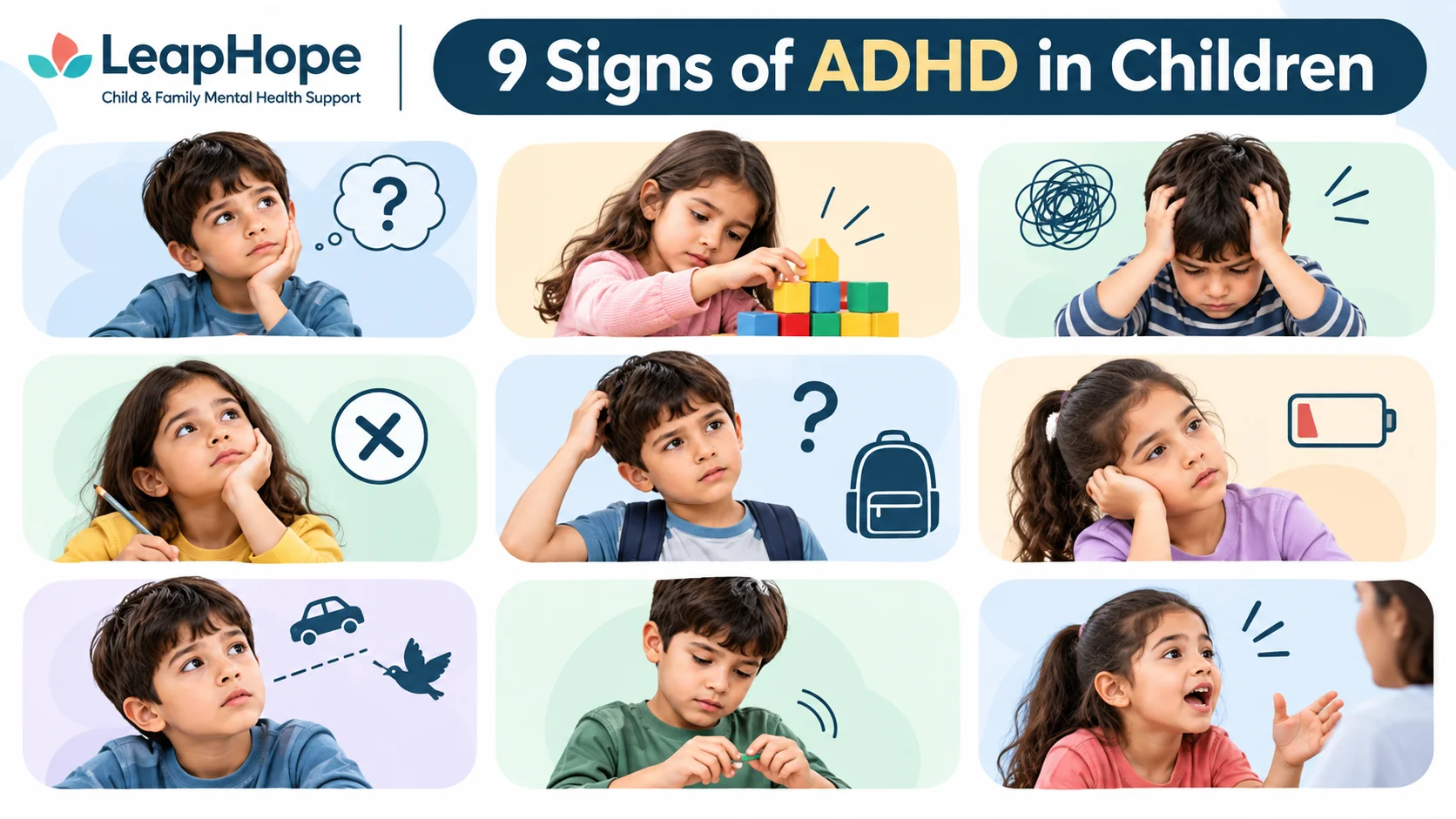
9 Signs of ADHD in Children That Parents Often Miss
1. They Appear to Listen but Miss What You’re Saying
You explain something to your child while they’re looking directly at you. A minute later, they ask a question you’ve already answered.
Children with ADHD may have difficulty sustaining attention during spoken conversations, even when they’re trying to listen.
You might notice that they:
- Miss important parts of a teacher’s explanation.
- Lose track of what someone is saying.
- Respond to only part of an instruction.
Parents may mistake this for selective listening. However, appearing not to listen when spoken to directly is a recognised symptom of inattention.
Hearing or language difficulties can produce similar problems and may need to be considered.
2. They Start Activities but Rarely Finish Them
Your child begins putting away their toys, finds something interesting, and starts playing. Half an hour later, the room is still untidy.
The issue isn’t necessarily getting started. It’s staying with an activity long enough to complete it.
Children experiencing this ADHD-related difficulty may leave household chores, school assignments, or everyday activities unfinished despite understanding what they’re supposed to do.
A useful distinction is whether the child repeatedly loses track of an activity after beginning it, rather than simply refusing to participate.
3. They Constantly Lose Everyday Belongings
Some children seem to have a different missing item every day.
One morning, it’s their school diary. The next, it’s their water bottle. Later, they cannot find something they were holding only a few minutes earlier.
Frequently losing items needed for activities is a recognised inattentive symptom.
The important clue is the frequency and impact. Occasional forgetfulness is common, but repeated losses can make school routines and independent activities considerably harder.
4. They Make Careless Mistakes Despite Understanding the Work
Your child solves a maths problem correctly when you explain it aloud, but their written answers contain missed symbols, skipped questions, or overlooked instructions.
It may appear that they’re rushing, even when they’ve spent considerable time on the assignment.
Difficulty attending closely to details is one of the established ADHD symptoms.
For parents, the useful question is whether the mistakes reflect missing knowledge or repeatedly overlooking information the child already understands.
This distinction can help guide discussions with teachers, although it cannot establish a diagnosis by itself.
5. They Find Organising Simple Tasks Surprisingly Difficult
A child may know what needs doing but struggle to work out the order.
For example, they’re old enough to prepare their schoolbag independently but repeatedly forget which books to pack, where materials belong, or what needs to be ready for the next day.
These difficulties involve organising tasks and activities, another recognised area of ADHD-related inattention.
Planning and organisation are supported by executive functions, a group of mental skills that also includes working memory and self-monitoring.
As children grow older and responsibilities increase, organisational difficulties may become more noticeable.
6. They Avoid Tasks That Need Prolonged Mental Effort
Some children consistently put off reading, writing, lengthy homework, or activities requiring sustained concentration.
They may complain, delay starting, or repeatedly look for something easier to do.
The behaviour can look like unwillingness, but maintaining attention during demanding activities may genuinely require greater effort for a child with ADHD.
However, avoidance is not always an attention problem. If a child resists only reading or mathematics, difficulties understanding that subject should also be explored.
7. They Become Distracted Without Making Any Noise
A child doesn’t need to leave their seat or interrupt a lesson to struggle with attention.
They might be reading a page, hear someone walking outside, and lose their place. At other times, their thoughts shift away from the activity without an obvious external distraction.
Unlike difficulty listening during a conversation, this sign concerns maintaining attention when competing thoughts or events arise.
Quiet children may not draw attention to these difficulties because they aren’t disrupting anyone else.
8. They Fidget Even When They’re Sitting Still
Hyperactivity can be less obvious than constantly running or climbing.
A child might repeatedly:
- Tap their feet beneath the table.
- Move their fingers or handle nearby objects.
- Squirm or shift position while seated.
Fidgeting is common at many ages. In ADHD, clinicians consider whether the movement is excessive for the child’s developmental stage, persists over time, and occurs alongside other relevant symptoms.
9. They Interrupt Conversations or Struggle to Wait
Your child repeatedly starts speaking before someone has finished, calls out answers, or enters a game without waiting for their turn.
These behaviours may be interpreted as poor manners.
However, ADHD can involve difficulties with impulse control, making it harder to hold back an immediate response.
The child may understand the social rule but repeatedly struggle to apply it in the moment.
Frequent interrupting, intruding on others, and difficulty waiting are recognised hyperactive-impulsive symptoms.
Can a Child Have ADHD Without Being Hyperactive?
Yes. A child can have ADHD without being noticeably hyperactive.
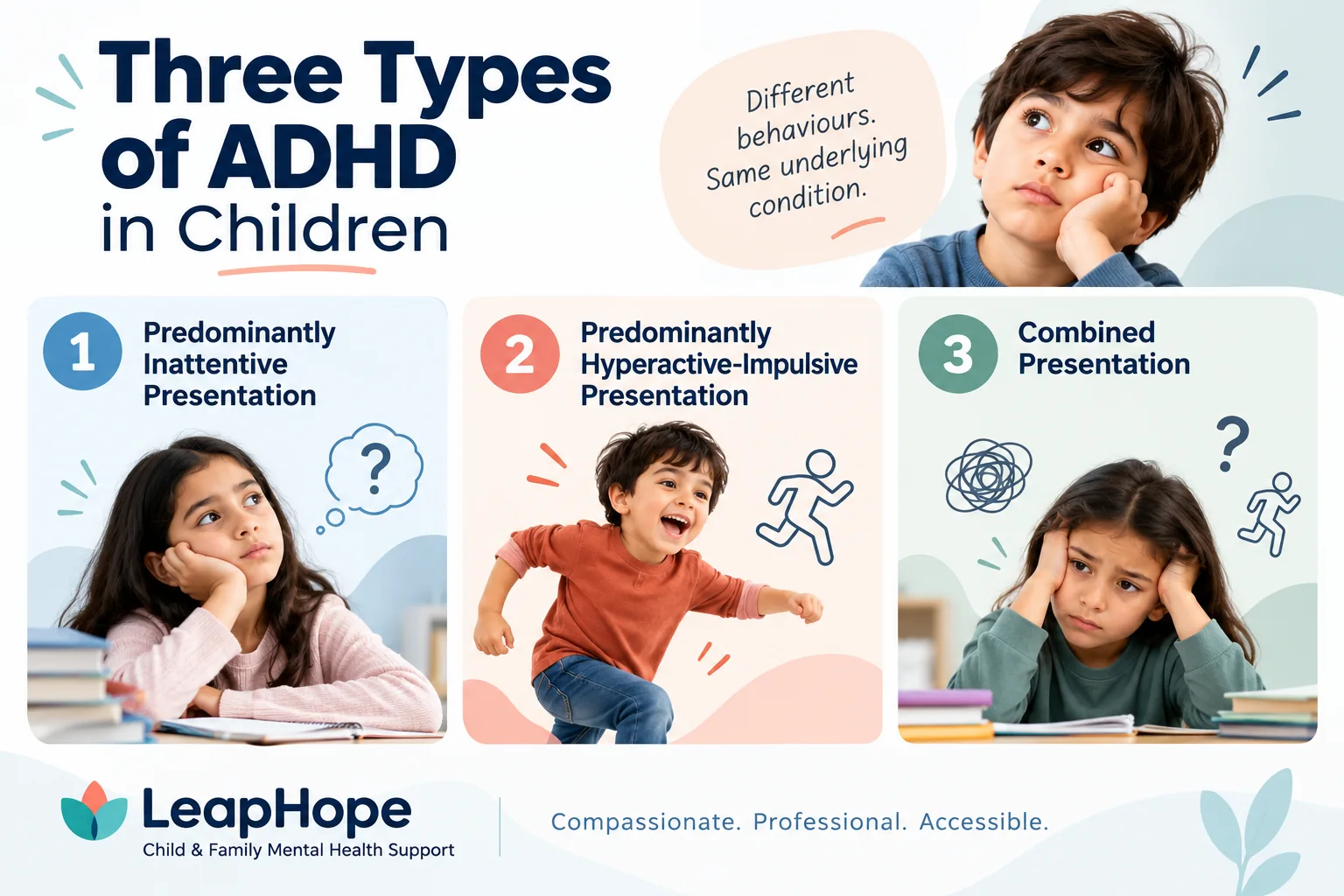
Clinicians recognise three ADHD presentations:
| Presentation | Main features |
|---|---|
| Predominantly inattentive | Difficulties sustaining attention, organising activities, and remembering everyday information |
| Predominantly hyperactive-impulsive | Excessive restlessness, fidgeting, interrupting, and difficulty waiting |
| Combined | Symptoms from both groups |
Children with predominantly inattentive ADHD may remain quiet during lessons and avoid attracting attention, even when they’re struggling.
The way ADHD appears can also change with age. For example, obvious childhood hyperactivity may become a feeling of restlessness as children grow older.
When Are These Behaviours Normal, and When Could They Indicate ADHD?
Losing a pencil, forgetting an instruction, or interrupting an adult occasionally is part of ordinary childhood behaviour.
The distinction becomes clearer when you look at four factors:
- Age: Is the behaviour noticeably different from what would be expected at your child’s developmental stage?
- Frequency: Does it happen repeatedly rather than occasionally?
- Settings: Are difficulties evident in more than one place, such as home and school?
- Impact: Are they affecting learning, friendships, family routines, or other important activities?
According to the CDC’s diagnostic guidance, ADHD symptoms must have persisted for at least six months, several must have been present before age 12, and they must interfere with functioning. At least six symptoms from the relevant diagnostic symptom group are required for children up to age 16; the threshold is five from age 17.
These requirements are part of a broader clinical assessment. They are not a checklist parents should use to diagnose their child at home.
Could Something Else Explain Similar Behaviours?
Yes. A child may appear inattentive because of anxiety, inadequate sleep, depression, learning difficulties, or another concern.
For example, a child who struggles to understand spoken language may repeatedly miss instructions. Another child may seem distracted because they’re preoccupied with worries about school.
Some of these difficulties can also occur alongside ADHD.
For a more detailed explanation of other possible causes, see LeapHope’s guide to why children struggle to concentrate.
What Should Parents Do If They Notice Several ADHD Signs?
You don’t need to decide whether your child has ADHD before asking for advice. A few specific observations can make the next conversation more useful.
- Write down what actually happens. Instead of saying, “My child never listens,” note examples such as frequently missing the second part of spoken instructions.
- Ask the teacher about specific situations. Does the difficulty occur during independent activities, conversations, transitions, or group work?
- Provide support without waiting for a diagnosis. Clear instructions, visual reminders, predictable routines, and positive feedback can make activities more manageable.
- Speak with a qualified professional. If you’re concerned about your child’s attention, development, or everyday functioning, arrange a consultation.
A formal assessment may involve developmental history, information from parents and teachers, clinical interviews, and standardised questionnaires. The NICE ADHD guideline makes clear that rating scales alone are insufficient for diagnosis.
When to Seek Professional Support
Parents can consult a child psychologist whenever they want guidance about their child’s behaviour or development. You don’t need to wait for academic failure or serious difficulties.
A specialist ADHD assessment becomes especially relevant when symptoms persist across settings and interfere with daily life. The assessment should be carried out by an appropriately qualified professional, following the requirements of the child’s location.
LeapHope offers online child and teen counselling and information about child ADHD counselling. Families in India, the USA, the UK, Canada, and the UAE can explore relevant services.
A Final Thought for Parents
If your child repeatedly struggles with tasks that seem simple for their age, try looking beyond whether they’re making enough effort.
You might notice that they understand instructions but lose track halfway through, or manage one activity independently while needing considerable help with another. These details can be useful when speaking with a teacher or specialist.
The aim isn’t to label your child. It’s to understand where they’re struggling and what support would make everyday life easier.
Clinical Resources
- CDC — Symptoms of ADHD — Recognised inattentive and hyperactive-impulsive symptoms.
- CDC — Diagnosing ADHD — Diagnostic requirements and assessment considerations.
- NIMH — ADHD: What You Need to Know — Clinical information about symptoms and treatment.
- NICE — ADHD: Diagnosis and Management — Professional recommendations for assessment and management.


