
In our work with couples, across their 20s, 30s and beyond, one concern comes up again and again:
“Why do we argue so much?”
They’re not talking about big issues.
They’re talking about everyday moments turning into arguments.
- “We love each other, but we keep fighting over small things.”
- “We end up saying things we don’t mean.”
- “We ignore each other after fights and then repeat the same argument again.”
Some couples describe long-distance relationships where things feel fine in person, but arguments happen almost daily over calls or messages. Others feel stuck in cycles where nothing truly gets resolved, just paused.
Over time, the questions become heavier:
- “Are we incompatible?”
- “Is something wrong with us?”
- “Should we just end this?”
What makes it confusing is this:
You still care about each other.
You don’t want to leave.
But you also don’t know how to stop the arguing.
And that’s where most couples feel stuck, not because the relationship is broken, but because the pattern underneath the arguments hasn’t been understood yet.
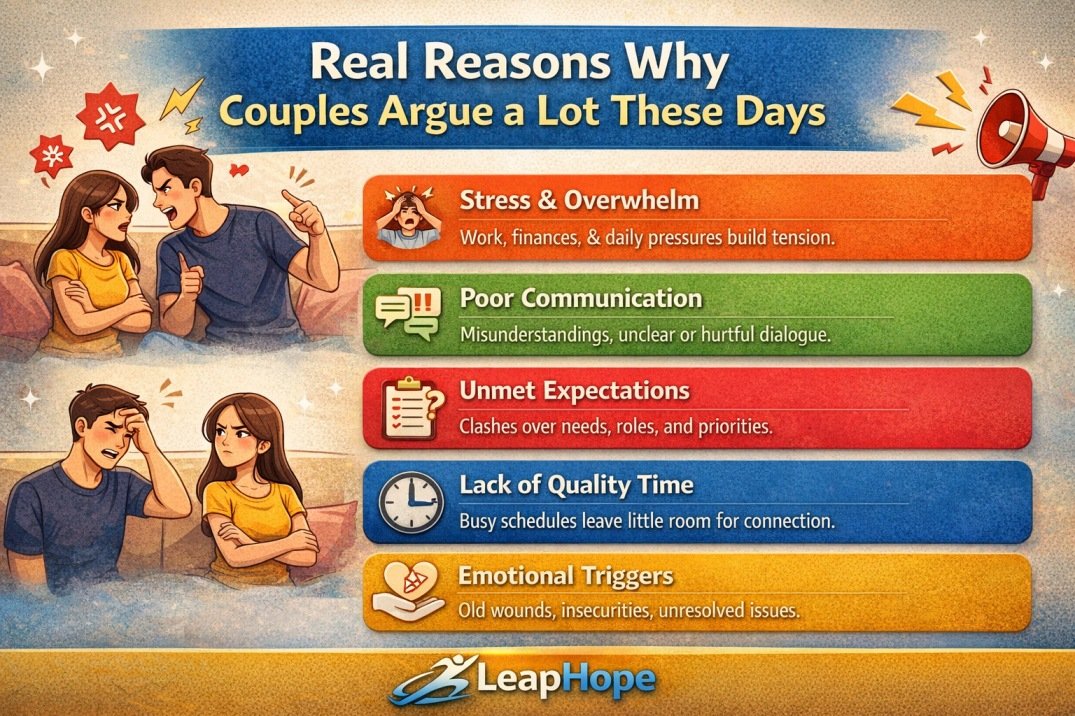
Real Reasons Why Couples Argue a Lot These Days
1. You’re Arguing to Be Right, Not to Understand
Many couples argue because both are trying to prove they are right. A simple discussion quickly turns into correcting each other, defending what was said, and proving whose version is correct.
In real situations, this looks like arguing over what was actually said, repeating the same point again and again, and not accepting the other person’s explanation. Instead of understanding, both partners try to make the other agree with them.
This creates a power struggle. Each person wants their point to be accepted and does not want to feel dismissed or wrong. Disagreement starts to feel personal, not just a difference in opinion.
As a result, the conversation stops moving forward. Both partners keep defending their side, listening reduces, and the argument keeps going without any real outcome.
This is why small issues turn into long arguments and the same fights keep repeating.
2. Defence Mode Is Always On
Many couples react defensively without even realising it.
The moment something is said, it is taken personally. It no longer matters what was actually said or what was meant. The focus shifts to protecting oneself.
This shows up as:
- reacting quickly instead of listening
- assuming the worst intention
- explaining or justifying immediately
- feeling attacked even in normal conversations
When both partners do this, no one is actually hearing the other. Each person is responding to what they think was said, not what was actually said.
In simple terms, defensive reactions mean you are pre-guessing, not listening, and often overreacting. Because of this, real problems don’t get solved. The same issues keep coming back, and arguments become frequent and intense.
3. Criticism, Contempt, and Emotional Shutdown
Arguments become harmful when the focus shifts from the issue to the person.
Instead of addressing a specific behaviour, partners start using general and attacking statements like “you always do this” or “you never understand.” This is criticism. It targets the person’s character, not the situation.
As arguments continue, the tone often becomes disrespectful. This includes sarcasm, mocking, eye-rolling, or speaking in a way that puts the other person down. This is contempt. At this stage, the intention is no longer to solve the issue but to dismiss or hurt the other person.
In response, the other partner either reacts with the same intensity or shuts down completely. Emotional shutdown looks like going silent, ignoring the conversation, withdrawing, or refusing to engage.
This creates a repeating pattern where one person attacks and the other either escalates or withdraws. The issue remains unresolved.
Over time, this pattern damages emotional safety. Conversations start to feel tense and unsafe, and even small disagreements turn into harsh arguments or complete disconnection.
4. Unexplained Behaviour Isn’t Actually Unexplained
Many arguments today are linked to unclear boundaries in the relationship.
Couples often do not clearly define what is personal and what affects the relationship. This shows up in areas like phone privacy, interactions with friends, and social media behaviour.
For example, one partner may:
- hide their phone or avoid sharing details
- stay in touch with someone late at night
- say “it’s my personal life” or “don’t check my phone”
- dismiss questions by saying “he or she is just a friend”
When the other partner asks simple questions like who they were talking to or where they were, it is often taken as an attack instead of a concern.
At the same time, the answers are not clear or reassuring. This creates doubt.
Because of this:
- trust starts getting affected
- small incidents stay in memory
- old situations come back in new arguments
So the reaction is not just about the present moment. It is influenced by past actions that were never properly explained or resolved.
This is why behaviour feels confusing or “unexplained.” It is usually a result of unclear boundaries, lack of transparency, and repeated situations that created doubt over time.
5. Different Attachment Styles Are Clashing
Couples argue more when they don’t understand how each other handles closeness and distance.
One partner may want to talk immediately, get reassurance, and resolve the issue quickly. The other may need space, time alone, or may avoid discussion until they calm down.
Both believe their way is normal.
When this difference is not understood, it creates conflict. The partner who wants closeness feels ignored or rejected. They may start thinking, “you don’t love me” or “you are not serious.” The partner who needs space feels pressured or controlled and may think, “you are overreacting” or “you are making this bigger than it is.”
Because of this, both react to each other’s behaviour without understanding the reason behind it. The issue is not just the argument, but the difference in how each person deals with emotions and conflict. This leads to repeated misunderstandings and ongoing arguments.
6. Emotional Triggers Are Driving Reactions
Life today has become more demanding, even for people in their 20s. There is pressure from work, family expectations, and the need to match a certain lifestyle shaped by social media. Many people are already in a state of stress or burnout.
When you are already mentally exhausted, your emotional capacity reduces. Patience is lower and reactions become sharper.
Because of this, even a small moment with your partner can connect to deeper feelings like not being enough, not being heard, not being respected, or not being important. The reaction then becomes stronger than the situation itself.
For example, a delayed reply may feel like being ignored. A certain tone may feel disrespectful. These reactions are not only about the present moment, but also about existing stress and emotional load.
There is also a tendency to analyse behaviour closely. Words, tone, and timing are quickly interpreted, often without full clarity.
As a result, responses are based on assumptions and internal pressure. This is why arguments feel intense and out of proportion to the actual issue.
7. Same Fights, Different Day
Many couples report arguing about the same issue repeatedly, even after they believe it has been discussed or resolved.
This usually happens because the issue was not clearly resolved. The conversation may have ended, but both partners did not leave with the same understanding or expectation.
In some cases, one partner expects a change in behaviour, while the other assumes the matter is already closed. Because this difference is not clarified, the same situation leads to the same disagreement.
Over time, previous instances of the same issue remain unresolved. When the topic comes up again, it includes past frustration along with the current situation.
As a result, reactions become stronger, patience reduces, and arguments repeat around the same concern without reaching a clear outcome.
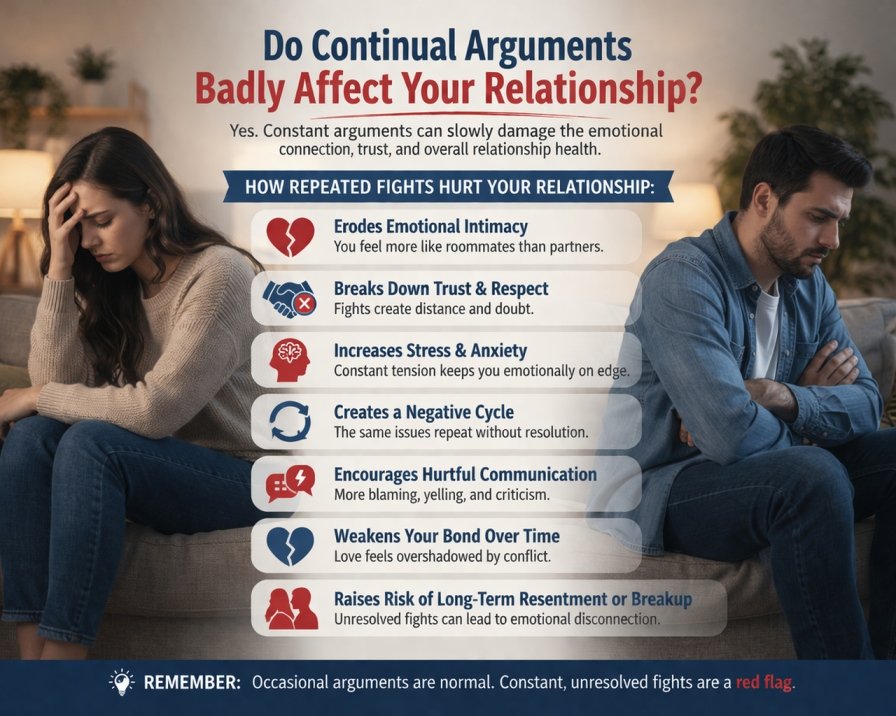
Do Continual Arguments Badly Affect Your Relationship?
Not all arguments are a problem. It depends on what you are arguing about and how it is handled.
When It’s Still Normal
Arguments are part of a normal, growing relationship when they are about everyday things like habits, expectations, time, or differences in thinking.
These arguments may happen often, but:
- both partners are still respectful
- issues are talked through, even if not perfectly
- there is some effort to understand and adjust
In this case, arguments are a sign that both people are expressing themselves and trying to figure out how to function together.
When It Starts Becoming Harmful
Arguments become a problem when they are not just about small issues, but about deeper concerns that remain unresolved.
This includes:
- secrecy, hiding things, or avoiding clear answers
- repeated unexplained behaviour
- disrespect during arguments
- saying hurtful or abusive things
- bringing the same unresolved issue again and again
The difference is simple.
If arguments help you understand each other better, the relationship can grow.
If arguments create doubt, disrespect, or insecurity, the relationship starts getting affected.
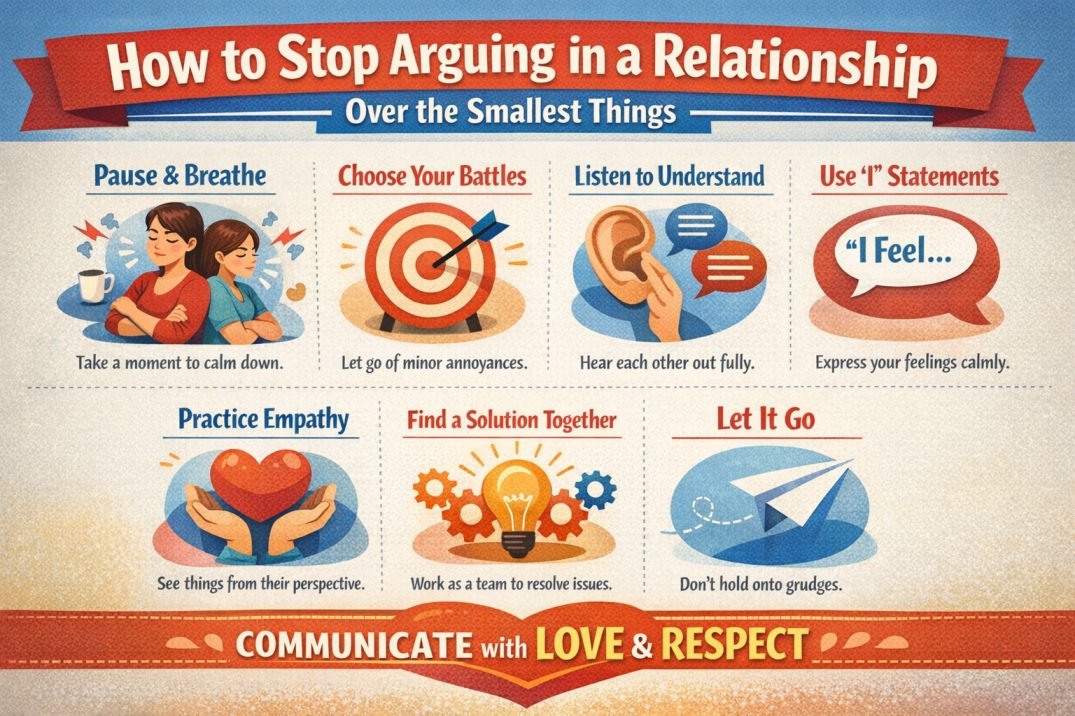
How to Stop Arguing in a Relationship Over the Smallest Things
1. Stop Trying to Win Every Conversation
Many arguments continue because both partners are trying to prove their point instead of understanding the issue.
When the focus is on:
- correcting details
- proving intent
- making the other agree
the conversation turns into a power struggle.
In most cases, the real issue is not what was said, but how it was felt. If you stay focused on being right, you miss what actually needs attention.
The shift is simple: stop pushing your point forward and start understanding what the other person is reacting to.
2. Recognise Your Role in the Pattern
Every argument follows a pattern, and you are part of it.
Common roles:
- attacking (raising issues with blame or intensity)
- defending (justifying, explaining, denying)
- withdrawing (shutting down or avoiding)
Most people repeat the same role in every conflict.
If you only focus on your partner’s behaviour, the pattern will not change. The moment you recognise your role, you can change how the argument unfolds.
3. Pause the Reaction, Not the Conversation
Immediate reactions escalate arguments.
When emotions are high:
- thinking reduces
- tone becomes sharper
- responses become impulsive
Pausing means stepping out of the reaction, not avoiding the issue.
It allows:
- emotional control to return
- the conversation to continue with clarity
Without this, arguments become emotional exchanges instead of problem-solving.
4. Address Patterns, Not Just Incidents
Most arguments look like they are about small situations, but they are repeated patterns.
For example, the issue is not one behaviour. It is something that keeps happening.
If you only discuss the current incident, the problem stays.
Clarity comes when you address:
- what is repeating
- what is not changing
- what needs to be different going forward
This is what prevents the same argument from returning.
5. Talk When You’re Calm, Not Just Triggered
Most couples only talk when they are already upset.
At that point:
- listening is low
- defensiveness is high
- understanding is limited
Important conversations need to happen when both people are calm.
This is where you can:
- explain clearly
- understand properly
- agree on changes
If discussions only happen during conflict, the pattern continues.
When to Seek Help
Consider help when:
- arguments keep repeating with no change
- you feel anxious, low, or exhausted after fights
- you keep thinking about breakup or incompatibility
- there are doubts about trust or loyalty
- issues involve secrecy or unclear behaviour
At this point, it’s not just normal conflict, it’s a pattern.
You can consider online therapy at LeapHope to work through repeated arguments and trust issues before they worsen.
Final Thoughts
You’re not arguing more because the love is gone.
You’re arguing more because patterns are becoming visible.
Most couples try to fix this by trying harder, controlling reactions, or avoiding topics. That usually doesn’t work because the pattern itself remains the same.
Real change happens when you start seeing:
- how you react
- what keeps repeating
- what is actually driving the conflict
Awareness changes how you respond.
And that is what starts reducing arguments.
FAQs
Why do we argue so much even though we love each other?
You argue so much even though you love each other because emotional closeness makes reactions stronger. Small issues trigger deeper feelings, leading to defensiveness, misinterpretation, and repeated conflict patterns instead of clear understanding.
Is it normal to fight every day in a relationship?
Fighting every day in a relationship is not considered healthy. Occasional arguments are normal, but daily conflict usually means there are repeated patterns, unresolved issues, or emotional build-up that is not being addressed.
We fight over small things all the time, why does this happen?
If you fight over small things all the time, it usually means the issue is not small. These moments are triggering deeper concerns like feeling ignored, not important, or not respected. The reaction becomes bigger because it connects to ongoing patterns.
How do we stop constant arguments if we both want to stay together?
To stop constant arguments, both partners need to change how they respond, not just what they argue about. This includes not trying to win, recognising personal patterns, pausing reactions, and addressing repeated issues clearly instead of reacting in the moment.
Why does my partner say hurtful things during arguments?
Your partner may say hurtful things during arguments because of loss of control, built-up frustration, or the need to defend themselves. It often happens when the focus shifts from solving the issue to reacting emotionally or trying to hurt back.
Why do we keep having the same argument again and again?
You keep having the same argument again and again because it was not fully resolved. The conversation may have ended, but both partners did not reach the same understanding or agreement, so the issue repeats in similar situations.
How do you know if you’re incompatible or just going through a rough phase?
You can understand if you’re incompatible or just going through a rough phase by looking at patterns. If there is still respect, effort, and willingness to improve, it is usually a phase. If there is constant disrespect, no change, and ongoing emotional strain, it may be deeper incompatibility.
Should we break up if we argue all the time?
Arguing all the time does not automatically mean you should break up. The decision depends on the impact. If arguments involve disrespect, trust issues, or emotional harm and nothing improves, it needs serious attention. If both partners are willing to work on patterns, it can still be improved.