You’re married, in your 20s, and you’ve started questioning your sexuality.
At LeapHope, we hear this directly in counselling. People say they feel confused about their attraction, not just sex, but who they’re actually drawn to. Some notice attraction toward the same gender. Some feel their current relationship doesn’t match what they expected sexually or physically. Others say they feel “straight” but keep doubting it.
In 20s, sexuality can become more noticeable because life shifts from expectations to reality. Marriage brings routine, responsibility, and less space to ignore what you feel. For some, this is about stress, pressure, or anxiety affecting sexual experience. For others, it may be a sign of deeper patterns in attraction that were never explored earlier.
If you come from a non-supportive family or cultural background, even thinking about this can create guilt or fear. That often leads to overthinking, trying to analyse every feeling, reaction, or thought, and ending up more anxious.
Before jumping to conclusions, it’s important to understand this clearly: questioning your sexuality after marriage does not automatically mean something is wrong with you or your relationship. It also doesn’t mean you need to label yourself immediately.
In this article, we’ll help you understand what might be happening, how to make sense of your feelings, and what to do next without panic or rushed decisions.
Married, Questioning Your Sexuality, and Feeling Mentally Broken
Questioning your sexuality isn’t the problem. It becomes difficult when you’re married.
Because it doesn’t stay personal. It affects you, your partner, and the life you’ve already built. This is true anywhere, India, the US, the UK but it feels heavier where there’s less space to talk about it.
You start noticing it in real moments. Sex doesn’t feel right. You may continue out of expectation, but it feels forced or uncomfortable. Over time, many people start avoiding intimacy without fully understanding why.
At the same time, some notice a pull in another direction, curiosity, attraction, or a clear urge toward the same gender. That contrast creates tension.
You’re in a committed relationship, but your internal experience doesn’t match it.
When this continues, it affects your mental state. People describe feeling stuck, mentally exhausted, even broken. Not because something is wrong with them, but because they don’t understand what they’re feeling and can’t process it openly.
That’s where the distress comes from, not just the questioning, but having no space to understand it while still trying to live normally.
Why Are You Questioning Your Sexuality After Marriage?
Questioning your sexuality is normal. It often becomes clear after marriage because your experience is now real, not just in your head.
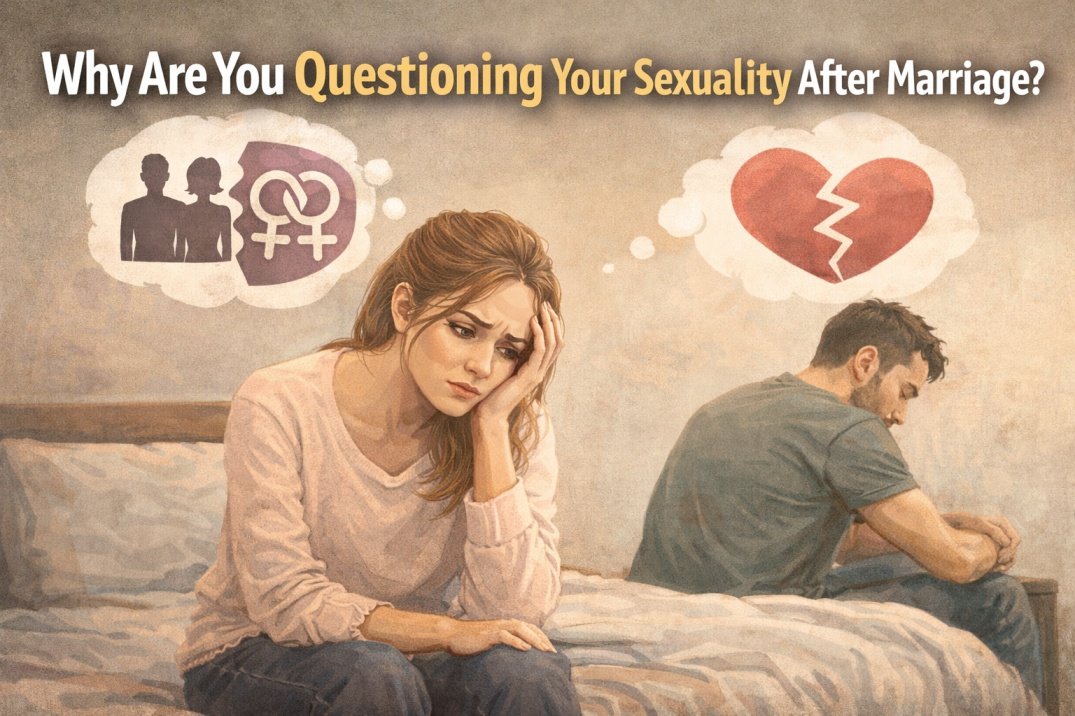
Here are common reasons:
- You overanalyse your sexuality
- Real sex and intimacy feel different from what you expected
- You notice new or unexpected attraction
- You feel emotionally close, but not fully sexually connected
- The label you used before may not feel right now
- You start thinking more deeply about who you are
- You question what you were taught vs what you actually feel
This happens more after marriage because you can’t ignore your real experience anymore.
Why You Don’t Need to Label Your Sexuality Right Now
When you’re married in your 20s and questioning your sexuality, the pressure to find a clear answer can feel intense. You may feel like you need to label yourself quickly because your decisions affect not just you, but your partner and your relationship. But forcing a label at this stage often creates more confusion than clarity.
Part of the difficulty is that sexuality is not just “straight” or “gay.” It exists on a spectrum. Some people feel attraction to the opposite gender, some to the same gender, some to both, and some find their attraction is not fixed. Terms like bisexual, pansexual, or queer exist because people’s experiences don’t always fit into one simple category. Some people also fall on the asexual spectrum, where sexual attraction is limited or different.
When you’re still trying to understand your own pattern, these labels can feel overwhelming rather than helpful. You may not fully relate to any one term, or your feelings may not be consistent enough to fit into a clear category yet.
What you’re feeling right now may not be fully clear or stable. One phase, one experience, or one shift in attraction does not define your entire identity. Your understanding can take time, especially when you’re experiencing real intimacy for the first time.
Instead of trying to “figure it out” immediately, focus on understanding your actual experience. Labels can come later, if they fit. Clarity develops gradually, not under pressure.
Questions to Ask Yourself to Understand Your Sexuality
Asking yourself a few questions might help if you’re struggling or confused about your sexuality after marriage in your 20s. The goal is to understand your real experience, not guess.
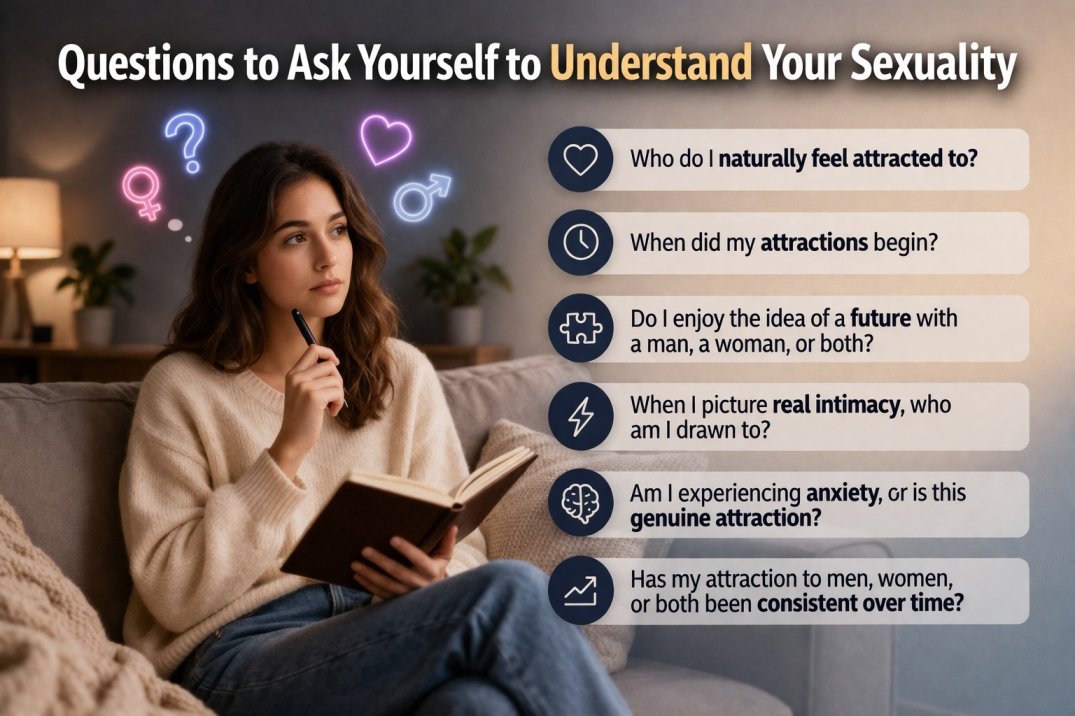
Ask yourself:
- What do I actually feel during intimacy with my partner – comfort, disconnect, or avoidance?
- Is this confusion new, or was it there before marriage but ignored?
- Have I felt genuine attraction toward the same gender? What did that feel like in real situations, not just thoughts?
- Do I feel emotionally connected but physically not fully engaged?
- When I imagine myself freely, who do I see myself with?
- Am I reacting to stress, pressure, or expectations around sex and marriage?
- If there was no fear, no family pressure, and no consequences, what would I feel honestly?
- Am I trying to prove something to myself, or understand something?
- Do I feel more anxious during intimacy because I’m analysing myself?
- Has my attraction or comfort changed over time?
Also be clear about this:
- Questioning does not mean you don’t love your partner
- It does not mean your marriage is fake
- It does not mean you need to decide or label yourself immediately
- It does not mean something is “wrong” with you
These questions are meant to bring clarity, not force an answer.
Is Your Sexuality Confusion Coming From Stress and Pressure or a Real Pattern in Your Attraction?
Today’s lifestyle can play a big role. Stress, routine, and pressure, especially in marriage, can affect how you experience intimacy. When sex starts to feel like something you have to do, your natural response can shut down. At the same time, you might feel unexpectedly more comfortable or connected with someone of the same gender, emotionally, or even sexually. That contrast can make you question your sexuality.
Sometimes it’s not about a clear change in orientation, but about where you feel ease vs pressure. With your partner, there may be expectation, performance, or routine. With someone else, there is no pressure which can make that connection feel stronger or more natural.
At the same time, in some cases, this is not just situational. It reflects a pattern, but not always a clear one. It doesn’t show up as certainty; it shows up as ongoing confusion that doesn’t go away.
At LeapHope, we often hear questions like:
“I feel emotionally connected to women, but sexually attracted to men.”
“I feel fine in my marriage, but I keep noticing attraction elsewhere.”
These are not always easy to label. When it’s a real pattern, it may not feel clear or stable at first, it can feel mixed, inconsistent, and confusing. That’s why the focus should be on understanding what repeats over time, not forcing a quick conclusion.
What You Should Do Right Now (Without Panicking or Hurting Your Marriage)
You are in your 20s, so it’s too early to label your sexuality. Explore intimacy in more ways, talk to your partner, your styles, what makes you comfortable. Right now, don’t try to “solve” your sexuality. Do these instead:
- Stop testing yourself during sex
Don’t check “am I feeling enough?” in the moment. It kills natural response. - Track patterns for 2–4 weeks
After intimacy, note: comfort, avoidance, attraction (0–10). Look for repeats, not one-offs. - Separate anxiety from attraction
Ask: does this feeling come with pressure/performance worry, or does it feel natural and consistent? - Pause decisions
No sudden labels, no big talks, no changes to the relationship until patterns are clearer. - Don’t act outside the relationship to “test” it
Experiments create damage and more confusion. - Reduce pressure around sex
Take a short break or keep intimacy non-sexual for a while (touch, closeness without performance). - Create private space to think
Journal honestly after real experiences (not imagined ones). - Limit overthinking loops
Set a boundary: no analysing during intimacy; reflect later. - Get a neutral space if stuck
Talk to a therapist who understands sexuality; this is for clarity, not labels.
Goal: understand your pattern first. Act later.
When to Seek Professional Help
Consider help when:
- The confusion stays and keeps coming back
- You feel anxious, low, or mentally drained
- Intimacy feels stressful, avoidant, or forced
- You’re stuck between your feelings and your marriage
- You can’t stop overanalysing and need clarity
You can start by learning through trusted LGBTQ+ resources:
- The Trevor Project
- GLSEN
- Kinsey Institute
For private, structured support, you can consider sex therapy or sexuality counselling at LeapHope, focused on understanding your pattern clearly, without pressure or rushed decisions.
Final Thoughts
Questioning your sexuality after marriage can feel heavy, but it doesn’t mean your life is falling apart.
You’re trying to understand something that wasn’t clear before. That takes time.
Don’t rush to label yourself. Don’t make decisions from panic. Focus on understanding what you actually feel, not what you think you should feel.
Clarity doesn’t come from overthinking; it comes from observing your pattern over time.
You’re not broken. You’re in a phase of figuring yourself out, and that can be uncomfortable before it becomes clear.
FAQs
How can I stop overanalyzing my sexuality when I know I am straight and feel anxious?
If you know you are straight but keep overanalyzing, the issue is usually anxiety, not your sexuality. The more you check your thoughts, reactions, or feelings, the stronger the doubt becomes. Instead of trying to prove you’re straight, stop testing yourself in the moment. Give your mind space, and focus on what is consistent over time. Anxiety creates “what if” thoughts, but they are not the same as real attraction.
If I’m confused about my sexuality, does it mean I’m not straight?
No. Being confused about your sexuality does not automatically mean you are not straight. Confusion can come from overthinking, stress, or exposure to new ideas. What matters is your actual pattern of attraction over time, not temporary doubt or curiosity.
Why do I feel straight but still worry that I might be gay?
This usually happens when your mind is trying to find certainty. When you say “I’m straight,” your brain throws a “what if I’m not?” thought. When you try to accept the opposite, it flips again. This back-and-forth is a common anxiety pattern, not a sign that you’re in denial.
Do straight people ever question their own sexuality?
Yes, some straight people do question their sexuality, especially during periods of stress, self-reflection, or exposure to new experiences. Questioning alone is not proof of a different orientation. It’s the consistency of real attraction that matters.
Why am I so confused about my sexuality even though I don’t feel same-sex attraction?
If there is no real same-sex attraction but constant doubt, the confusion is often coming from overanalysis and anxiety. You are trying to “figure it out” mentally instead of looking at your actual feelings. This creates more confusion, not clarity.
How do I figure out my sexual orientation without experimenting with other people?
You can understand your sexual orientation without experimenting. Pay attention to your consistent attraction, emotional connection, and natural responses over time. You don’t need to act on anything to get clarity. Forced experiences often create more confusion, not answers.