Last Updated on September 23, 2026
There is no single national statistic showing how many Indian marriages have serious relationship problems.
But recent Indian research, NFHS-6 data and LeapHope’s own 2025–2026 counselling records give us useful numbers on marital discord, family interference, spousal violence, trust problems and communication difficulties.
These sources measure different things. A community study measures marital adjustment. NFHS measures specific population indicators. Clinical research looks at couples already seeking help. Counselling data shows which problems people bring to therapy.
So the numbers should not be combined into one “marriage problem rate for India.”
Key Marriage Problems Statistics in India
| Finding | What it measures | Source |
|---|---|---|
| 21.7% had poor marital adjustment | Community sample | 2026 study of 212 married adults |
| 22.3% reported spousal violence | Ever-married women aged 18–49 | NFHS-6, 2023–24 |
| 24.4% rural vs 17.5% urban | Rural–urban difference in spousal violence | NFHS-6 |
| 90% of women and 72% of men had poor marital adjustment | Couples already seeking help for marital discord | Clinical study of 50 couples |
| Hedges’ g = 0.65 | Association between parental interference and marital instability | 2025 Indian scoping review |
| 24% infidelity / trust breach | Primary problems reaching marriage counselling | LeapHope 2025–2026 |
| 16% communication / conflict | Primary problems reaching marriage counselling | LeapHope 2025–2026 |
The numbers are easier to understand when each source is examined separately.
How Common Is Marital Discord in India?
A recent Indian community study examined 106 married couples, or 212 adults, living in an urban area of western Maharashtra.
Researchers used the Locke–Wallace Marital Adjustment Test and found that 21.7% of participants had poor marital adjustment or marital discord.
Poor marital adjustment was reported in:
- 22.6% of women
- 20.7% of men
The same study found a strong relationship between marital discord and psychological distress. Among participants with psychological distress, 29.3% had marital discord, compared with 3.2% among those without psychological distress.
Read the 2026 marital-adjustment study
This is useful because the participants came from the community rather than a divorce court or marriage-counselling clinic.
But it was one urban community in western Maharashtra. The 21.7% figure should not be presented as the percentage of all Indian marriages experiencing problems.
What Does Serious Marital Discord Look Like?
Another Indian study examined 50 married couples who were already seeking clinical help for marital discord.
Poor marital adjustment was found in:
- 90% of women
- 72% of men
The researchers also found that poorer marital adjustment was associated with psychological distress and alcohol misuse.
Read the clinical study on marital discord
The much higher percentages make sense because this was not a general population sample. Every couple recruited for the study was already experiencing marital discord.
This difference is important.
A community study can tell us how often poor marital adjustment appeared in that community sample. A clinical study shows what the problem looks like among people who have already reached professional services.
They answer different questions.
What Problems Are Couples Bringing to Marriage Counselling?
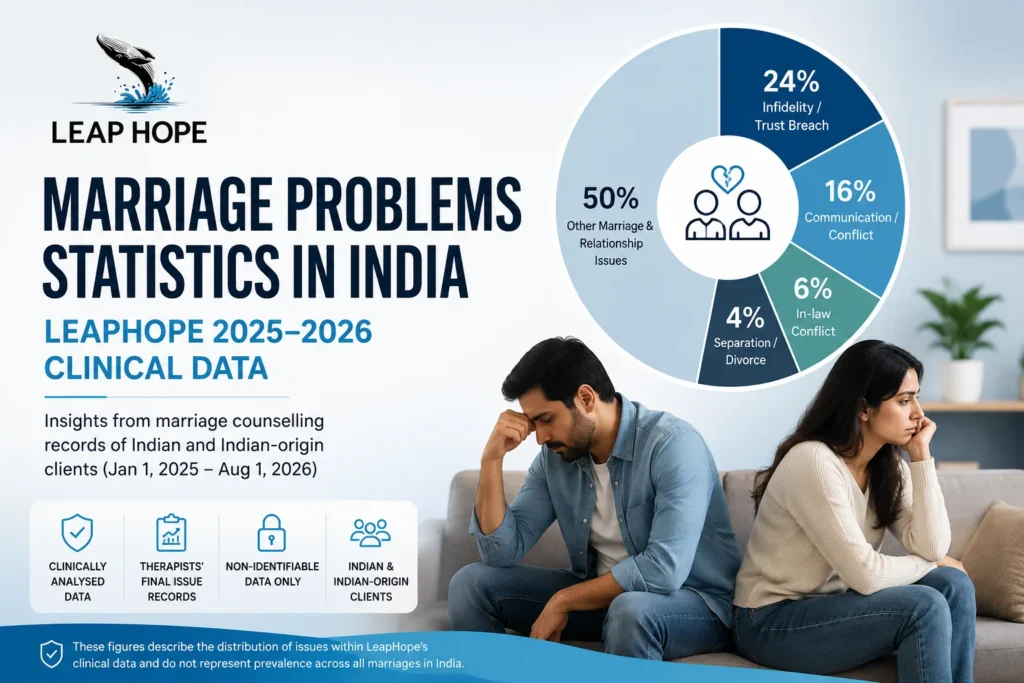
LeapHope analysed marriage-counselling records covering January 1, 2025 to August 1, 2026 for Indian and Indian-origin clients.
| Primary marriage concern | Share of classified concerns |
|---|---|
| Infidelity / trust breach | 24% |
| Communication / conflict | 16% |
| In-law conflict | 6% |
| Separation / divorce | 4% |
| Other marriage and relationship concerns | 50% |
Source: LeapHope clinical service data, January 1, 2025–August 1, 2026.
Infidelity and trust breaches were the largest individually classified concern.
That does not mean 24% of Indian marriages involve infidelity. It means trust breaches accounted for 24% of the primary concerns classified within this specific counselling dataset.
Couples dealing with an affair, secrecy or loss of trust can learn more about LeapHope’s infidelity counselling.
Communication and conflict formed the second-largest individual category at 16%.
For some couples, the visible problem is frequent arguing. For others, conversations about difficult subjects have almost stopped. When communication itself has become part of the relationship problem, relationship counselling may help identify the pattern behind repeated disagreements.
About the LeapHope data
The dataset covers Indian and Indian-origin/NRI clients who reached LeapHope for marriage counselling.
The analysis used the final marriage-related concerns recorded by therapists. Only non-identifiable information was analysed; names, contact details and therapy conversations were not included.
The data was clinically reviewed by Dr. Mansi More Nopany, RCI Licensed Clinical Psychologist and Marriage Therapist, M.Phil. Clinical Psychology, PhD Scholar, with 10+ years of experience.
LeapHope’s figures describe its counselling case mix. They are not national prevalence estimates.
How Much Do Parents and In-Laws Affect Indian Marriages?
Family involvement is particularly relevant when looking at marriage problems in India.
A 2025 scoping review examined Indian research published between 2010 and 2023 on parental interference and marital stability.
The review found a significant association between parental interference and marital instability, with an overall Hedges’ g effect size of 0.65.
Read the 2025 review on parental interference and marital stability
The review linked excessive parental involvement with problems including:
- reduced privacy between spouses;
- less marital autonomy;
- resentment;
- interference in household decisions;
- conflict between loyalty to parents and loyalty to a spouse.
This does not mean close family relationships are harmful.
Parents and extended family can provide financial, practical and emotional support. The problem described in the research is interference that reduces the couple’s ability to make decisions and manage their relationship independently.
LeapHope’s counselling data also recorded in-law conflict as a separate primary concern in 6% of classified cases.
Spousal Violence in India: What NFHS-6 Shows
Spousal violence should not be grouped together with ordinary arguments, communication difficulties or marital dissatisfaction.
The National Family Health Survey-6 (NFHS-6) was conducted during 2023–24 and covered more than 679,000 households across 715 districts.
It reported that 22.3% of ever-married women aged 18–49 had ever experienced spousal violence.
The figure in NFHS-5 was 29.2%.
NFHS-6 also found a large rural–urban difference:
- 24.4% of rural women
- 17.5% of urban women
View the official NFHS-6 release from the Ministry of Health and Family Welfare
View the NFHS-6 fact-sheet summary and indicators
Unlike the smaller marriage studies discussed above, NFHS is a large national survey.
It also measures a much more serious issue.
When a relationship involves violence, coercion, threats or fear, safety needs to be considered separately from ordinary couples conflict.
What Does Research Say About Divorce in India?
There is no reliable national table showing that one specific problem causes a fixed percentage of divorces in India.
A systematic review published online in 2025 examined 22 scholarly studies on divorce in India and its effects on women.
Across those studies, recurring factors included:
- domestic violence;
- dowry-related problems;
- patriarchal dominance;
- communication breakdown.
Read the systematic review on causes of divorce in India
The review does not give a nationally representative percentage for each cause.
That is why claims such as “X% of Indian divorces happen because of cheating” or “Y% happen because of poor communication” should be treated carefully unless the population and source are clearly stated.
Couples who have reached the point where staying together or separating has become the main question can explore LeapHope’s separation and divorce counselling.
Why Marriage Statistics Can Look So Different
Different studies select different people and measure different outcomes.
| Type of data | What it tells us |
|---|---|
| National survey | Population estimates for specific indicators included in the survey |
| Community study | Relationship outcomes among people included in that community sample |
| Clinical study | Problems among people already experiencing enough difficulty to seek clinical help |
| Counselling data | Problems being brought to a specific counselling service |
| Divorce research | Factors found among people experiencing marital dissolution or divorce |
This explains why 21.7% poor marital adjustment, 22.3% spousal violence and 24% trust-related counselling concerns can all be valid figures without measuring the same thing.
What Can We Actually Say About Marriage Problems in India?
The available evidence supports several clear findings.
Marital discord exists outside counselling clinics. A 2026 community study found poor marital adjustment in 21.7% of its participants.
Psychological distress and marital adjustment are connected. The same study found substantially more marital discord among participants experiencing psychological distress.
Family interference can affect marital stability. A 2025 review found a significant association between parental interference and marital instability in Indian families.
Violence remains a serious problem. NFHS-6 found that 22.3% of ever-married women aged 18–49 reported having experienced spousal violence.
Marriage breakdown rarely has one explanation. Research on divorce identifies domestic violence, dowry-related problems, patriarchal dominance and communication breakdown among recurring themes.
Counselling clients bring different problems. In LeapHope’s data, trust breaches and communication/conflict were the two largest individually classified categories, while half of cases fell across other marriage and relationship concerns.
There is no credible single percentage that represents all marriage problems in India.
When May Marriage Counselling Be Useful?
There is no statistical cutoff for when a couple should seek help.
Counselling may be worth considering when the same problem keeps returning without resolution, trust has been seriously damaged, communication has become hostile or avoidant, family involvement repeatedly divides the couple, or both partners feel stuck about what to do next.
Marriage counselling does not automatically mean keeping a relationship together.
The work may involve understanding what is maintaining the problem, rebuilding parts of the relationship that can change, or making clearer decisions about its future.
LeapHope provides online marriage counselling in India with psychologists and marriage therapists for couples dealing with trust problems, communication conflict, family pressure, emotional disconnection and separation concerns.
Frequently Asked Questions
What are the most common marriage problems in India?
There is no national survey ranking every marriage problem in India. Recent research identifies communication breakdown, parental interference, psychological distress, domestic violence and other relationship difficulties. LeapHope’s counselling data also shows trust breaches, communication conflict and in-law problems among clients seeking help.
What percentage of Indian marriages have problems?
There is no reliable national percentage covering all marriage problems. A 2026 community study of 212 married adults in western Maharashtra found poor marital adjustment in 21.7%, but the result should not be generalised to all Indian marriages.
Is infidelity a major marriage problem in India?
There is no current nationally representative statistic showing how common marital infidelity is in India. In LeapHope’s 2025–2026 counselling data, infidelity and trust breaches represented 24% of classified primary concerns.
How common is spousal violence in India?
NFHS-6 reported that 22.3% of ever-married women aged 18–49 had ever experienced spousal violence. The figure was 24.4% among rural women and 17.5% among urban women.
View NFHS-6 information from the Government of India
Do parents and in-laws affect marriages in India?
A 2025 scoping review found a significant association between parental interference and marital instability in Indian families, with an overall Hedges’ g effect size of 0.65. It does not mean normal family involvement is harmful.
What are the main reasons for divorce in India?
There is no single national ranking. A systematic review of 22 studies identified recurring factors including domestic violence, dowry-related problems, patriarchal dominance and communication breakdown.
References
- Renny RJ, Panda SP, Mopagar V, et al. Marital adjustment, psychological distress, and Internet addiction among married couples in an urban community: A cross-sectional study. Industrial Psychiatry Journal. 2026.
View research - Panda SP, Sharma PK, Mathur V, et al. Psychosocial correlates in cases of marital discord: A cross-sectional study. Medical Journal Armed Forces India.
View research - Singh A, Shanbhag T. Parental Interference and Marital Stability: A Scoping Review of Sociocultural Influences on Indian Families. Indian Journal of Community Medicine. 2025.
View research - Ottakkam Thodukayil FS, Palaniswamy U, Kunjumon A, et al. The Causes of Divorce and Its Effects on Women: A Systematic Review. Marriage & Family Review. Published online April 18, 2025.
View research - Ministry of Health and Family Welfare, Government of India; International Institute for Population Sciences. National Family Health Survey-6 (NFHS-6), 2023–24. Released May 29, 2026.
View official NFHS-6 release - LeapHope. Marriage Counselling Clinical Service Data, January 1, 2025–August 1, 2026.
How to Cite This Report
LeapHope. (2026). Marriage Problems Statistics in India: What Research and Counselling Data Show. LeapHope.