We talk to many caregivers in their 30s, 40s, and 50s who are still taking care of their spouse every day. They love their partner and have not given up. From the outside, they look strong and dependable, like they are handling everything.
But inside, they are very tired.
Over the years, the stress keeps building. There is worry all the time. Sleep gets disturbed. There are doctor visits, problems to solve, and no real break. Life slowly becomes about managing one crisis after another. There is little time to rest or just be yourself.
After a while, this starts to change how you feel inside. You may feel numb, tense, or scared without knowing why. You may feel alone even when your spouse is right next to you. Things that once felt warm and safe now feel heavy or overwhelming. Even closeness or touch can feel like too much, not because you don’t care, but because you are worn out.
If this sounds like you, this article is not here to tell you to try harder or fix your marriage. It is here to help you understand what is happening inside you and how to steady yourself after carrying so much for so long.
What Long-Term Spousal Caregiving Does to Your Mind and Body
Caring for your spouse for a long time does not just make you tired. It affects your thoughts, feelings, and body too. When one person carries most of the responsibility day after day, often with little help, stress builds up. The work does not stop at night or on weekends.
Over time, you may feel drained, tense, alone, or emotionally worn out, even though you keep going and do what needs to be done.
Here are some areas where caregiving burnout in marriage often shows up:
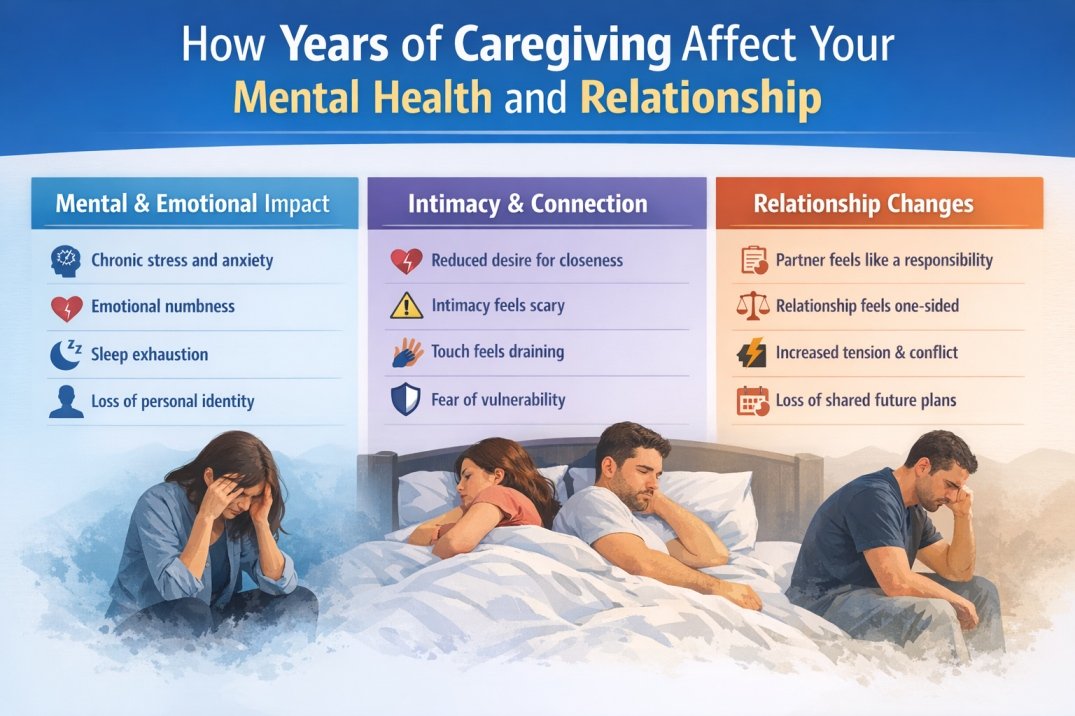
Chronic Stress Without Recovery
Life already has ups and downs. But when you are caring for a sick spouse, the load becomes much heavier. You may be handling many things at once, such as:
- Your spouse’s daily needs
- Children or other family members
- Household tasks and logistics
- Finances and paperwork
- Doctor visits, tests, and medications
Even when things seem stable, there is often a quiet fear that your partner could suddenly get worse again.
Over time, your mind learns to stay on alert. Happy moments can feel temporary because part of you is always watching and preparing for what might happen next. This keeps your body under constant stress, even when nothing urgent is happening.
There is rarely a true break or time to recover. The responsibilities continue every day, and real support may be limited. Many people say, “Take care of your spouse,” but few ask how you are doing.
This nonstop pressure can leave you deeply exhausted, tense, and unable to fully relax or recharge.
Loss of Personal Identity
You may have started your marriage with dreams, plans, and a shared future. Then one difficult period or diagnosis changed everything, and over time you became a caregiver instead of just a spouse.
As the years pass, it can start to feel like you are no longer living your own life. You are managing one.
You may feel:
- Less like a partner and more like a manager or helper
- Disconnected from who you used to be
- Emotionally flat or numb
- Quietly scared about the future
- Lonely, even when your spouse is right there
Your days revolve around tasks, needs, and responsibilities. There is little space left for your own feelings, desires, or identity. Conversations, decisions, and plans often center on the illness, not the relationship.
Over time, it can feel as if your personality, dreams, and sense of self have faded into the background. You may still be functioning on the outside, but inside, you feel distant, worn down, or unsure who you are anymore beyond this role.
Constant Responsibility and Hypervigilance
When your spouse depends on you, it can feel like everything rests on your shoulders. You are the one who must notice changes, make decisions, solve problems, and keep things running. Even when others help, the main responsibility often stays with you.
You may find that:
- It is hard to leave the house without worry
- You keep checking on your spouse, even when they are okay
- You plan your day around “what if something happens”
- Small issues feel urgent because you cannot afford mistakes
- You feel pressure to always be available
Over time, this level of responsibility can make life feel narrow and heavy. Instead of feeling free to move, rest, or focus on yourself, you may feel tied to the situation at all times. This can create a deep sense of pressure and fatigue, as if you are carrying an invisible weight that never fully lifts.
Grief for the Relationship You Once Had
You may have once felt like a true team, building a life together, sharing problems, and leaning on each other. Your partner was the one who steadied you when things went wrong.
Now that support may not be there in the same way.
You may hold back your worries so you do not upset them and handle problems alone to avoid adding to their burden. There is no safe place to “fall” anymore, no one to catch you like before. Over time, your mind can stop seeing your spouse as an equal partner and start seeing them mainly as a responsibility.
This shift can leave you feeling lonely and unsupported, even though you are still together.
To keep going, you may push your feelings aside. Emotional closeness becomes hard, and physical or sexual intimacy can feel uncomfortable or even scary, not because you do not care, but because you are exhausted and guarded. Many caregivers say it feels easier to run on autopilot than to face how much has changed.
Caregiving often brings overwhelm, exhaustion, resentment, and grief, especially when one person carries most of the responsibility for years without enough support. Over time, this can slowly wear you down mentally, emotionally, and physically, even if you keep going and doing what needs to be done.
Why You May Feel Emotionally Shut Down or Numb After Long-Term Caregiving
When stress lasts for years, your mind cannot stay in crisis mode forever. To keep you functioning, it begins to shut down parts of your emotional system. Feeling less becomes easier than feeling everything.
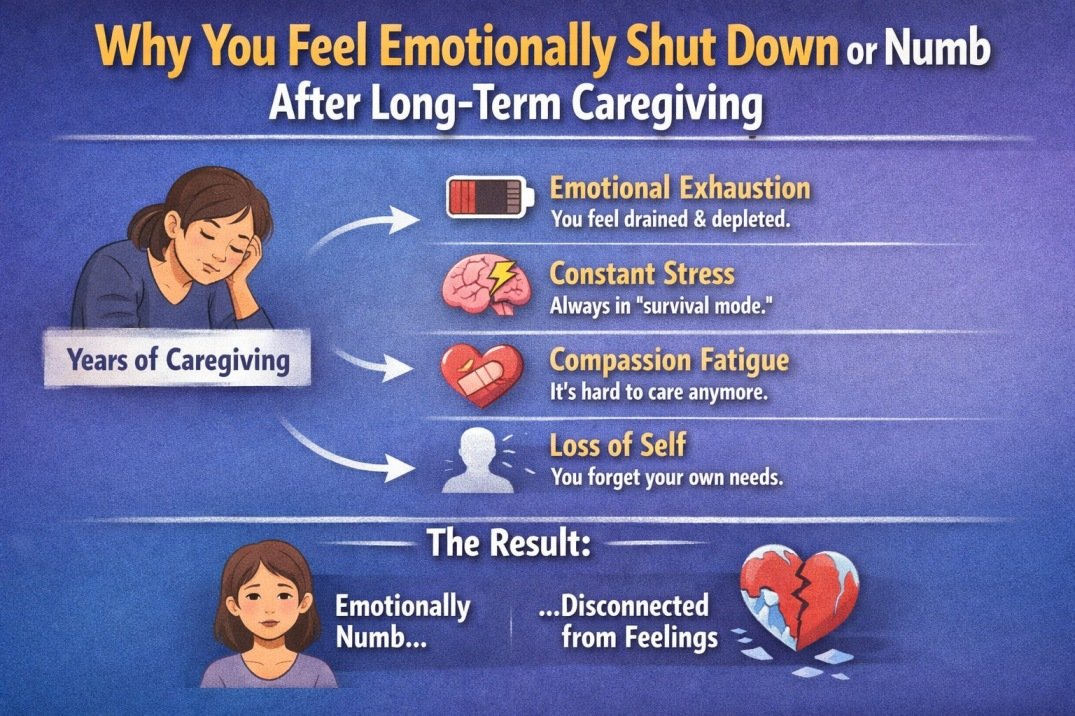
At first, you may still cry, panic, or feel overwhelmed. But when there is no time, space, or safety to process those feelings, your brain learns to suppress them. You focus on tasks instead of emotions. Over time, this becomes automatic; you stop noticing what you feel because your system has trained itself not to go there.
Gradually, your emotional range narrows. It is not just painful feelings that fade, but positive ones too.
You may notice that:
- You feel empty rather than sad
- Joy and interest are harder to access
- Motivation is low
- Emotional connection feels distant
- You react less to both good and bad events
This is sometimes called emotional shutdown or “freeze.” Your system is conserving energy and protecting you from overload, like a switch being dimmed.
It can feel frightening, as if you have lost yourself. But this numbness is not a character flaw or lack of love. It is what can happen when a person carries too much for too long without relief.
Why Intimacy May Suddenly Feel Frightening Instead of Comforting
It’s true, normal closeness in marriage can start to feel scary for long-term caregivers because your system no longer feels safe or rested. For years, your energy has gone outward. When nothing is left, even loving contact can feel like too much.
Your Body Now Links Closeness With More Giving
After being needed for so long, your body expects effort, not comfort. A hug, touch, or sexual advance can feel like something you must respond to, not something you can relax into. Instead of warmth, you may feel pressure, tension, or the urge to pull away.
Touch No Longer Feels Comforting
Hugs, kisses, or lying close may feel empty or distant. Your body does not “switch on” the way it once did. You may stay stiff, distracted, or emotionally absent, as if you are present only on the surface.
Sexual Intimacy Feels Draining or Mechanical
Desire may be low or gone. You might participate out of duty, guilt, or to avoid hurting your partner. Your mind can drift to responsibilities, worries, or fatigue instead of connection. The intensity and emotional closeness that once came naturally may feel unreachable.
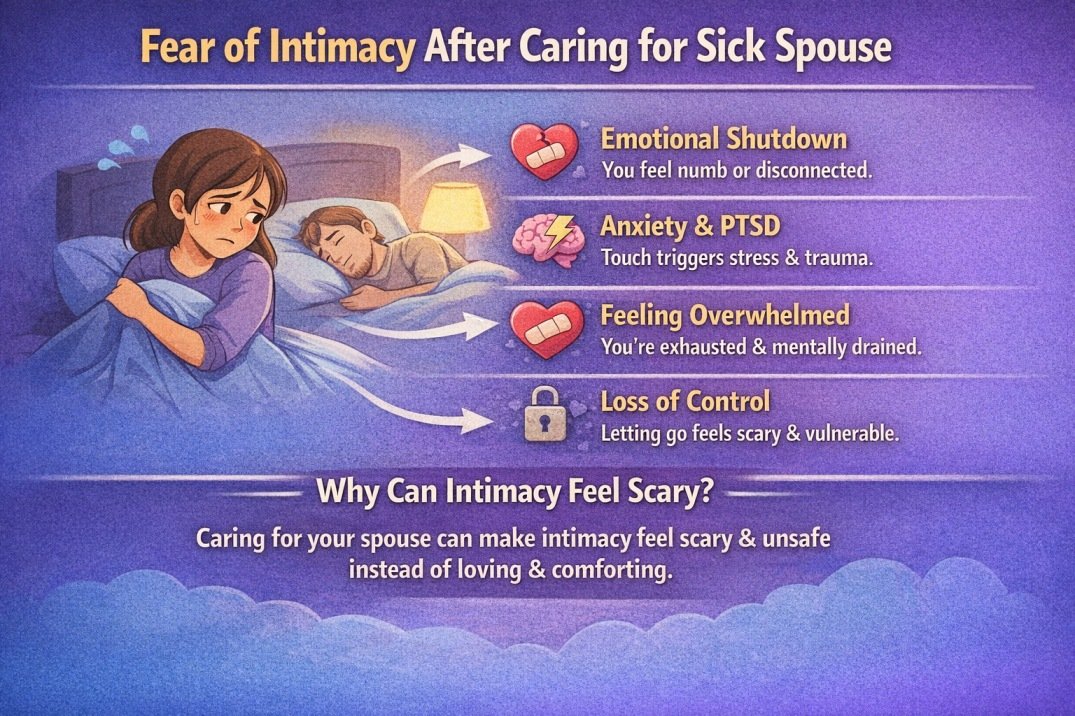
Exhaustion Makes Vulnerability Feel Unsafe
Intimacy requires openness. When you are depleted, opening up can feel risky as if you do not have the strength to handle more feelings, expectations, or needs. Staying guarded feels safer than letting your defenses down.
None of this means love has disappeared. It usually means your emotional and physical reserves are empty. When you have carried too much for too long, even ordinary affection can feel overwhelming instead of comforting.
Signs You May Be Experiencing Burnout in Marriage From Caring for Your Spouse
Burnout from caring for a spouse can build slowly, especially in your 30s, 40s, or 50s. You may not notice it at first because you are focused on managing daily needs.
You may recognize some of these signs:
- Emotional numbness or feeling “shut down”
- Irritability, distance, or detachment from your spouse
- Constant exhaustion that rest does not fix
- Feeling trapped, stuck, or without a way out
- Sleep problems, including trouble falling or staying asleep
- Loss of interest in things you once enjoyed
- Reduced desire for emotional or physical intimacy
- Feeling lonely even when you are not alone
- Guilt for struggling or wanting space
How to Begin Stabilizing Yourself (Without Overwhelming Yourself)
When you are burned out from caring for your spouse, recovery does not come from generic self-care advice. It starts by lowering chronic threat in your system and rebuilding capacity in layers. Think of this as stabilization, not improvement. You are not trying to become “better,” you are trying to become steady enough to function without constant collapse.
First: Stabilize Your Body, Brain, and Daily Load
Your nervous system cannot calm down if your life still requires emergency-level output every day. The most effective intervention is often reducing demands, not adding coping tasks.
- Identify tasks only you can do vs. tasks that can be delegated
- Stop performing at “pre-illness standards” for home, work, or parenting
- Use paid help, community services, or family for concrete duties (cleaning, transport, supervision, meals)
- Batch medical tasks instead of letting them interrupt every day
- Create at least one protected low-demand period daily where you are not “on duty.”
- If possible, arrange predictable backup coverage (even a few hours weekly)
A realistic goal is not full relief, but reducing overall load by even 20–30%, which significantly lowers chronic stress activation.
Second: Regulate the Emotional System, Not Just Express Feelings
Many caregivers are either emotionally flooded or completely numb. Both states need regulation, not pressure to “open up.”
- Contain overwhelming thoughts by setting specific times to think about problems
- Limit rumination triggers (late-night worry, constant health research, crisis checking)
- Use grounding behaviors that signal safety to the brain, steady breathing, slow movement, sensory focus
- Maintain at least one emotionally neutral activity daily (not draining, not demanding)
- Reduce exposure to people who increase guilt, pressure, or panic
Individual therapy can be useful here. Approaches such as CBT, trauma-informed therapy, or skills-based counseling focus on stabilizing thinking patterns and emotional regulation, not just discussing distress.
Third: Rebuild Emotional Intimacy Before Physical Intimacy
When burnout is severe, the system cannot tolerate high emotional or sexual demand. Trying to “fix intimacy” too quickly often increases avoidance.
- Shift focus from performance to low-pressure presence
- Allow contact that has a clear end and no expectations
- Share practical or neutral conversation before personal topics
- Re-establish a sense of partnership in small ways (decision-making, shared routines)
Emotional safety must return before desire or closeness can follow.
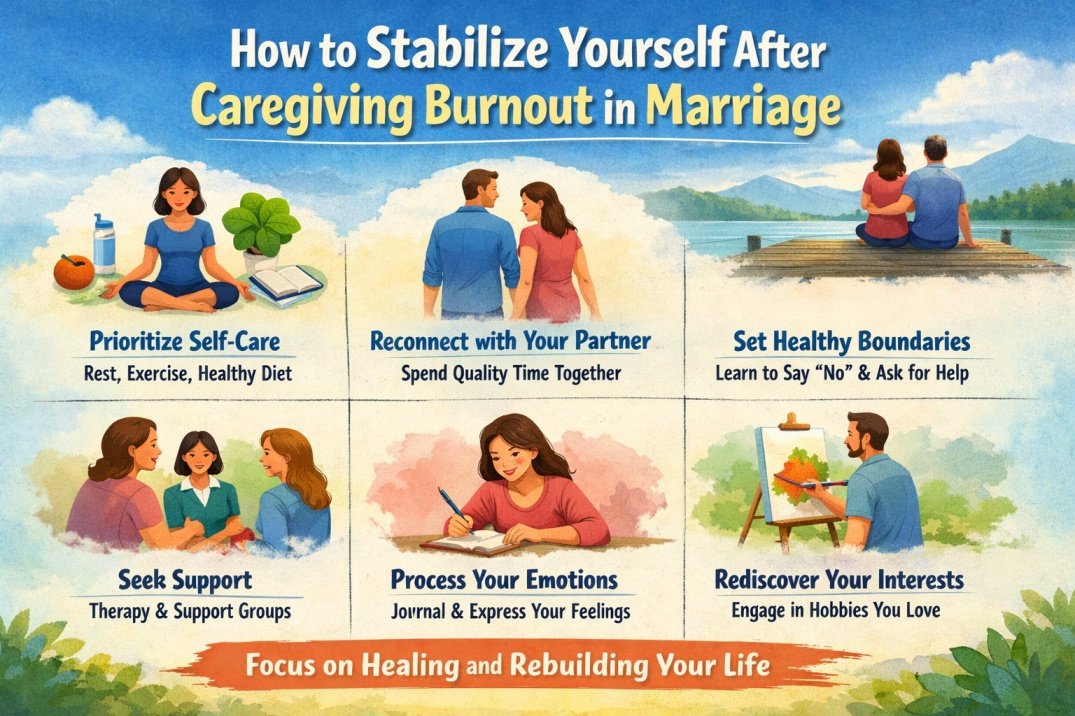
Fourth: Reconnect With Your Own Self
Long-term caregiving narrows identity to one role. Recovery requires reactivating parts of you that existed outside caregiving.
- Make decisions based on your needs at least once daily
- Reintroduce activities that are not useful, productive, or caregiving-related
- Spend time in environments where you are not known primarily as a caregiver
- Revisit abandoned interests in small, manageable ways
- Set personal goals unrelated to illness or family functioning
This is not indulgence, it is rebuilding a stable sense of self.
Fifth: Reduce Isolation and Single-Point Responsibility
Being the only responsible person keeps your brain in permanent alert mode.
- Share full information about the situation with at least one trusted person
- Create a practical contingency plan so everything does not depend on you
- Accept imperfect help rather than no help
- Use online tools, telehealth, delivery, or automation to reduce cognitive load
- If finances allow, paid assistance often provides more reliable relief than informal support
No single person can sustain long-term caregiving without structural support.
Stabilization is not about doing more. It is about removing enough pressure so your mind and body can stop operating in survival mode. When the load decreases and safety increases, emotional capacity and connection often begin to return on their own.
Caregiving should not erase your life. Whether you are a man or woman, any age, do not let illness or society take over your entire day and identity. Set boundaries, even with your sick partner. Loving them does not mean you must sacrifice yourself completely or accept every emotional fluctuation.
Take breaks. Go out. Meet friends. Visit places. Do things you love. Having a life outside caregiving is not selfish; it is what keeps you stable. Talk to your partner too. Most will understand and even want this for you. Plan small shared activities so the relationship is not only about illness.
Something bad has happened, and it is painful. Accept it. But do not reduce life to just crossing days. You can still experience moments of normal life, connection, and meaning within this situation.
When to Seek Professional Help for Yourself
Seek help when it no longer feels manageable on your own. Constant exhaustion, emotional numbness, anxiety, or the sense that you are barely holding things together are signs you should not carry this alone.
A therapist can offer a safe space to speak openly, make sense of what you are going through, and help you regain stability step by step. If leaving home is difficult, online sessions can be an easier option. An online clinical psychologists at LeapHope provide confidential online support for caregivers facing burnout, emotional shutdown, and strain within their marriage.
Getting help is not a failure. It is a way to protect yourself before you are completely worn down. 💛
Final Thought
You did not fail.
You carried more than one person should have to carry for a very long time.
Stabilizing yourself is not abandoning your spouse; it is preserving you. Without your wellbeing, everything else becomes harder to sustain.
If your partner’s behavior, communication, or the strain in the relationship is adding to your distress, online marriage counseling can also help both of you understand what is happening and find healthier ways to cope together.
Taking care of yourself is not selfish. It is what allows you to continue with strength, clarity, and compassion instead of running on empty.
FAQs
Is it normal to feel numb after years of caregiving?
Yes. It is very normal to feel numb after years of caregiving. When stress, responsibility, and emotional strain continue for a long time, your mind protects you by reducing how much you feel. This numbness is not a lack of love or empathy. It is a survival response. Your system is trying to conserve energy and prevent emotional overload. Many long-term caregivers report feeling flat, distant, or “not like themselves” after carrying too much for too long.
Why does intimacy feel overwhelming after burnout?
Intimacy can feel overwhelming after burnout because your emotional and physical reserves are depleted. Closeness requires energy, openness, and a sense of safety. When you are exhausted, your body may interpret touch, affection, or sexual expectations as more demand rather than comfort. Even if you still love your partner, your system may pull back to protect you from further strain. This reaction is common in caregiver burnout and does not mean attraction or care has disappeared.
Can caregiver burnout affect marriage?
Yes, caregiver burnout can strongly affect marriage. Over time, the relationship may shift from equal partnership to caregiver–patient roles. Communication often becomes focused on illness and logistics instead of emotional connection. Both partners may feel lonely, misunderstood, or guilty in different ways. Without support, this strain can reduce intimacy, increase tension, and create emotional distance, even when love is still present.
How long does it take to recover from caregiver exhaustion?
Recovery from caregiver exhaustion varies from person to person. There is no fixed timeline because it depends on how long the strain lasted, how much support you have now, and whether you can reduce responsibilities. Many people begin to feel better gradually once they get rest, practical help, and emotional support. Recovery is usually not sudden, it happens in small steps as your body and mind relearn what safety and relief feel like.