
“Will my partner cheat again?”
This is the question most people get stuck on after cheating. Not because you don’t understand what happened, but because you don’t know what to expect next.
Whether it’s your husband, wife, girlfriend, or boyfriend, once trust is broken, your mind doesn’t stay in the past. It keeps looking ahead, trying to figure out if this is something you can move forward from, or something that will repeat.
You’ll notice yourself watching more closely. Small things feel bigger. You start questioning behaviour, not just what they say, but what it might lead to.
This is not paranoia. It’s what happens when trust is disrupted.
But the answer to this question is not in guessing or trying to be certain. It comes from understanding what has actually changed since the cheating, and what that change really means.
That’s what we’ll break down here.
What Actually Decides If Someone Cheats Again (Not What You Think)
So how do you actually decide if you should not give your partner a second chance, or if they might cheat again.
Our marriage therapists at LeapHope suggest looking at a few clear things.
If your partner shows no remorse, blames you, or makes excuses, they have not taken responsibility.
If secrecy continues, still in contact with the other person, hiding the phone, vague timelines, unpredictable routine, then the situation has not changed.
In some relationships, the partner may act better on the surface, doing things to keep you happy. But if secrecy and inconsistency remain, surface effort does not matter.
If there is a pattern, more than one incident, repeated boundary crossing, then it is not a one-time mistake.
What matters is simple. Not what they say now, but what is actually different in their behaviour.
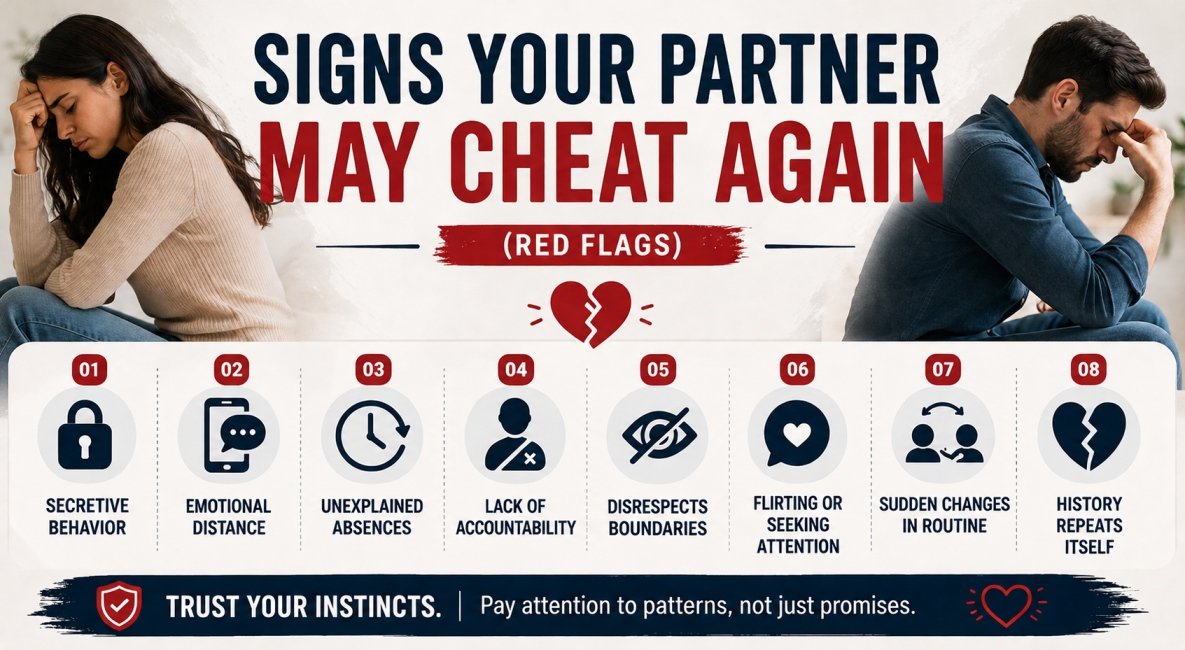
Signs Your Partner May Cheat Again (Red Flags)
Our marriage therapists at LeapHope point to some clear signs your husband, wife, girlfriend, or boyfriend may cheat again. These signs don’t work in isolation; it’s usually a combination of them, not just one, that shows the real risk.
Lack of Accountability
You can usually see this in how your partner talks about what happened.
They deny parts of it, say it wasn’t “that serious,” or focus more on how it happened than what they did. They may bring up your behaviour, the relationship issues, or the situation as the reason, instead of owning their decision.
In real life, it sounds like:
- “I don’t know how it happened.”
- “You were distant, there was no closeness.”
- “There was no sex or connection between us.”
- “I was too drunk, I wasn’t thinking.”
They avoid clear answers, get defensive when you ask questions, or act like you should move on quickly.
This is not accountability. It’s a way to reduce their responsibility, and without full ownership, real change is unlikely.
No Real Change in Behaviour
After the cheating is revealed, things may look different for a short time. But if you look closely, the same habits and patterns are still there.
Same office setup, same people, same “work reasons” or “just friends” explanations. Nothing around the situation has actually been addressed.
You may also notice more attention, more time, better behaviour on the surface. But when it comes to clarity, what they’re doing, where they are, who they’re with, you still have to ask.
If routine, boundaries, and transparency haven’t changed, then behaviour hasn’t changed.
Still in Contact With the Affair Partner
If your partner is still in contact with the person they cheated with, the situation is not closed.
The contact is often explained in everyday ways. Saying they are just a coworker, an ex, or part of the same social circle. It may be presented as unavoidable or harmless.
It can also show up in small actions. Liking their posts, checking their profile, reacting to stories, or saying it happened “by mistake” or without thinking.
Even if it looks minor, the connection is still active. As long as that link exists, the boundary that was crossed is not fully closed.
Secretive Behaviour Returns
You start noticing the same patterns again.
The phone is turned away, taken everywhere, or suddenly has new privacy. Messages are cleared, notifications are hidden, and access feels restricted.
There are gaps in the day that don’t add up. Simple questions about where they were or who they were with get vague or incomplete answers.
It’s not always obvious at once, but the overall feeling is the same as before. Information is controlled, not shared.
Disrespecting Your Boundaries
After cheating, you usually set clear boundaries to feel safe. If your partner ignores them, pushes back, or keeps crossing them, that’s a problem.
You may have asked for simple things, more transparency, no contact with the other person, or basic clarity about their day. Instead, you hear “you’re overthinking,” “this is too much,” or they agree but don’t follow through.
It doesn’t feel like they’re trying to understand what you need. It feels like they’re trying to get back to normal without changing anything.
Avoiding Effort to Fix the Relationship
After cheating, repair needs effort. If your partner avoids it, nothing changes.
They say, “let’s forget it and move on,” or “it won’t happen again,” but don’t explain what happened or why. They don’t answer clearly, don’t address your anxiety, and don’t help you understand what will be different now.
There are no changes, no boundaries set, no plan for similar situations, no willingness for relationship counselling. It becomes about ending the topic, not fixing the problem.
Inconsistent Effort
After being caught, there is effort for a while. More attention, more time, better behaviour.
But it doesn’t last.
Slowly, things go back. The same habits, the same routine, the same lack of clarity. Conversations reduce, openness drops, and the initial effort fades.
This short-term change is often driven by fear or guilt, not real change. If the behaviour doesn’t hold over time, the pattern is still there.
No Empathy for Your Pain
You bring it up because it still affects you. They get irritated, shut it down, or say you’re dragging it.
You hear, “how long will you keep talking about this,” “I already said sorry,” or “just move on.” The focus shifts to ending the conversation, not understanding your pain.
There’s no patience for your questions, no space for your reactions, and no effort to sit with what you’re going through.
Without empathy, trust doesn’t rebuild.
Signs Your Partner Is Less Likely to Cheat Again (Positive Signs)
Our marriage therapists at LeapHope say there are clear signs when a husband, wife, girlfriend, or boyfriend is less likely to repeat the behaviour. In these cases, cheating is not treated as something to move past quickly, but as something serious that needs to be understood and corrected. That’s where it starts to look more like a one-time lapse, not a pattern.

Full Accountability Without Excuses
They say it clearly: “I chose to do this.” No blame on you, the relationship, alcohol, or the situation.
They answer directly, don’t change the story, and don’t minimise what happened. They don’t rush you to move on or get irritated when you ask again.
They stay with the discomfort of what they did and take responsibility for the impact, not just the act.
That level of ownership is what allows real change to start.
Consistent Transparency Over Time
Transparency is not shown once, it is shown repeatedly.
They don’t wait for you to ask. They share where they are, who they are with, and what their day looks like without being pushed. There is no hesitation, no gaps, no need to check or cross-verify.
The phone is not hidden, messages are not cleared, and behaviour stays open even when things feel normal again.
What matters here is consistency. Not for a few days or weeks, but over time.
Clear Behaviour Change (Not Just Words)
You can see it in what they do, not just what they say.
The situations, habits, or boundaries that allowed the cheating are not the same anymore. There are visible changes in routine, interactions, and how they handle similar situations.
They don’t rely on promises like “it won’t happen again.” You can see different decisions being made in real situations.
If behaviour has clearly changed and stays changed, it shows the issue has been addressed, not just talked about.
Respecting Boundaries You Set
After cheating, you set boundaries to feel safe. They take those boundaries seriously and follow them without pushing back.
If you’ve asked for no contact with the other person, more clarity in their day, or openness around phone and communication, they don’t argue or delay it. They act on it.
You don’t have to repeat the same thing or remind them again and again. The boundaries are respected consistently, not just when it’s convenient.
That consistency shows they understand what’s needed to rebuild trust.
Willingness to Work on the Relationship
They don’t try to skip past what happened. They are willing to sit through uncomfortable conversations and stay in them.
They make time for it, not just when you bring it up. They are open to getting help, whether that means talking to an online counsellor for relationship issues or working with an online sex therapist if intimacy has been affected.
You can see effort in how they communicate, how they handle conflict, and how they try to rebuild things step by step.
It doesn’t feel like they want to “move on quickly.” It feels like they are trying to fix what broke.
Shows Real Empathy for Your Pain
They don’t get irritated when you bring it up. They stay with the conversation and listen.
They understand that your reactions, questions, and anxiety are a result of what happened. They don’t tell you to “move on” or act like you’re overreacting.
They acknowledge the impact, not just the act. You can see they are trying to understand what you’re going through, not just end the discussion.
That empathy is what allows trust to rebuild over time.
Can a Person Who Cheated Really Change?
Yes, but not always.
It depends on a few things.
Do they have enough self-awareness to understand what they did and why it happened? Are they putting in real effort, not just for a few weeks, but consistently over time?
Are they actually changing their behaviour, or just saying they will? Change is possible, but only when these things are clearly present.
Why You Still Feel Like Your Partner Will Cheat Again
After cheating, your sense of safety in the relationship is disrupted. Your mind shifts into a more alert state, scanning for anything that might signal risk.
You start noticing patterns, questioning inconsistencies, and replaying situations. Even small changes feel significant because your brain is trying to prevent a repeat of what already happened.
This is not random thinking. It’s a protective response. Once trust is broken, your mind relies less on assumptions and more on constant checking.
That’s why the feeling stays, even when things seem normal on the surface.
What You Should Focus On Instead of Overthinking
- watch behaviour, not words
- set clear, non-negotiable boundaries
- check if those boundaries are actually followed
- look at consistency over time, not short-term effort
- notice if your anxiety is reducing or staying the same
If you keep finding yourself wondering “will my partner cheat again” or struggling with how to trust your partner after cheating, bring your focus back to these things.
Clarity comes from what stays consistent, not from overthinking.
When to Seek Professional Help
- confusion doesn’t go away, even after time
- trust isn’t rebuilding despite effort
- emotional stress, anxiety, or overthinking keeps increasing
At this point, it’s not about figuring it out alone.
Talking to a professional can help you see things clearly, understand what is actually changing, and decide what makes sense for you.
At LeapHope, you can speak to an online relationship counsellor or work with an online marriage therapist to get clarity and structured guidance.
The Bottom Line
Yes, you can forgive your partner for cheating if you can clearly see they are changing what led to it, taking responsibility, being transparent, and staying consistent over time.
But forgiving someone who shows the same behaviour again, avoids responsibility, or keeps crossing boundaries will not fix the situation. That pattern usually repeats.
Also pay attention to how you feel in the relationship now. Are you becoming more secure, or more anxious and uncertain?
At the same time, don’t lose focus on your own life. Keep working on yourself, your routine, your independence, and your sense of stability.
In the end, it’s not just about forgiveness. It’s about whether this relationship is actually becoming safe and different from what it was before.