Last Updated on October 23, 2026
Clinically Reviewed by Mohit Yadav, RCI-Registered Clinical Psychologist (CRR A100623)
Your child’s teacher says they’re easily distracted, forget instructions or struggle to sit still. Someone mentions ADHD, and now you’re worried.
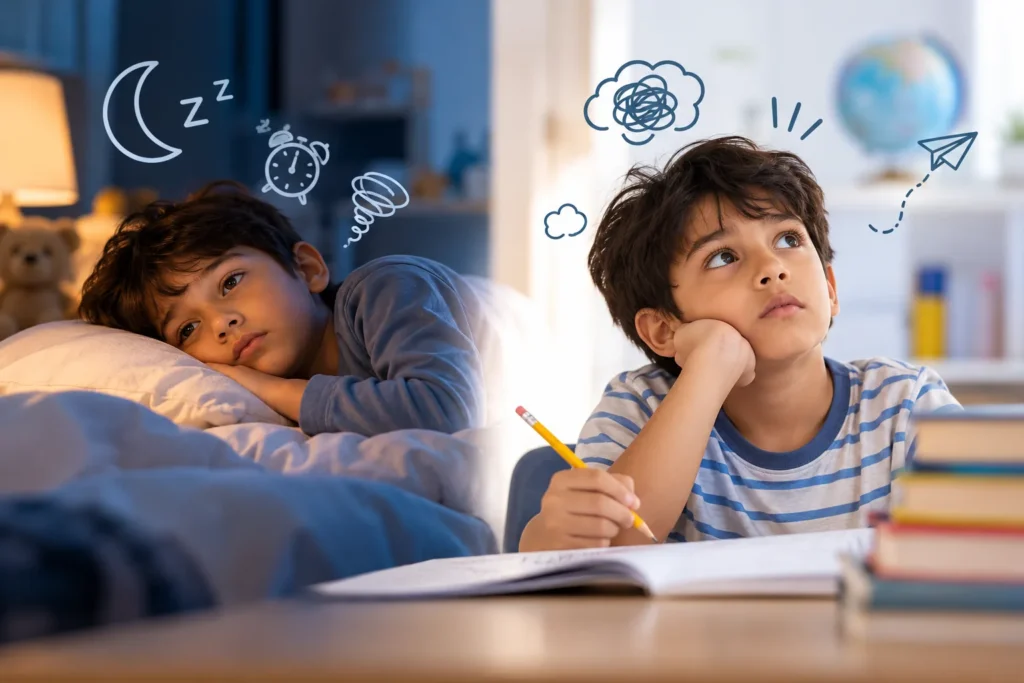
But you’ve also noticed that your child hasn’t been sleeping properly. They stay awake late, wake frequently or seem exhausted in the morning.
Could poor sleep be making your child behave like they have ADHD?
Yes, it can. Sleep problems sometimes cause attention and behaviour difficulties that resemble ADHD. But many children experience sleep difficulties while growing up without having ADHD, and some children have both.
Here’s what parents need to understand before drawing conclusions about their child’s behaviour.
How Sleep Problems Can Resemble ADHD in Children
A child who hasn’t slept properly still has to concentrate in class, remember instructions, complete schoolwork and manage their behaviour throughout the day.
Insufficient or disrupted sleep can make these tasks harder, sometimes producing behaviours also associated with ADHD.
1. Difficulty Paying Attention and Following Instructions
You ask your child to pack their schoolbag, put their homework inside and get dressed. A few minutes later, they’ve forgotten two of the three things.
At school, their teacher notices unfinished assignments or difficulty following explanations.
ADHD can affect attention and working memory, but poor sleep can also make it harder for children to concentrate and remember what they’ve just been told.
If these difficulties started recently, particularly after a change in your child’s sleeping pattern, mention that during an assessment.
For related concerns, LeapHope’s article on why children suddenly stop concentrating on studies explores other possible contributors.
2. Restlessness and Difficulty Sitting Still
A tired child doesn’t always sit quietly or fall asleep.
Some become unusually restless, interrupt others or move constantly between activities.
In a controlled study involving 34 children aged 7–11, researchers found that restricting sleep by approximately 54 minutes was associated with worse teacher-rated emotional regulation, restless-impulsive behaviour and daytime sleepiness.
So when a teacher says your child cannot sit still, their sleep is worth discussing alongside other possible explanations.
3. Impulsive Reactions and Emotional Outbursts
Your child shouts before you’ve finished speaking, becomes upset when a game ends or reacts strongly to a small disagreement.
Poor sleep can make emotional control more difficult, particularly when children are already tired after a demanding day.
ADHD may also involve impulsive behaviour, although emotional outbursts alone are not diagnostic of ADHD.
What matters during assessment is the wider pattern: how long these difficulties have been present, where they occur and what else may be contributing.
Is It Poor Sleep, ADHD, or Both?
All three are possible. A child may have attention difficulties because they’re sleeping poorly, have ADHD independently of their sleep, or have both conditions together.
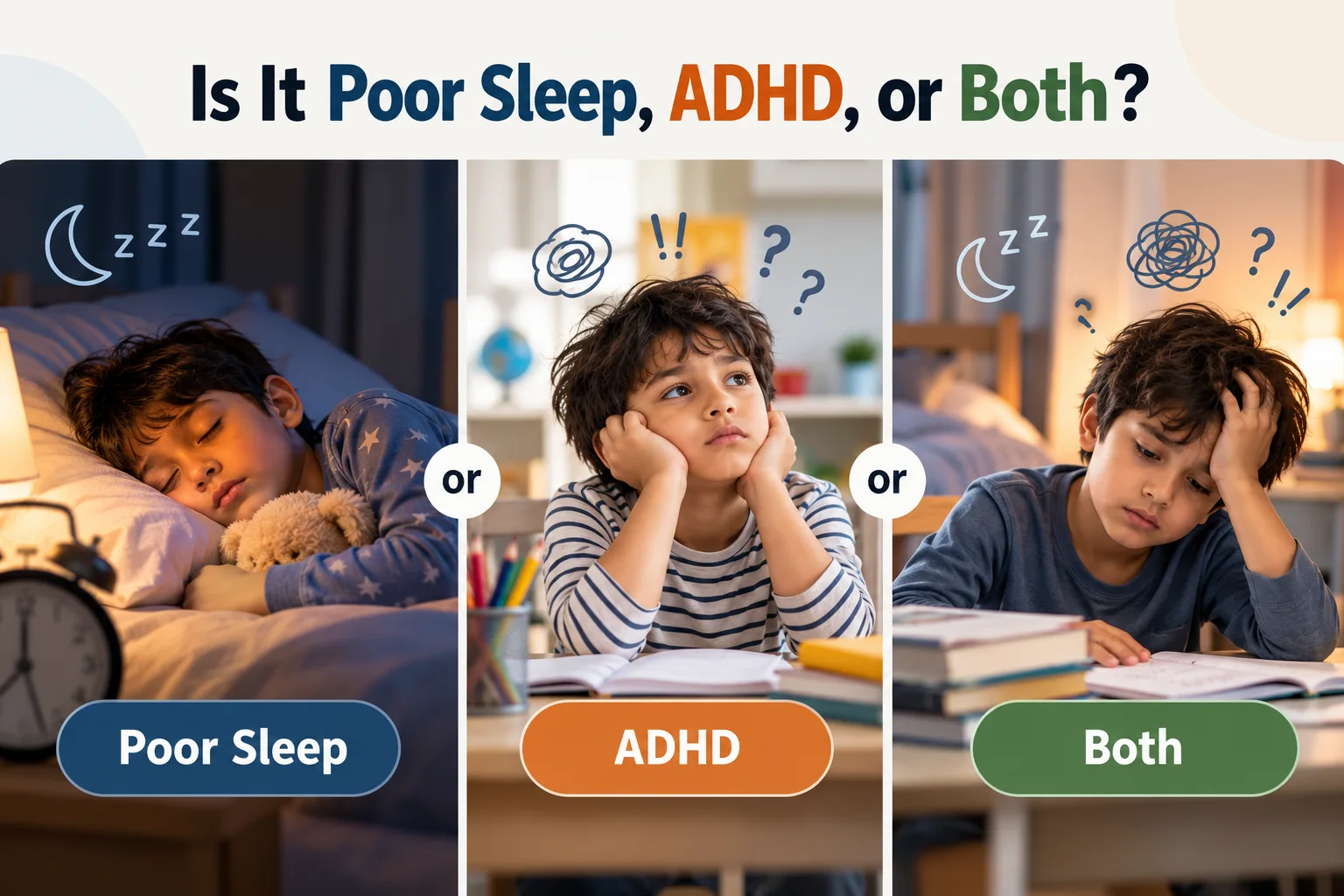
The following differences can help parents understand what professionals investigate.
| Situation | What parents may notice |
|---|---|
| Sleep difficulties contributing to symptoms | Concentration or behavioural problems become more noticeable after a period of poor sleep |
| Possible ADHD | Persistent attention or impulsivity difficulties have been present over time and interfere with functioning in different settings |
| ADHD with sleep difficulties | A child already experiencing ADHD symptoms also has insufficient or disturbed sleep, potentially making daily functioning harder |
These are examples, not rules for identifying a diagnosis. ADHD can become more noticeable when school demands increase, and children with ADHD can also sleep poorly.
Parents often ask whether their child’s ADHD symptoms will disappear once their sleep improves.
Better sleep may improve attention and behaviour, but improvement doesn’t rule out ADHD, just as persistent difficulties don’t automatically confirm it.
A qualified clinician needs to consider developmental history, school experiences, emotional health, medical conditions and whether symptoms meet established diagnostic criteria.
What Parents Should Check Before an ADHD Assessment
You don’t need to diagnose your child yourself. Instead, bring information that helps the professional investigate the problem accurately.
1. Record Actual Sleep, Not Just Bedtime
For one or two weeks, note when your child falls asleep, wakes up and experiences nighttime interruptions.
A nine-year-old who falls asleep at 11 PM and wakes at 6 AM is getting approximately seven hours—below the recommended 9–12 hours per 24 hours for children aged 6–12.
Also distinguish between two situations:
- Not enough opportunity to sleep: Homework, gaming or a late schedule leaves too few hours.
- Difficulty sleeping despite enough opportunity: Your child goes to bed on time but cannot fall asleep or wakes repeatedly.
These may require different investigations.
2. Ask the Teacher What Actually Happens
Rather than accepting only “your child isn’t concentrating,” ask for specific examples.
Does your child:
- Miss verbal instructions?
- Leave classwork unfinished?
- Become distracted during particular lessons?
- Struggle with organisation or completing multi-step tasks?
Ask whether the difficulties are recent and how much they affect learning or relationships.
Written teacher observations, previous school reports and examples of unfinished work may be helpful at an appointment.
3. Look at the History, Not Just Recent Behaviour
Think about whether these concerns existed in earlier school years or appeared after a change in routine.
Mention previous difficulties with attention, organisation or impulsivity, as well as recent stress, illness or major family changes.
A clinician will consider symptoms over time and across settings. ADHD should not be diagnosed solely because a child has become distracted during a stressful few weeks.
4. Tell the Paediatrician About Nighttime Warning Signs
Some children spend enough hours in bed but still experience disrupted sleep.
Medical assessment is particularly important if your child has habitual loud snoring, breathing pauses, gasping during sleep or excessive daytime sleepiness.
A paediatrician may investigate possible sleep-related breathing disorders or refer your child to an appropriate specialist.
5. Don’t Use Internet Videos as a Diagnostic Test
You may have watched videos suggesting that interrupting, forgetting instructions, avoiding homework or moving constantly are definite signs of ADHD.
These behaviours can occur for several reasons, including insufficient sleep, anxiety, learning difficulties and ADHD.
Online questionnaires and videos may encourage you to seek advice, but they cannot replace a proper assessment.
Avoid starting unverified supplements, medicines or treatment routines because someone online claims they help ADHD.
And don’t postpone a needed assessment while trying to fix every sleep problem first. Sleep difficulties and possible ADHD can be investigated together.
When to Seek a Child Psychologist or Paediatrician
If your child’s sleep, attention or behaviour is worrying you, or you’re unsure whether the difficulties are related to poor sleep or ADHD, it’s perfectly reasonable to seek professional guidance.
You don’t need to wait until the problem becomes serious. Speaking with a qualified child psychologist or paediatrician can help you get clarity, reassurance and appropriate advice for your child’s situation.
If you’re worried about your child’s attention, sleep or behaviour, you can speak with a qualified psychologist through LeapHope’s online child ADHD counselling. Depending on your child’s difficulties, you can also explore support for behavioural concerns or enquire about online psychological assessments to understand what may need further attention.
Families can also explore online child counselling in India, the USA, the UK, Canada and Australia.
Recap
Many children experience disturbed sleep, distraction or restlessness while growing up. These difficulties do not automatically indicate ADHD, and some improve with changes to sleep and daily routines.
However, poor sleep doesn’t rule out ADHD either.
If the difficulties persist or affect your child’s school or home life, consult a qualified child psychologist or paediatrician rather than relying on online symptom videos. Professional guidance can help clarify whether the concern involves sleep, ADHD, another condition or a combination and whether any treatment is needed.
Clinical References
- Centers for Disease Control and Prevention. Diagnosing ADHD.
- Wolraich ML, et al. Clinical Practice Guideline for the Diagnosis, Evaluation, and Treatment of ADHD in Children and Adolescents. Pediatrics. 2019.
- Gruber R, et al. Impact of Sleep Extension and Restriction on Children’s Emotional Lability and Impulsivity. Pediatrics. 2012.
- Paruthi S, et al. Recommended Amount of Sleep for Pediatric Populations. Journal of Clinical Sleep Medicine. 2016.
This article provides general educational information and does not replace individual medical or psychological assessment.