Last Updated on October 17, 2026
Clinically Reviewed By: Aradhana Gambhir, Senior Child Psychologist & Parenting Counsellor
You may be working long hours because you want a better life for your family and a secure future for your child.
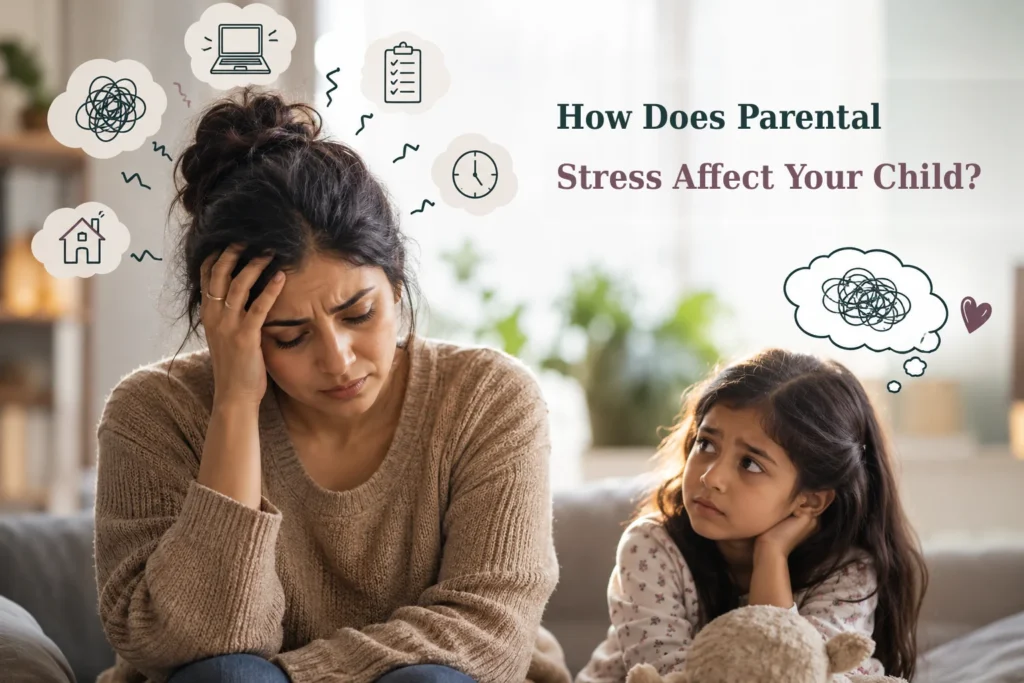
But building that life can come with a cost. Work deadlines, financial pressure, household responsibilities, parenting demands and sometimes problems between partners can leave you mentally and physically exhausted. For some parents, ongoing stress and burnout slowly become part of everyday life rather than something that ends when the workday does.
As an adult, you may understand why you are stressed. You know the difficult project will finish, the financial problem may improve or the argument with your partner was about something specific.
Your child may not understand any of that.
They may still laugh, play, go to school, meet friends and talk normally with both parents. Nothing may look obviously wrong.
And not every child living around parental stress will be negatively affected.
Even when children are affected, they do not all respond in the same way. One child may become more irritable. Another may seek more attention. Another may become quieter. Another may show no noticeable change at all.
The bigger question is what happens when stress stops being temporary and becomes a repeated part of the environment your child is growing up in.
How Does a Parent’s Stress Show Up Around Your Child?
Parental stress does not always look like shouting, major arguments or an obvious family crisis.
Often, it shows up in ordinary moments.
You come home from work, but mentally you are still thinking about what happened in the office.
Your child starts telling you about school while you are replying to a message.
They ask you to look at something they made.
“Give me five minutes.”
A little later:
“Not now. I’m busy.”
Homework takes longer than expected and you lose patience much faster than you normally would.
At bedtime, another question, another request for water or another story can feel like one more thing you have to manage.
You may find yourself thinking:
“I work this hard for my child. Why do I have no patience left when I finally get home?”
Stress can show up as:
- shorter answers
- constantly rushing mornings or evenings
- repeatedly saying “later”
- checking work messages while your child is talking
- feeling irritated by normal noise
- having less patience with mistakes
- struggling to listen to a long story
- speaking more sharply than usual
- being physically present but mentally somewhere else
- arguments or tension between parents
- snapping over something small and regretting it later
Children may not understand why you are stressed, but they can often notice that something feels different.
They may notice your tone.
They may notice that you are harder to approach after work.
They may notice that mum and dad are talking differently to each other.
They may notice that ordinary questions now receive impatient answers.
That does not mean noticing your stress automatically harms them.
Parents get tired. Parents become distracted. Parents have bad days.
The more important question is whether the change has become the usual pattern at home rather than an occasional difficult day.
If you find yourself repeatedly reacting to your child in ways you later regret, parenting counselling can help you look at what is happening between stress, your reactions and your child’s responses without assuming the child is the problem.
And if stress is regularly coming out as shouting or anger, our guide on taking stress and anger out on your child looks more closely at that pattern.
How May Parental Stress Affect Your Child?
Research suggests there can be a relationship between parental stress and children’s emotional and behavioural difficulties.
A 2024 systematic review included 24 studies involving 31,183 school-age children. Researchers found an association between parental stress and emotional and behavioural problems in children.
But this does not mean:
“If I am stressed, my child will develop a psychological problem.”
An association is not a guaranteed outcome.
A child’s age, temperament, sensitivity, relationships, school experiences, support from other adults and how long the stressful period continues may all make a difference.
Even two siblings living in the same home may respond very differently.
One child may appear affected while another seems largely unchanged.
Psychological and Emotional Effects
Some children become more sensitive to the emotional atmosphere around them when stress at home continues for a long time.
A younger child may not understand:
“Dad is under pressure because his company is going through a difficult month.”
They may simply notice:
“Dad gets angry more easily now.”
Another child may know that their mother is stressed but still wonder whether they did something wrong when she suddenly becomes impatient.
Some children may:
- seek more reassurance
- worry about whether a parent is angry
- become more sensitive to tension between adults
- hesitate before bringing up their own problems
- become more irritable themselves
- repeatedly ask whether everything is okay
- become quieter in some situations
An older child may understand that a parent is already overwhelmed and, in some families, decide not to add another problem to the parent’s day.
But none of these reactions proves parental stress is responsible.
A child may be worried because of school.
They may be irritable because of friendships, poor sleep or another emotional difficulty.
They may become quieter because they are entering adolescence.
And many children continue to feel secure and emotionally connected even while a parent is going through a demanding period.
This is why parents should avoid both extremes.
Do not assume:
“My child is laughing, so nothing affects them.”
But also do not assume:
“My child seems quiet today, so my stress must be damaging them.”
Look at what is different from your child’s usual behaviour and whether that change continues.
Behavioural Effects Parents May Notice
Children do not always explain emotional difficulty in words.
Sometimes parents notice changes in behaviour first.
A child may:
- argue more over ordinary requests
- react more strongly to small frustrations
- ask for attention more often
- have greater difficulty settling into routines
- check a parent’s mood before asking for something
- become unusually quiet
- show changes in sleep
- begin having difficulties at school
- become more reactive around homework or everyday limits
But again, there is no single behaviour that tells you:
“This happened because I am stressed.”
Sometimes the direction runs the other way.
Your child may already be struggling with something.
Imagine homework has become difficult.
Your child gets frustrated and refuses to continue.
You have had a stressful workday and still have several things to finish.
You become impatient.
Your child becomes more upset because you sound angry.
Now you become even more frustrated because a twenty-minute homework task has turned into a long argument.
The child’s difficulty increased your stress, and your stressed response then made the interaction harder.
In some families, this becomes a repeating cycle.
Neither the parent nor the child deliberately creates it.
Looking at the whole interaction is more useful than deciding who caused the problem.
If your child is showing persistent emotional or behavioural changes across home, school or relationships, child and teen counselling may help parents understand what is happening rather than guessing from one behaviour.
LeapHope also provides child psychologist support for families in India, the USA, Canada and the UAE.
How Can Ongoing Stress Affect Childhood Development?
This is often what worries parents most.
You may think:
“My child seems completely fine. They are playing, studying and talking normally. Can the stress at home still affect them?”
The answer is not simply yes or no.
Children develop through repeated relationships and everyday experiences over many years.
They gradually experience what happens when people become frustrated.
They see how adults respond when things go wrong.
They experience whether it usually feels comfortable to approach a parent when upset.
They see what happens after disagreements.
They learn whether everyday family life is generally predictable or whether they need to keep checking what mood everyone is in.
But a child’s development is not determined by one bad evening, one argument or one stressful month.
A parent losing patience tonight has not decided their child’s emotional future.
What becomes more important is the pattern repeated over time.
There is a difference between a family experiencing a difficult period while the adults remain generally responsive and a child living for a prolonged period in an environment where stress dominates most interactions.
A useful way to think about it is to ask yourself:
Does my child usually feel able to come to me?
Do we normally reconnect after difficult moments?
Are most days reasonably predictable?
Has stress changed our usual relationship for weeks or months rather than a few difficult days?
This is also why being a busy working parent does not automatically mean being emotionally unavailable.
A parent may have limited time with their child but still listen, respond and notice when something matters.
Another parent may be physically at home for many hours while persistent stress makes emotional engagement much harder.
The number of hours together is not the whole story.
If your child has become noticeably quieter or communication has changed, our guide on why children stop talking to parents explores that issue in more depth.
Can a Stressful Home Environment Increase the Risk of Trauma?
Ordinary parental stress is not the same as childhood trauma.
Being busy does not traumatise a child.
Being exhausted after work does not automatically traumatise a child.
Occasionally losing patience does not mean you have traumatised your child.
Even an argument between parents does not automatically create trauma.
The concern becomes different when a child’s home environment involves severe, frightening or prolonged experiences.
This may include:
- violence
- abuse
- severe neglect
- repeated frightening conflict
- serious instability
- situations in which a child regularly feels unsafe
The severity and duration of what the child experiences matter.
So does whether the child has reliable adults who continue providing protection, comfort and stability.
Not every child exposed to a difficult family environment develops trauma either.
Children can respond differently to the same circumstances because of their age, temperament, previous experiences, relationships and available support.
This is also why ordinary parental stress should not automatically be labelled toxic stress.
A difficult period at work, financial pressure or parental burnout is not automatically the same as a child living through severe and prolonged adversity.
The more useful question is whether the child is repeatedly experiencing something frightening, threatening, severely unpredictable or beyond what the family is currently able to manage safely.
When Should You Talk to a Psychologist?
You do not need to wait until your child has a diagnosis or until family life reaches a crisis.
It may be worth speaking with a psychologist if stress is affecting your home most days, the same conflicts repeatedly return, or you notice sustained changes in your child’s emotions or behaviour.
Pay particular attention if you find that:
- you feel emotionally exhausted most days
- you are repeatedly reacting in ways you later regret
- tension between parents is regularly affecting the home environment
- the same parent-child conflicts continue despite your efforts
- changes in your child’s emotions or behaviour continue rather than passing
- your child is beginning to struggle across several parts of life
- you cannot tell whether the main difficulty is your own stress, your child’s needs or a combination of both
The first step does not always need to be child therapy.
If the main difficulty is the parent’s stress or burnout, support may need to begin with the parent.
If the child is showing persistent difficulties, direct work with a child psychologist may be more appropriate.
And sometimes a psychologist may first need to understand the wider family situation before deciding where support should begin.
You do not need to work that out perfectly before asking for guidance.
Final Thoughts
You may be working this hard precisely because you want your child to have opportunities, stability and a better future.
Feeling stressed does not make you a poor parent.
Working long hours does not automatically make you emotionally unavailable.
Having a difficult period at home does not mean your child will develop emotional, behavioural or developmental problems.
And not every child is affected by parental stress in the same way.
Some children may become more worried.
Some may become more irritable.
Some may seek more attention.
Some may become quieter.
And some may show very little noticeable effect.
What deserves attention is when stress stops being temporary and begins regularly changing how people speak, listen, respond and feel around one another at home.
Your child may still laugh, play, study and talk normally while noticing that you have become more tired, distracted or impatient.
That does not mean something must secretly be wrong with them.
Instead of asking yourself:
“Have I harmed my child because I’m stressed?”
a more useful question may be:
“What is my child repeatedly experiencing around our stress, and is our family still able to return to the way we normally want to relate to one another?”
If that question has become difficult to answer, talking to a psychologist can help you understand what is happening before deciding what kind of support, if any, your child or family needs.