
A husband came to us for marriage counselling. He was living in the USA with his family. He said most days were okay, but the moment an argument started, everything changed.
They could be talking about something small, like daily plans or a simple disagreement. Then suddenly, his wife would bring up his past mistakes. Not just once, but again and again. The whole argument would shift. It was no longer about what they were talking about, it became about what he had done before.
He had already said sorry for those mistakes. He had tried to change. But in those moments, it felt like none of that mattered. He said, “No matter what we talk about, I end up feeling like the same person who made those mistakes.”
After some time, he stopped feeling heard. He started feeling stuck. Like he could not move forward, no matter what he did.
And this is not just his story. We see this with many husbands from India, the UK, the UAE, Australia. Different lives, same situation. Past mistakes keep coming into present arguments.
If this is happening in your relationship, then it is not just about those mistakes anymore. Something is still unresolved, and that is why it keeps coming back.
Reasons Why Your Wife Keeps Using Past Mistakes
This is usually not just one simple reason. Sometimes it comes from hurt that was never fully healed. Other times, it becomes a pattern where past mistakes get used in arguments to prove a point or take control.
Read below to understand the real reasons.
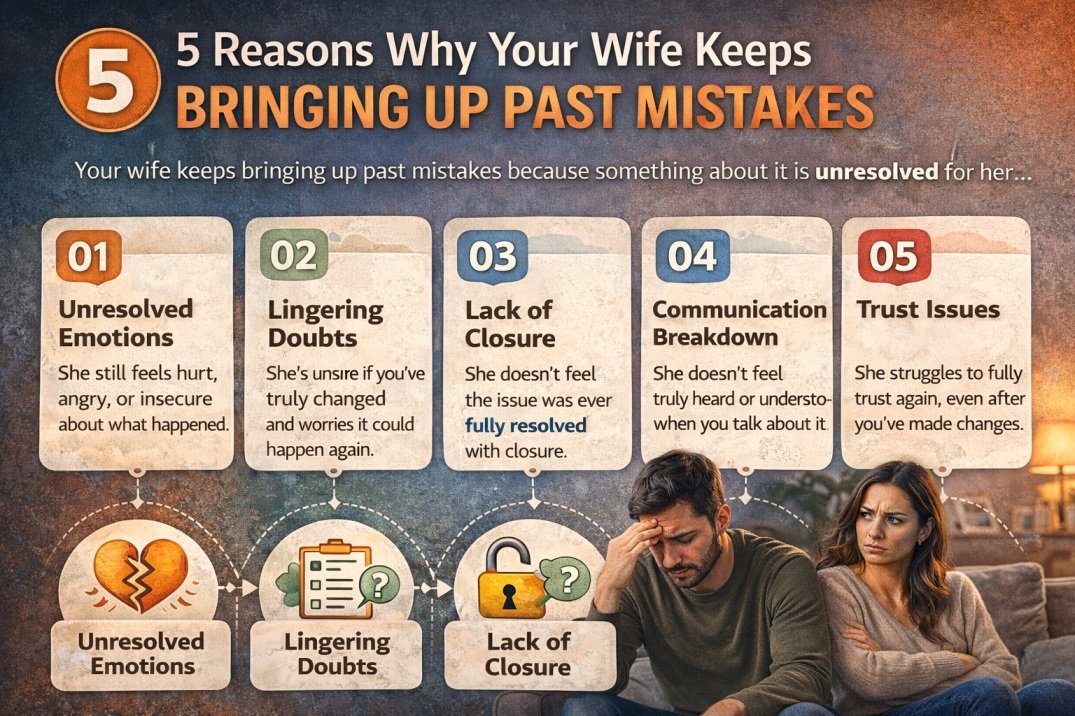
Your Wife Has Not Fully Forgiven What Happened
It could be something like you cheated, didn’t support her when she needed you, took someone else’s side, or hurt her in a way that was never properly dealt with. At that time, she may have let it pass just to move forward.
But letting it pass is not the same as forgiving and forgetting.
When something is not truly forgiven, it stays in the background. And during arguments, especially emotional ones, those past mistakes come back because for her, that part was never fully resolved.
Your Wife Does Not Feel Heard Or Understood
In your day-to-day life, she may feel that when she shares something important, it doesn’t really land. You may respond, but your focus goes to explaining, correcting, or moving the conversation forward instead of really sitting with what she is feeling.
Over time, this builds a deeper frustration. She starts feeling like her experience is not fully seen, even in the present.
So during arguments, she brings up past mistakes, not just to talk about what happened, but to show you a pattern. For her, it is a way of saying that what she felt then is still happening now, and that is why it has not gone away.
Your Wife Feels The Issue Was Never Fully Resolved
The hurt from that mistake may have been deeper than it looked. She may have chosen to move on because of the relationship, family, or kids, but that does not mean she truly accepted what happened.
On the surface, things moved forward. But inside, it may still feel unfair, incomplete, or unresolved.
So during arguments, that same issue comes back. Not because she wants to repeat it, but because for her, it still hurts and never fully settled.
Your Wife Does Not Feel Emotionally Safe After What Happened
After that mistake, something may have changed in how safe she feels with you. Even if things look normal outside, inside she may still feel unsure, guarded, or careful.
She may not fully trust that she will be understood, supported, or protected in the same way again.
Because of that, during arguments, she goes back to past mistakes. For her, it is not just about what happened before; it is about a sense of safety that still feels broken today.
Your Wife Still Feels Insecure In The Relationship
After what happened, her sense of stability in the relationship may have been shaken. Even if things look fine on the surface, inside she may still have doubts, questions, or fear that it could happen again.
She may not say it directly, but that insecurity shows up during arguments.
Bringing up past mistakes becomes a way to express that fear, to remind you of what hurt her, and to check if things have really changed or not.
Your Wife Gets Emotionally Overwhelmed During Arguments
In the middle of an argument, her emotions can rise quickly. When that happens, the mind does not stay only on the present issue. It pulls in past experiences that carry the same feeling.
So even if the current topic is small, the emotional intensity brings back older moments where she felt hurt, ignored, or let down.
In that state, bringing up past mistakes is not planned. It is a reaction. Her mind is trying to express the full weight of what she is feeling, not just what is happening right now.
Your Wife May Use The Past To Regain Control In Conflicts
In some situations, this can be conscious and intentional. When an argument is not going in her favour, bringing up past mistakes can shift the focus and put you in a weaker position.
Instead of staying on the current issue, the conversation moves to something where she knows you already feel guilty or defensive. That changes the balance of the argument.
It becomes less about solving the problem and more about gaining control or having the upper hand in that moment.
Your Wife Compares Mistakes To Balance Guilt
In some arguments, she may bring up your past mistakes to balance what is happening now. If she feels wrong or questioned in the moment, comparing it with what you did earlier can reduce her own guilt.
Instead of staying with the current issue, the focus shifts to, “you did this before.”
This creates a sense of balance for her, but it does not solve the problem. It only turns the argument into a back-and-forth where both sides start defending instead of resolving anything.
Your Wife Is Reacting To Your Defensiveness Or Withdrawal
When an issue comes up, you may become defensive, explain quickly, or shut down to avoid the argument. From your side, it may feel like protecting yourself or keeping things calm.
But for her, it can feel like you are not taking responsibility or not staying present with the issue.
So she brings up past mistakes to push the conversation further, to make you respond, or to break through that distance. It becomes a way to pull you back into the discussion, even if it turns into a bigger conflict.
How To Stop the Blame Cycle and Rebuild Your Marriage
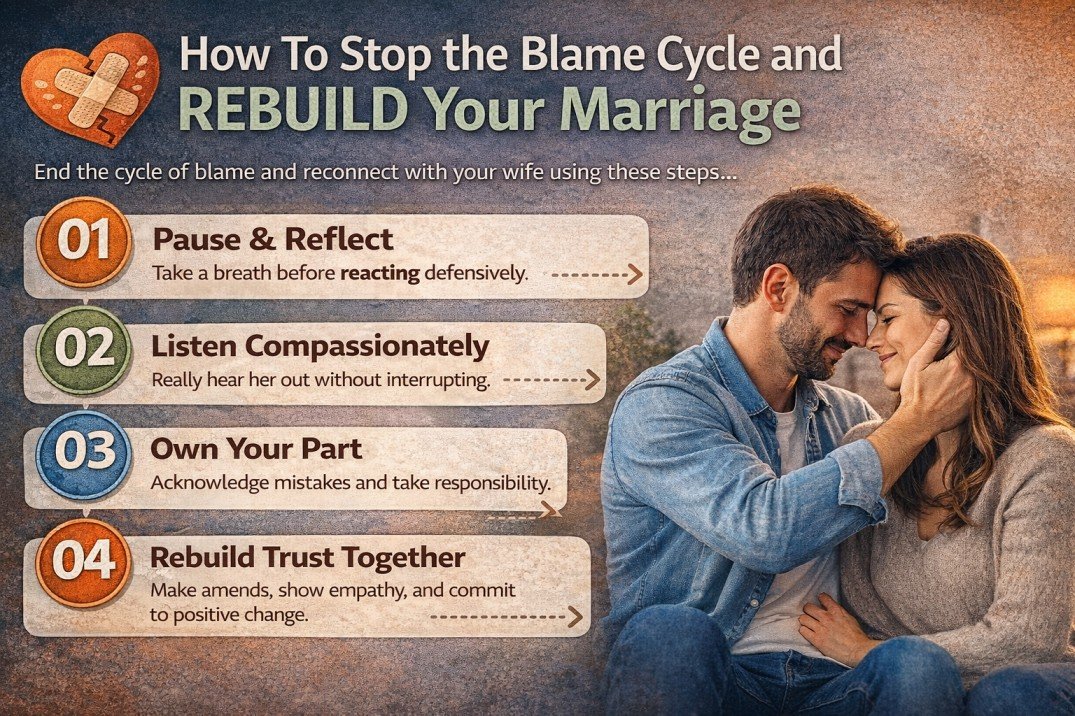
Address What Still Feels Unresolved Instead Of Repeating The Past
If the same mistake keeps coming up, it means something about it is still unfinished for her. Stop going back to what happened and start asking what still feels incomplete. Until that part is addressed, the past will keep returning in different arguments.
Acknowledge Her Feelings Before Explaining Your Side
Most people make the mistake of mixing both. When you explain too early, it sounds like defence. First, let her feel that you understand what it did to her. Only after that, if needed, share your side. The order changes how your words are received.
Stop Rushing To Close The Conversation
Trying to end the conversation quickly may calm things in the moment, but it leaves things unresolved. That is why it comes back later. Let the conversation reach a point where she actually feels heard, not just where the argument stops.
Ask Clearly What She Needs To Move Forward
Do not assume that saying sorry or changing behaviour is enough. Ask her directly what would help her feel settled about it. Many couples never do this, and that is why they stay stuck in the same loop.
Regulate Your Reactions Instead Of Becoming Defensive
When you react defensively, it confirms her feeling that you are not really understanding her. Even if you disagree, stay present, listen, and respond calmly. Your reaction in that moment decides whether the cycle continues or slows down.
Build Trust Through Consistent Behaviour, Not Repeated Explanations
You can explain yourself many times, but trust does not rebuild through words. It rebuilds when your actions stay consistent over time. That is what slowly reduces the need to bring up the past.
Have One Structured Conversation Outside Of Arguments
Trying to fix this in the middle of a fight rarely works. Choose a calm moment and talk about the issue directly. Set the intention clearly, to understand and resolve, not to defend or win.
Respond To The Pattern, Not Just The Trigger
Instead of reacting to each argument separately, address the pattern itself. Say clearly that you notice this keeps coming back and you want to resolve it properly. This shifts the conversation from reaction to awareness.
Set Clear And Calm Boundaries Around Repeated Blame
Understanding her does not mean accepting repeated blame in every argument. You can calmly say that you are willing to talk about it properly, but not in a way where it keeps getting used again and again without resolution.
Shift From Proving Yourself To Rebuilding Emotional Safety
Trying to prove that you have changed often comes from your side. What she is looking for is a sense of safety. Focus on creating that through how you respond, how consistent you are, and how present you stay in difficult conversations.
What Not to Do If Your Wife Keeps Bringing Up Past Mistakes
When this keeps happening, your reaction matters just as much as the issue itself. Many times, without realising it, your response can make the situation worse and keep the same cycle going.
- Don’t say “I already apologised”
- Don’t argue facts during emotional moments
- Don’t bring up her mistakes to balance things
- Don’t shut down, go silent, or walk away mid-conversation
- Don’t rush to close the issue just to end the argument
- Don’t label her as overreacting or “too emotional”
- Don’t explain your intention too early, it sounds like defence
- Don’t minimise it by saying “it was in the past”
- Don’t joke, distract, or change the topic to avoid discomfort
- Don’t agree just to end it, without actually understanding
- Don’t keep repeating the same explanation expecting a different result
- Don’t treat it like she should “just move on” because time has passed
- Don’t stay stuck in guilt without taking clear, consistent action
When to Seek Professional Help
If this keeps repeating and nothing is changing, talking about it the same way won’t help anymore. At that point, structured guidance can help you break the pattern. Platforms like LeapHope offer online marriage counselling to work through this with a professional.
- The same issue keeps coming up for months or years
- Your efforts or changes are not being acknowledged
- Arguments follow the same pattern and escalate the same way
- You both feel stuck and unable to move forward
- Emotional distance is increasing, even outside arguments
Final Thoughts
This is not just about one mistake anymore. It is about something that never fully settled between you.
You may have moved on, but for her, a part of it is still active. That is why it keeps coming back in different arguments.
Until that part is understood and properly addressed, the same pattern will continue, no matter what the topic is.
FAQs
Why does my wife keep bringing up my past mistakes?
Your wife keeps bringing up your past mistakes because something about it still feels unresolved to her. Even if it was discussed earlier, the emotional impact may not have fully settled, so it keeps coming back during arguments.
How do I stop my partner from using the past against me?
You cannot force it to stop, but you can change how you respond. Focus on what still feels unresolved, acknowledge her feelings properly, and avoid getting defensive. Over time, this helps reduce the pattern.
Can a relationship survive constant blame?
A relationship can survive if the underlying issue is properly addressed. But if blame keeps repeating without resolution, it slowly damages trust and connection.
What if my wife won’t forgive me even after I’ve changed?
Sometimes change alone is not enough. She may still need emotional closure or reassurance. In such cases, deeper conversations or professional help may be needed.
How do we stop repeating the same arguments?
You stop repeating the same arguments by addressing what is still unresolved instead of re-discussing what already happened. Until that part is cleared, the same issue will keep coming back.