
At LeapHope, one of our marriage therapists recently worked with a client in his 30s who said, “We fight almost every day. I can’t have a normal conversation with my wife without it turning into an argument. I feel trapped… and I keep thinking about cheating. It’s starting to affect my mental health.”
These thoughts are not just random. They are often sexual, driven by curiosity, or a pull towards something new, easier, and without tension. Over time, they become frequent, distracting, and harder to ignore, creating confusion and internal discomfort.
Thinking about cheating in a marriage is more common than people admit, but acting on those thoughts is where real consequences begin. And this is not limited to one gender; both men and women experience this in similar situations.
In this article, our marriage counsellors will help you understand why these thoughts are happening, what is going on psychologically behind them, and how to deal with them before they turn into something you cannot control.
Why You Keep Thinking About Cheating in Your Marriage
If you’re dealing with constant arguments, daily stress, and mental load in your marriage, it slowly starts taking up most of your energy. Over time, excitement, anticipation, and sexual connection reduce, even if everything else continues as usual. You stay busy and functional, but you don’t feel mentally relaxed or satisfied.
In this state, your mind starts looking for relief, not necessarily another person. Strong thoughts of cheating often come from unmet needs like validation, attention, or excitement. Boredom, loneliness, repeated conflict, and the need to escape stress can make these thoughts more frequent and harder to ignore.
Social media makes this stronger. You constantly see people looking happy, desired, and cared for, which creates comparison. When your own life feels routine or filled with tension, the idea of something new, easy, and without pressure starts feeling more attractive.
At a deeper level, these thoughts are not just about cheating. They are about wanting to feel different, lighter, and more alive. When your daily life starts feeling mentally heavy and repetitive, your mind naturally moves towards what feels easier, more exciting, and free from pressure.
The Real Reasons Behind Thinking About Cheating in Your Marriage
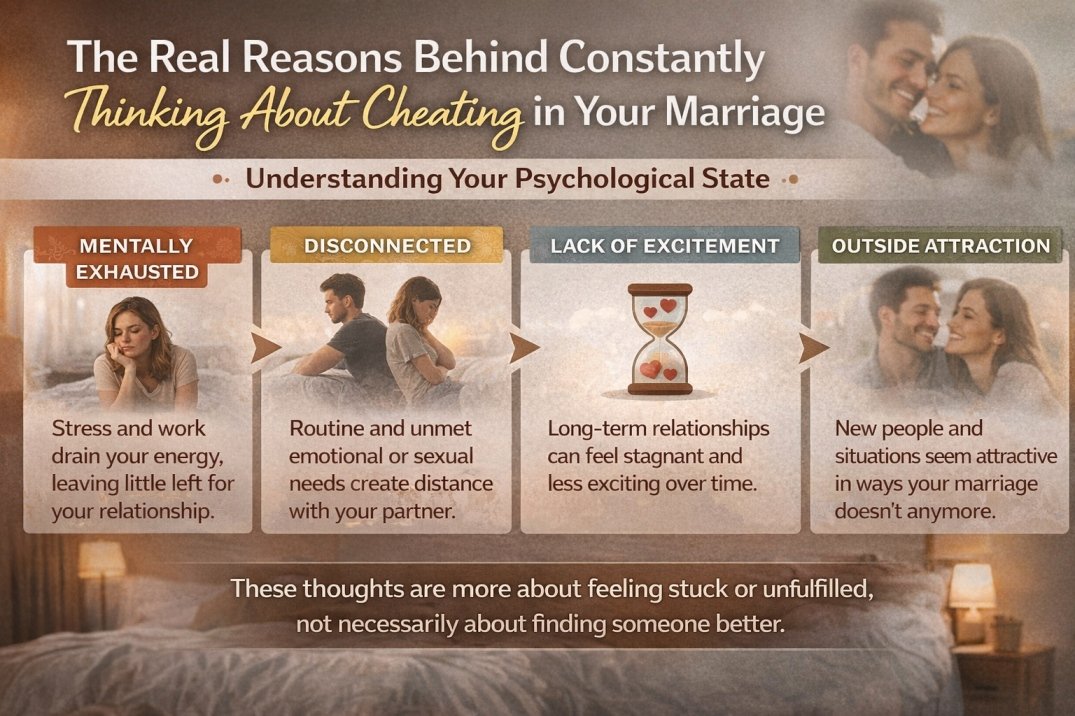
You’re Mentally Exhausted All the Time
Today’s life is already stressful. Office work is demanding, and the person managing the household is dealing with a different kind of pressure every day. When you are mentally exhausted and things are not going well with your partner, your thinking slowly shifts.
You start feeling, “I do so much, but it’s not appreciated.” Instead of understanding each other’s stress, the focus moves towards your own needs and what you’re not getting. That emotional gap makes you more sensitive to anyone who seems to listen, understand, or acknowledge you.
This is where your mind begins to drift. You start thinking about someone who makes you feel heard, respected, or noticed, even in small ways. It’s not always about that person, it’s about how different you feel in that moment.
Fights and Tension Are Killing the Attraction
Repeated arguments don’t just stay in the moment, they linger even when nothing is happening. You can be in the same space with your partner and still feel heavy, irritated, or mentally distant. Your energy drops because you’re always slightly on edge, expecting or avoiding the next conflict.
This slowly affects attraction. When your partner starts feeling like a source of stress, your mind doesn’t move towards closeness or intimacy. Instead, it pulls away and looks for spaces where you feel relaxed and understood.
When you explain things to someone else, they may understand you instantly and respond in a way that feels right. It can make you think, “This is how my partner should have responded.” But they are not part of the situation; they are not carrying the same emotions or history, which makes it easier for them to react calmly and agree with you.
Sex Has Become Predictable or Less Exciting
Many clients describe a similar shift in their sexual life over time. Intimacy starts feeling routine, sometimes even happening right after an argument just to avoid more conflict. You go along with it, but something internally begins to change, your emotional connection, respect, and excitement don’t feel the same.
Over time, it becomes predictable. There is less build-up, less curiosity, and often less attention to each other’s satisfaction. It starts feeling mechanical rather than something you genuinely look forward to, which can leave you feeling disconnected or unsatisfied.
This kind of experience can slowly lead to cheating thoughts. Not because you only want another person, but because you want to feel that energy again, the excitement, the desire, and the intensity you felt in the early days. Your mind starts associating “new” with “better,” especially when your current experience feels repetitive or unfulfilling.
You Don’t Feel Desired or Noticed Anymore
Over time, many people start feeling like they are seen only as a partner or a role, not as an individual. Conversations become functional, appreciation reduces, and small efforts often go unnoticed. You may be present in each other’s lives, but not truly seen or valued in the same way.
This creates a gap where validation is missing. When you don’t feel desired, appreciated, or acknowledged, your mind naturally becomes more sensitive to even small attention from outside. Someone noticing you, listening to you, or showing interest can feel much more impactful than it normally would.
Someone New Feels More Exciting Right Now
Something new naturally feels more exciting because there is no history attached to it. There are no past arguments, no built-up tension, and no expectations to manage. The interaction feels light, easy, and free, which creates an instant pull.
This sense of novelty brings back feelings of curiosity, attention, and sexual energy. Even small conversations can feel more engaging because they don’t carry emotional weight. It’s not always about the person being better, it’s about how different and effortless the experience feels compared to what you’re used to.
Opportunities Are Easier Today Than Ever Before
Today, access is everywhere, through social media, workspaces, messaging, and constant digital interaction. You are exposed to more people, more conversations, and more chances to connect than ever before. This makes it easier for casual interaction to slowly turn into something more personal or engaging.
But it’s important to understand this clearly. Opportunities don’t create these thoughts on their own, they only make acting on them easier. The shift starts internally, based on your current mental and emotional state.
Access doesn’t create desire, it just makes acting on it easier.
How to Deal With Cheating Thoughts Without Ruining Your Marriage
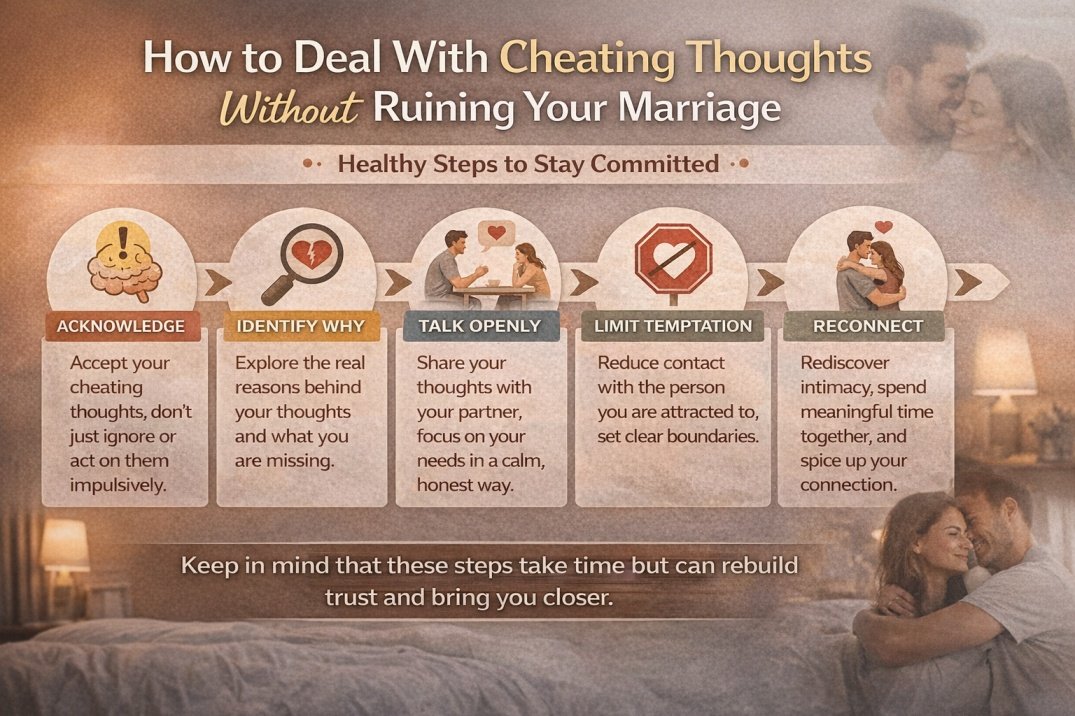
Pause – Don’t Act on Impulse
Cheating thoughts can feel strong in the moment, but they are still just thoughts, not actions. What you feel and what you choose to do are two different things, and that gap is where your control lies.
Most people don’t plan to cheat, it happens when they act in the moment without thinking through the consequences. One decision, taken impulsively, can change your relationship, your trust, and your mental peace in ways that are hard to reverse.
So the first step is simple but important. Pause, don’t react immediately, and give yourself space to understand what you’re actually feeling before doing anything about it.
Be Honest About What You’re Really Missing
Instead of focusing on the person you’re thinking about, focus on what you’re actually feeling. Is it sex, attention, validation, or just a break from stress? When you don’t name it clearly, your mind attaches it to another person, which makes the situation more confusing.
Clarity changes how you respond. Once you understand what you’re missing, you can address it in a more direct and controlled way instead of letting it turn into a distraction or impulse.
Stop Feeding the Attraction
Attraction doesn’t grow on its own, it grows with attention, time, and access. The more you engage, the stronger it feels, even if it started as something small.
Reduce unnecessary closeness and limit interactions that are not needed. Avoid creating private emotional or sexual space, like personal chats, late-night conversations, or sharing things you don’t share with your partner.
Distance doesn’t kill attraction instantly, but it stops it from building further. If you don’t feed it, it gradually loses intensity.
Bring Back Sexual Energy in Your Marriage
Over time, intimacy can become routine and predictable. Instead of focusing only on frequency, focus on changing patterns and bringing back curiosity.
Talk about what you like, what you miss, and what you want to try, whether it’s fantasies, preferences, or simply how you want to feel. Keep it pressure-free, without expectations or performance anxiety so it feels natural and engaging again.
Reduce Daily Friction Between You
Repeated conflicts don’t just stay in conversations; they build a constant layer of tension between you. Small arguments, tone, and unresolved issues slowly affect how you feel around each other. Over time, even normal interactions can start feeling heavy or defensive.
Instead of repeating the same patterns, focus on understanding what keeps triggering these conflicts. It’s not just about solving one argument, it’s about changing how you communicate and respond. When the overall emotional environment becomes calmer, connection and attraction naturally improve.
Reconnect With Yourself, Not Just Your Role
Over time, you can get stuck in roles, partner, parent, provider, and forget your individual identity. When everything revolves around responsibility, your personal energy, confidence, and sense of self start to reduce.
Step out of just being a “partner” and reconnect with what makes you feel like yourself. Your interests, your space, your sense of confidence all matter. When you feel better within yourself, it naturally reflects in how you connect, feel, and show up in your relationship.
When You Should Seek Help Instead of Ignoring It
Sometimes these thoughts don’t just pass, they start becoming frequent, intense, and harder to control. You may feel stuck, mentally exhausted, and pulled in two directions at the same time.
You should consider seeking help if:
- Thoughts are becoming frequent or intense
- You feel close to acting on them
- Emotional or sexual disconnect feels stuck
- Conversations are not improving anything
- You feel divided between control and impulse
In such cases, support can help you regain clarity and control. Online marriage counseling can address ongoing conflict, while individual therapy helps you understand and manage your thoughts better.
Getting help early is easier than repairing damage later.
Final Thought
Cheating thoughts can feel confusing and uncomfortable, but they don’t define you. What matters is how you respond to them, not just that they exist. You still have control over your actions, even if your thoughts feel strong at times.
This phase is more common than people admit, especially when stress, routine, and conflict build up over time. Ignoring it or acting impulsively are both risky, but understanding it gives you a way forward.
You can’t always control what you feel, but you can control what you do next.
FAQs
Why do I keep thinking about cheating in my marriage?
Thinking about cheating in marriage often comes from unmet needs like attention, validation, or excitement, especially when stress, routine, and constant conflict reduce emotional and sexual satisfaction over time.
Is it normal to want to cheat in your 30s?
Wanting to cheat in your 30s is more common than people admit, especially with stress, routine, and exposure to new people, but acting on those thoughts depends on your boundaries and choices.
Do cheating thoughts mean my marriage is failing?
Cheating thoughts do not always mean your marriage is failing, they often reflect stress, disconnection, or unmet needs, and can be addressed before they turn into actions or damage the relationship.
How do I stop sexual thoughts about someone else?
To stop sexual thoughts about someone else, reduce contact, avoid feeding the attraction, understand what you are missing, and focus on managing your thoughts instead of acting on them.
Can a marriage recover from cheating urges?
A marriage can recover from cheating urges if both partners address underlying issues, improve communication, and rebuild connection, especially when action has not been taken and awareness is still present.