
Last Updated on September 25, 2026
You may know that someone is being unfair and even know exactly what you want to say. But once the other person becomes angry, dismissive or forceful, your body may react before you can respond clearly.
Your heart may race, your muscles may tense, and your thoughts may become harder to organise. Instead of saying what you intended, you may stay quiet, agree, apologise or try to end the conversation quickly.
Later, when the interaction is over, everything you wanted to say comes back. You replay the conversation, feel frustrated with yourself and wonder why you could not stand up for yourself when you knew your position was reasonable.
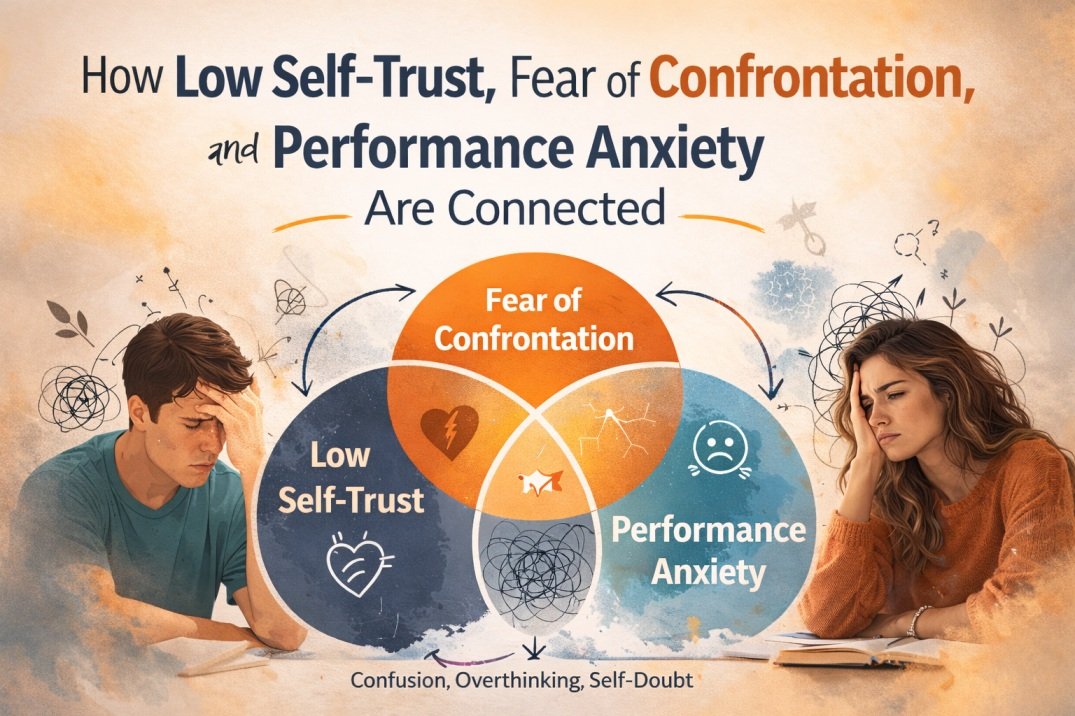
Fear of confrontation is therefore not always a communication problem. For many people, the more important issue is what they expect will happen once another person becomes angry, disappointed or strongly disagrees.
Why Can Confrontation Feel So Threatening?
Most everyday disagreements are not physically dangerous, but rejection, humiliation, criticism, anger and loss of approval can still carry strong emotional meaning.
If confrontation has become associated with these outcomes, your attention may shift away from what you originally wanted to discuss. Part of your mind starts monitoring whether the other person is becoming angrier and how the situation can be brought under control.
You may start worrying about:
- whether you are actually wrong
- whether the other person will shout or become aggressive
- whether you will embarrass yourself
- whether they will reject you
- whether the relationship will be damaged
- whether you will be able to handle what happens next
This can quietly change your goal. You begin the conversation wanting to express your position, but once anxiety rises, the priority becomes ending the tension without making things worse.
Why Does Your Body React Before You Can Think Clearly?
For some people, fear of confrontation is strongly physical. They may notice a racing heart, shaking, muscle tension, sweating, temperature changes, shallow breathing or a strong urge to leave.
Stress can also affect some of the mental functions you need during a difficult conversation. A meta-analysis examining acute stress and executive functioning found that acute stress was associated with poorer working memory and cognitive flexibility.
This may partly explain why several good responses come to mind twenty minutes after an argument, but not while it is happening. During the confrontation, some of your attention may be occupied with monitoring the other person’s tone, expression and possible reaction.
Why Does Your Mind Go Blank During an Argument?
When people say, “My mind went blank,” there may actually be too much happening mentally rather than too little.
You may be trying to listen, prepare an answer, judge whether your answer is acceptable and predict what the other person might do next. At the same time, thoughts such as these may be running in the background:
- “Don’t make this worse.”
- “What if I’m wrong?”
- “What if they get even angrier?”
- “I don’t know what to say.”
- “Just finish this conversation.”
- “Everyone will think I’m difficult.”
When your attention is divided between protecting yourself and explaining yourself, forming a clear response becomes harder. This is one reason rehearsing the perfect argument beforehand does not always solve the problem.
Why Do You Start Doubting Yourself When Someone Pushes Back?
You may enter a conversation fairly certain that a boundary was crossed or something was unfair. But once the other person confidently dismisses your concern, your certainty may fall very quickly.
For example, you think, “That wasn’t okay,” and they respond, “You’re overreacting.” Within seconds, you may start wondering whether you misunderstood the whole situation.
Reconsidering your position is healthy when someone gives you new information. The problem is when you change your position mainly because the other person sounds more certain, becomes angry or appears disappointed.
A useful question is:
Did I change my mind because I learned something new, or because their reaction made me uncomfortable?
That distinction matters when working on self-trust.
Why Does Backing Down Feel Like Relief?
Imagine that somebody keeps pushing during a disagreement. Your anxiety rises, your body becomes uncomfortable and eventually you say, “Okay, fine.”
The other person stops. The conversation settles, and your anxiety drops.
That immediate relief can make the same response more likely next time. Staying quiet, apologising, agreeing or withdrawing may become familiar ways of ending confrontation quickly.
The difficulty is that what reduces anxiety immediately may create regret later. Avoidance ends the discomfort of the moment without necessarily resolving the problem that caused it.
Why Do You Feel Angry With Yourself Afterwards?
Once the confrontation ends, the stress settles and your thinking may become clearer. You realise that you accepted unfair treatment, agreed to something you did not want or failed to express a boundary that mattered to you.
This is when people start replaying the conversation. They think of better answers, imagine how they should have responded and become frustrated that they backed down again.
Over time, the problem can move from “I hate confrontation” to “Why can’t I trust myself to act when something matters?”
How Fear of Confrontation Can Reduce Self-Trust
Self-trust is not simply feeling confident. It also involves believing that you can recognise what matters to you, make a judgement and remain connected to that judgement when somebody challenges it.
Repeatedly abandoning your own position can gradually weaken that confidence. You may begin to:
- ask other people whether your reactions are reasonable
- need reassurance before making decisions
- worry that you are too sensitive
- assume confident people know better
- overanalyse ordinary choices
- hesitate even when you initially know what you want
Eventually, you are no longer only afraid of confrontation. You may start doubting whether your own interpretation of situations deserves to be trusted.
If this has developed into broader doubts about your worth, judgement or ability to handle outcomes, Self-Esteem Counselling can help explore why your confidence has become so dependent on external approval.
Why Do Some People Become Agreeable Instead of Angry?
Not everyone responds to interpersonal pressure by arguing or walking away. Some people become unusually agreeable when they sense that another person is upset.
You may notice yourself:
- apologising very quickly
- saying yes when you want to say no
- softening your complaint
- smiling when you feel uncomfortable
- reassuring the person who upset you
- changing your opinion once they become angry
The internal priority becomes keeping the other person calm rather than making sure your own concern is understood. This is one reason fear of confrontation and people-pleasing can overlap.
It does not always mean you desperately want everyone to like you. Sometimes another person’s disappointment or anger simply feels so uncomfortable that calming them becomes the fastest route out of the tension.
If this is a broader pattern in relationships, People-Pleasing and Boundary Counselling may be more relevant than working on confidence alone.
What Taught You That Disagreement Has Such a High Cost?
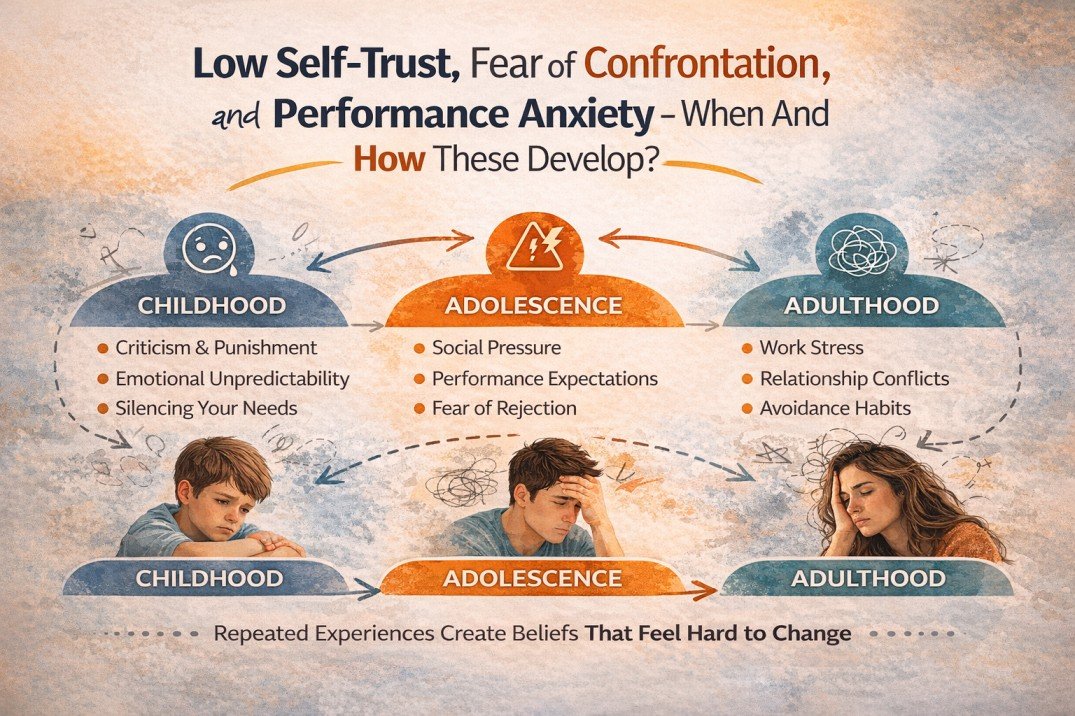
Fear of confrontation does not automatically come from childhood, and it should not automatically be interpreted as trauma. Earlier experiences can, however, influence what you come to expect from disagreement.
For some people, relevant experiences include:
- shouting or explosive conflict at home
- punishment for questioning adults
- ridicule when expressing opinions
- very strict expectations around obedience
- unpredictable reactions to mistakes
- needing to keep another person calm
- bullying or humiliation
- controlling relationships
- hostile or intimidating workplaces
The same pattern can therefore develop at very different stages of life. What matters is not only when it began, but what you came to expect from disagreement after those experiences.
A useful question is: What do I expect will happen if I disagree and refuse to back down?
Your answer may involve anger, rejection, humiliation, punishment, losing the relationship or simply feeling unable to cope with the other person’s reaction.
Why Can You Confront Some People but Not Others?
Many people who describe themselves as afraid of confrontation are not equally afraid in every situation. They may disagree comfortably with friends but become almost unable to speak around a parent, manager or dominant partner.
Notice what changes with that person:
- Do they have authority over you?
- Do you depend on them financially or emotionally?
- Does their approval matter more?
- Do they raise their voice?
- Have they humiliated you before?
- Are their reactions unpredictable?
- Are you afraid the relationship could end?
If your anxiety changes dramatically depending on who you are speaking to, the problem may not be general confidence. The stronger trigger may involve power, approval, emotional history or what that person’s reaction represents to you.
Why Is It Easier to Express Yourself Over Text?
Some people can write a clear message setting a boundary but struggle to say exactly the same thing face-to-face. This does not necessarily mean they lack communication skills.
Written communication removes several pressures at once. You do not have to watch an angry expression, hear a raised voice, deal with interruptions or produce an answer immediately.
You also have time to organise your thoughts. If you communicate clearly through messages but struggle during live conflict, real-time interpersonal pressure may be disrupting skills you already have.
What Actually Needs to Change?
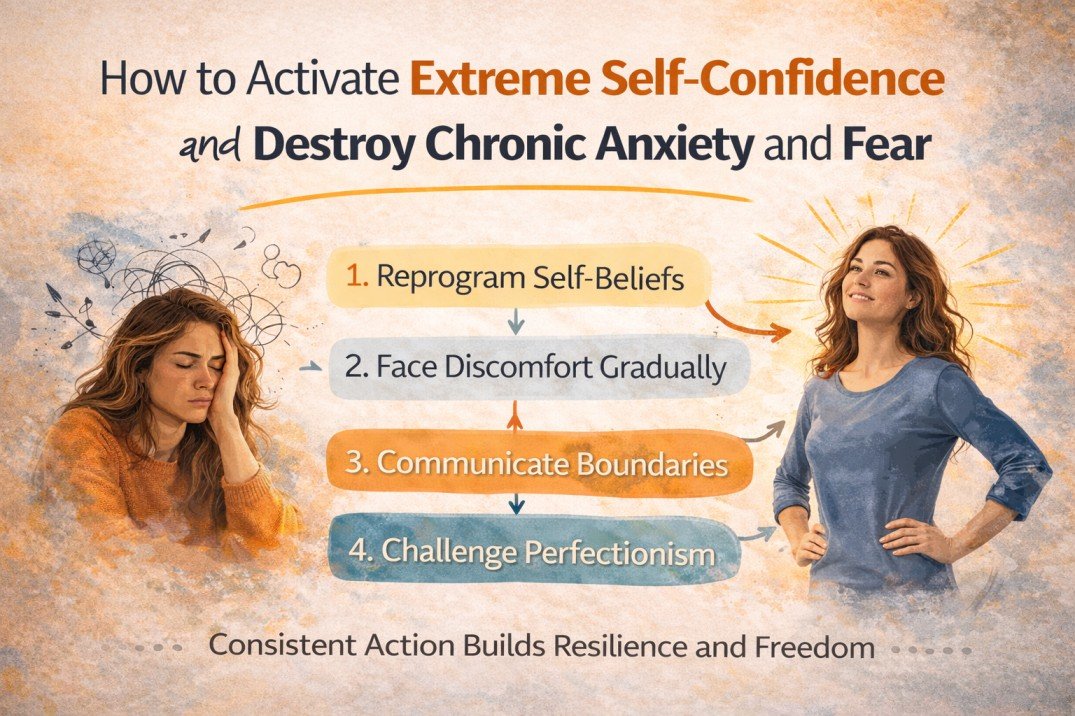
The goal is not to become fearless or to enjoy arguments. It is learning to remain connected to your own judgement while somebody else is unhappy with it.
Three psychological shifts are particularly important:
- Another person’s anger is not proof that you are wrong. Someone can dislike your boundary and the boundary can still be reasonable.
- Immediate relief is not always a good outcome. Agreeing may reduce anxiety for thirty seconds while leaving you resentful for several days.
- Being wrong is survivable. Self-trust does not mean believing every judgement you make is correct. It means knowing you can deal with the outcome if you make a mistake.
That is different from simply trying to tell yourself to “be more confident.”
How Is Self-Trust Rebuilt?
Self-trust develops through experience. Each time you make a reasonable decision, tolerate another person’s disagreement and deal with what happens next, you collect evidence that you can rely on yourself.
Sometimes you will discover that you were wrong. Being able to reconsider, apologise or change your position is healthy and does not mean your original judgement should never have been trusted.
The important difference is whether you change your mind after evaluating the situation or abandon your position automatically because another person’s reaction became uncomfortable.
What Can Help When Your Body Reacts Strongly?
When confrontation produces intense anxiety, understanding your personal sequence is often more useful than memorising assertive phrases.
For example:
- Trigger: Someone raises their voice.
- Body: Your heart races and muscles tense.
- Thought: “Don’t make them angrier.”
- Response: You apologise even though you disagree.
- Immediate result: Anxiety drops.
- Later result: You feel angry with yourself.
Once you recognise the sequence, the first goal is not to make the anxiety disappear. It is to create a small gap between feeling anxious and automatically doing whatever usually ends the discomfort.
If your usual response is to apologise, agree or withdraw, try delaying that response rather than immediately following it. You might say, “I need a moment to think about that,” or “I don’t want to answer this immediately.”
The confrontation may still feel uncomfortable. The difference is that anxiety has not made the decision for you before you have had time to think.
If intense physical arousal or emotional shutdown is central to the problem, Online Emotional Regulation Therapy can help you work on how you respond under interpersonal stress.
How Therapy Works With Fear of Confrontation
Good therapy should do more than teach you to say no. Two people can both remain silent during confrontation while having completely different reasons for doing it.
A psychologist may explore:
- what kinds of people or situations trigger you
- what you predict will happen if you speak
- what happens physically during disagreement
- which thoughts appear automatically
- what behaviour reduces your anxiety
- what you think about yourself afterwards
- whether earlier experiences shaped your expectations of conflict
This allows therapy to focus on the process maintaining the fear rather than treating every person as though they simply lack assertiveness.
For one person, the central issue may be fear of anger. For another, it may be rejection, self-doubt, people-pleasing, past experiences or intense difficulty tolerating another person’s disappointment.
When Fear of Confrontation Starts Affecting Your Life
Disliking conflict does not automatically mean something is psychologically wrong. It becomes more important to address when fear repeatedly changes decisions that genuinely matter to you.
Professional support may be useful if you:
- cannot protect important boundaries
- repeatedly accept unfair treatment
- say yes when you strongly want to say no
- avoid opportunities involving authority or leadership
- cannot raise important problems in relationships
- experience intense physical anxiety during disagreement
- frequently need reassurance that your judgement is reasonable
- understand the pattern but still cannot change your response
At this point, the issue is no longer simply that you dislike confrontation. It is beginning to affect how much control you have over your work, relationships and decisions.
Final Thoughts
You may already know how to stand up for yourself. The difficulty may begin only when another person becomes angry, dismissive or forceful and ending the discomfort starts feeling more urgent than staying connected to your own judgement.
This can explain why you back down during confrontation and then feel disappointed in yourself afterwards. Repeated often enough, the pattern can gradually weaken self-trust.
Changing it does not mean becoming aggressive or fearless. It means learning that disagreement, another person’s disappointment and even the possibility of being wrong can be tolerated without automatically abandoning your own position.