At LeapHope, many people tell us they have not slept for days. Some cannot sleep for three nights. Some say it has been a week or more. They feel very tired, but sleep does not come.
When they lie down, their mind becomes very active. It starts thinking about one thing again and again. This may be a future event, a person, a problem, a fight, or something that feels out of control. The thoughts do not stop.
Their body also feels tense. Many people feel their heart beating fast. Some feel tightness in the chest or stomach. Breathing may feel shallow. The body feels restless, even though they are exhausted.
If sleep happens, it is light and broken. People wake up often or wake early. In the morning, they still feel tired, foggy, and drained.
After a few nights like this, daily life becomes hard. It is difficult to focus, work, or make decisions. Mood may change quickly, or feelings may seem numb. Many people start to worry about bedtime because they expect the same problem again.
In this article, you’ll understand why your mind spins out of control at night, why the cycle keeps repeating, and how to calm it in a way that actually works, not by forcing sleep, but by helping your brain finally feel safe enough to rest.
Why Overthinking Gets Worse at Night
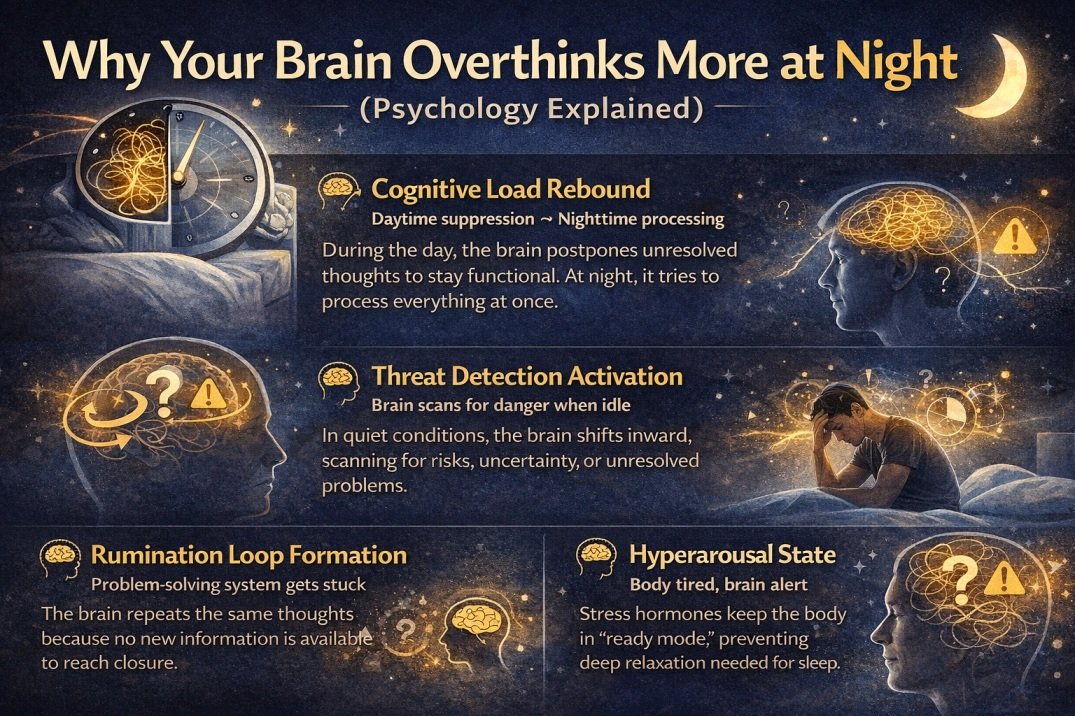
During the day, your mind stays busy with work, people, and daily tasks. At night, everything becomes quiet, and your brain finally has space to focus on worries, problems, or unfinished thoughts. If stress is already high, your mind may become more active instead of calming down.
Below are some main reasons why your overthinking and anxiety get worse when you lie down to sleep:
Busy Daytimes Leave No Space to Process
During the day, life moves very fast. You have work, office tasks, people, calls, messages, and responsibilities. The day fills up quickly, and before you notice, it is already evening. Even your free time often goes into social media, scrolling, or other distractions.
Because everything is so busy, there is little time to sit quietly and think about what you feel. Worries about a person, a big project, family issues, or important decisions get pushed aside so you can keep functioning.
When you finally lie down at night, the distractions stop. Your mind suddenly turns back to that same issue, and your heart may start racing. Thoughts become loud because the brain now has space to process what was ignored during the day.
Suppressed Stress Turns Into Mental Pressure
The trigger is usually something important in your life right now. It may be a big decision, work or business pressure, a project, promotion, travel, family responsibility, health concern, or anything that feels uncertain or high-risk. During the day, you stay busy, so the brain pushes this stress aside to keep you functioning.
But the brain does not forget unfinished problems. It keeps them in the background and connects them with past experiences of failure, loss, danger, or instability. This makes the situation feel more serious and urgent.
When the outcome is unknown, the brain tries to predict what could happen. It runs many possible scenarios to prepare for risk. Negative outcomes are checked first because the brain is built to protect you.
At night, when there are no distractions, this process becomes stronger. Because the problem cannot be solved at that moment, the brain keeps searching for answers, which keeps the body alert and makes sleep difficult.
The Mind Becomes Obsessed With Finding Closure That Doesn’t Exist Yet
At night, the brain tries to finish problems that feel incomplete. It goes over the same situation again and again, looking for a clear answer or a way to feel safe. This may include replaying conversations, reviewing decisions, imagining different outcomes, or trying to understand what will happen next.
The brain is designed to look for certainty. When something important is unclear, it keeps analyzing to reduce risk. It may predict future scenarios, check for mistakes, or try to understand other people’s actions.
But many real-life problems cannot be solved immediately. Decisions, results, and other people’s choices take time. Since no final answer is available at night, the brain does not stop. It repeats the same thinking cycle, hoping that more analysis will produce closure.
This repeated mental activity keeps the mind active and prevents sleep, even when the body is exhausted.
You Become Both the Question and the Answer
At night, overthinking often turns into asking yourself the same questions again and again. Your mind tries to solve the problem on its own, so it keeps thinking about what might happen, what you should do, and what could go wrong.
Because there is no new information at night, the brain cannot reach a final answer. So it repeats the same thoughts, checks the same possibilities, and doubts its own conclusions. This keeps the overthinking cycle going.
Since nothing interrupts this process, the mind stays active instead of calming down. The body remains alert, which makes falling asleep very difficult.
Your Body Is Tired, But Your Stress System Is Still Active
Sleep happens when the body feels safe and calm. But when you are stressed or overthinking, the body may stay in alert mode even if you are very tired.
Your heart may beat faster, muscles stay tight, and breathing may feel shallow. The body acts as if it needs to stay awake to deal with something important. This happens because stress hormones are still high.
So even though your body is exhausted, your nervous system is not ready for sleep. You lie in bed tired but alert, which makes it hard to switch off and fall asleep.
Why It Feels Like You “Overthought All Night”
Even if you slept for some time, your brain may not have reached deep, restful sleep. When stress and overthinking are high, the brain stays in a semi-alert state instead of fully switching off. This is called a hyper-alert mode, where the body is tired but the mind remains active.
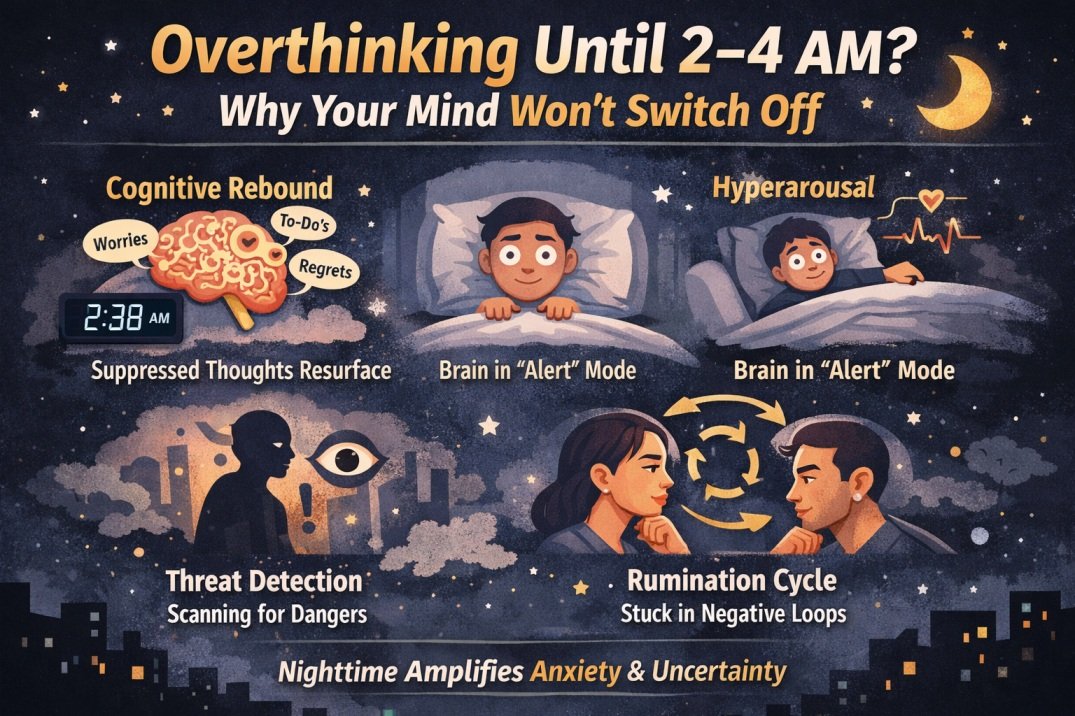
Many people cannot fall asleep until very late, often 2 AM, 3 AM, or even 4 AM. This happens because the brain needs to calm down before sleep can start. If stress hormones are still high, the brain delays sleep to stay “ready,” even when you feel exhausted. Some people remain awake the entire night for the same reason.
When sleep finally comes, it is often shallow and easily disturbed. The brain continues processing problems in the background, sometimes through repetitive dreams or sudden awakenings. You may wake up already thinking about the same issue, as if the mind was working the whole night.
Because deep recovery sleep is reduced, the body and brain do not reset properly. Morning feels like a continuation of the night rather than a fresh start. This leads to fatigue, brain fog, low focus, and a feeling that you never truly rested.
According to the NHS, stress, anxiety, and life problems are among the most common causes of insomnia.
How You Feel the Next Day After a Night of Overthinking
The next day does not feel normal, even if you slept a little. Some people wake up feeling strangely active, as if they slept deeply, but there are gaps in memory. They may not clearly remember parts of the morning, what they ate, how they reached work, or tasks they completed. This happens because the brain was fatigued and not processing information properly.
Others feel mentally overloaded, as if their mind is carrying something heavy. Thinking becomes slow, focus is weak, and simple decisions feel difficult. The brain has not fully recovered from the night.
Emotional control is also reduced. Some people become very sensitive, irritable, or unusually emotional. Others feel numb, detached, or empty. Motivation drops, and normal activities require much more effort.
Physical stress may continue as well. The heart may still beat faster than normal, the body feels tense, and energy levels are unstable. This happens because stress hormones remain elevated even after waking.
Overall, the brain and body are still in recovery mode, which makes it hard to function normally throughout the day.
Why Nighttime Overthinking Repeats Night After Night
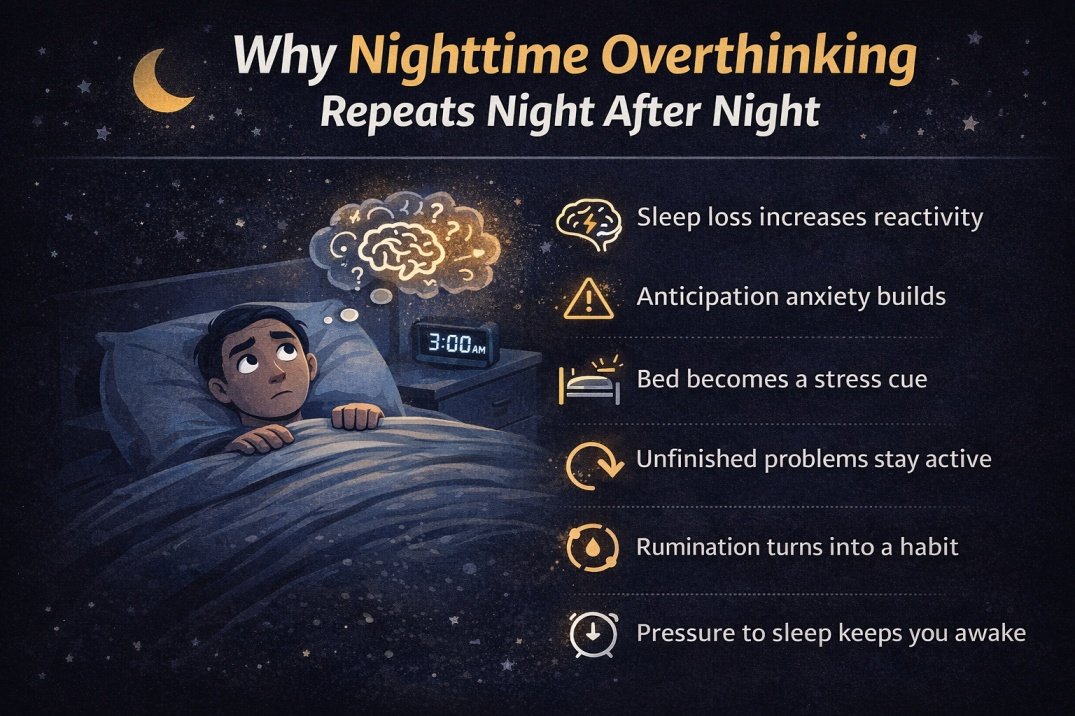
Once this pattern starts, it can continue even if the original problem has not changed. Poor sleep affects how the brain works, which makes the next night harder, creating a repeating cycle.
Exhaustion Makes Your Brain More Vulnerable
Lack of sleep weakens important brain functions. It becomes harder to control emotions, think clearly, handle stress, and judge situations accurately.
When you are exhausted, small concerns can feel much bigger and more threatening. The brain reacts faster to negative thoughts and has less ability to calm itself. This makes overthinking easier to trigger at night.
You Begin to Fear Night Itself
After several difficult nights, the brain starts expecting the problem to happen again. As evening approaches, worry about sleep may increase.
Thoughts like “What if I can’t sleep tonight?” create anxiety before you even go to bed. This anticipation activates the body’s stress response, making relaxation harder.
Your Brain Learns That Bed Means Threat
Over time, the brain forms an association between the bed and stress. If many nights are spent worrying and struggling to sleep, the bed itself becomes a trigger.
When you lie down, the body may automatically enter alert mode, heart rate rises, muscles tense, and the mind becomes active. Instead of signaling rest, the bed signals danger or problem-solving time, which keeps the cycle going.
How to Break the Night Overthinking Cycle
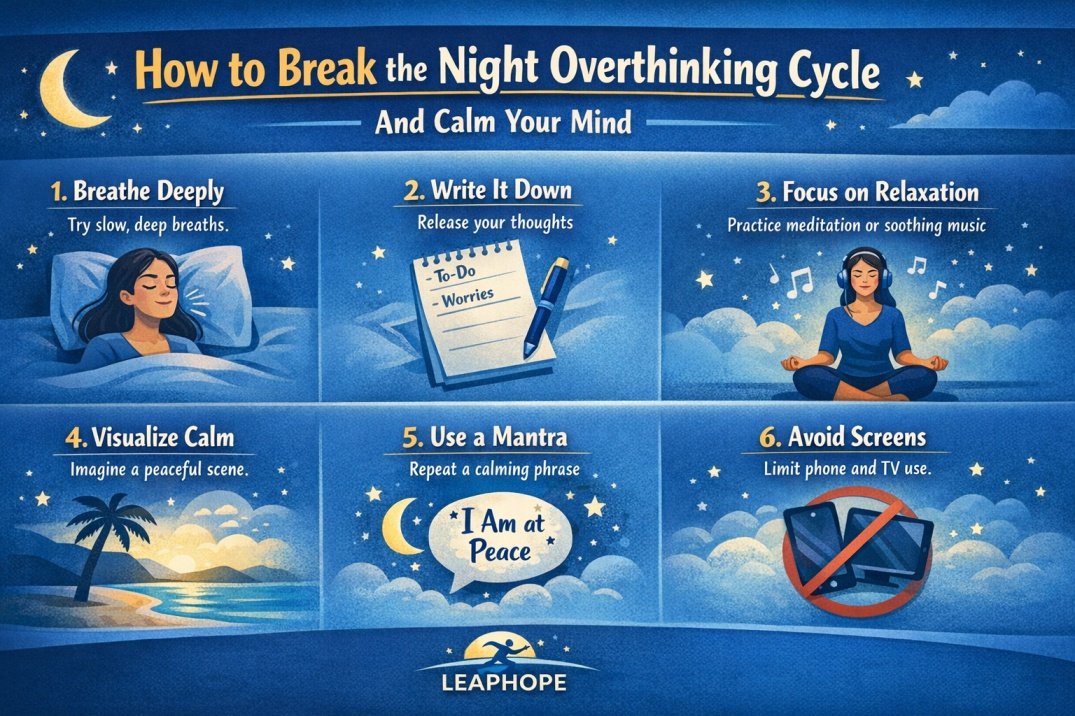
Accept That You Cannot Solve Important Problems at 2 AM
At night, the brain is tired and more emotional. It tends to exaggerate risks and miss useful solutions. Trying to solve serious issues at this time usually creates more confusion, not clarity.
Remind yourself that nothing important needs to be decided right now. For example, if you are worrying about a job decision, a relationship problem, or a financial issue, you can tell yourself: “I will think about this tomorrow when my mind is clear.”
This reduces the false urgency that keeps the brain working. Once the mind knows the problem is postponed, it becomes easier to disengage.
Give Your Brain a Place to Process During the Day
If worries are never addressed, the brain brings them up at night. Creating a specific time during the day to think about problems can prevent this buildup.
You can write your thoughts in a notebook, review upcoming tasks, or talk to someone you trust. For example, spending 10–15 minutes in the evening listing what is worrying you and what actions (if any) can be taken tomorrow can reduce nighttime rumination.
When the brain learns that problems will be handled during the day, it feels less need to process them while you are trying to sleep.
Calm the Body to Quiet the Mind
Overthinking at night is often driven by physical stress, not just thoughts. If the body is tense and alert, the mind will remain active.
Focus on calming the body first. Slow breathing, warm showers, stretching, or lying under a comfortable blanket can signal safety. For example, breathing in slowly for four seconds and out for six seconds can reduce heart rate and tension.
When the body relaxes, the brain receives a signal that it is safe to sleep.
Interrupt the Loop Instead of Trying to Win It
Arguing with your thoughts usually keeps them active. The goal is not to solve the problem but to break the cycle.
You can shift attention to something neutral and repetitive, such as listening to a calm podcast, counting breaths, or focusing on physical sensations like the feeling of the mattress or blanket. Some people find it helpful to get up briefly and read something light in dim light until they feel sleepy again.
These actions give the brain a different focus, allowing the overthinking loop to lose strength.
Remove the Pressure to Sleep
Trying too hard to sleep can increase anxiety. When you worry about the clock or the consequences of not sleeping, the body stays alert.
Replace the goal of “I must sleep now” with “I will rest, even if sleep comes later.” Resting quietly still helps the body recover.
Many people notice that sleep arrives more easily once they stop forcing it.
Rebuild Night as a Safe Time, Not a Stressful One
If many nights have been difficult, the brain may associate bedtime with worry and struggle. Rebuilding a sense of safety takes consistency.
Create simple, predictable routines before bed, such as dimming lights, avoiding stimulating content, and doing calming activities at the same time each night. Gentle self-talk can also help, such as reminding yourself that night is for rest, not problem-solving.
Over time, these repeated signals teach the brain that nighttime is safe again, reducing automatic alertness.
What NOT to Do When You Can’t Sleep Because of Overthinking
- Drinking alcohol to force sleep
- Scrolling social media or watching videos
- Checking messages, emails, or work apps
- Blaming or criticizing yourself
- Replaying the problem on purpose
- Watching the clock repeatedly
- Lying in bed tense for hours
- Taking caffeine, nicotine, or energy drinks
- Googling scary health information
- Trying to force sleep
When to Seek Support
If this cycle continues for weeks or months, professional help can make recovery easier and faster. You do not have to struggle alone.
Consider seeking support if:
- Sleep problems persist despite trying self-help strategies
- Daytime functioning becomes difficult
- Work, studies, or daily responsibilities are affected
- Panic, low mood, or trauma-related symptoms appear
- You feel constantly overwhelmed or unable to cope
An online clinical psychologist can help identify the underlying causes, reduce anxiety, and teach effective techniques to calm the mind and body. At LeapHope, our psychologists provide confidential online counselling tailored to sleep-related stress and overthinking.
Final Thoughts
Many people tell us the same thing: their mind keeps returning to one specific issue, a person, a painful event, an upcoming situation, or an uncertain outcome. Even when they try not to think about it, the thoughts keep coming back and new scenarios keep forming.
This happens because the brain focuses on what feels unresolved or unsafe, not on everything happening in life. You may have many responsibilities and problems, but the mind often locks onto the one area where you feel least certain or least in control.
Overthinking is not a sign of weakness or lack of discipline. It is the brain’s attempt to predict risk and protect you. Unfortunately, this process becomes unhelpful when it continues without resolution, especially at night.
With time, awareness, and the right support, this cycle can be reduced. Your mind can learn to let go, your body can return to a calmer state, and normal sleep can come back.