You’d be surprised how often this comes up in counselling. People don’t use the term micro-cheating at first. They usually come in with a simple question about their partner’s behaviour.
“My partner is talking to someone else more than usual.” “I found messages that felt too personal.” “It’s not cheating, but something doesn’t feel right.”
When we explore it further, it usually comes down to two different concerns. Either they are trying to understand if their partner crossed a line. Or they are questioning if they themselves did something wrong.
Some situations are very clear. Physical intimacy outside a committed relationship is generally considered cheating. Most couples agree on that.
But things become complicated in the grey areas. Texting, flirting, sexting, or even emotional sharing with someone else can mean different things to different people. One partner may see it as harmless, while the other sees it as a breach of trust.
This is where confusion builds. There is no single rule that applies to every relationship. Boundaries are often unspoken, and assumptions don’t always match.
A simple way to look at it is this. If something is being hidden, or you would feel uncomfortable doing it in front of your partner, it has likely crossed a line. Whether you call it cheating or not, it still affects trust.
What Is Micro-Cheating?
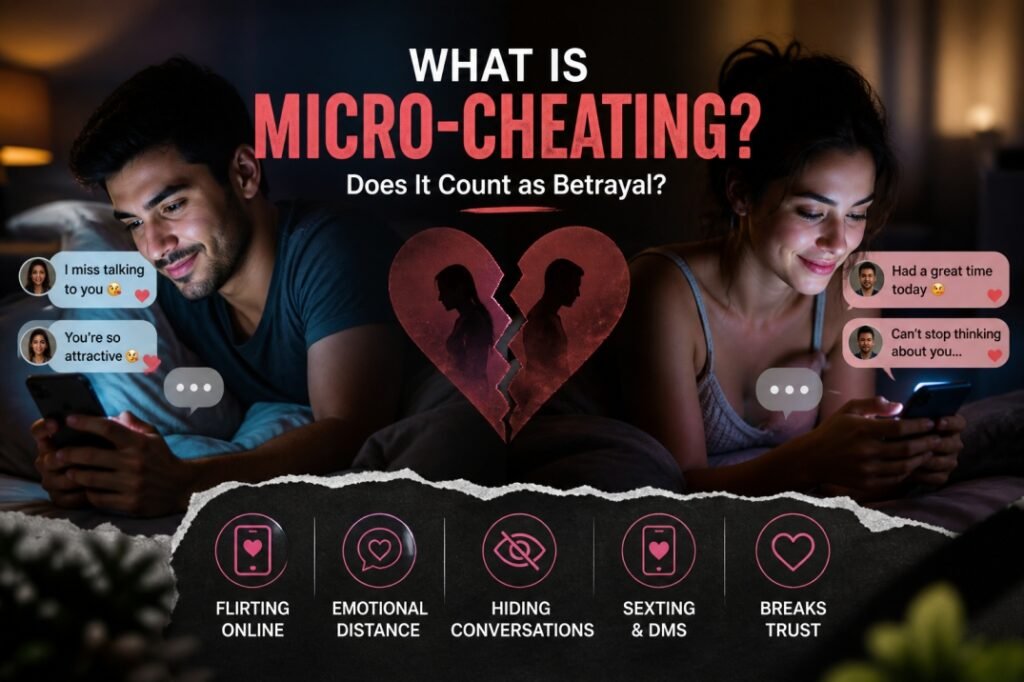
Micro-cheating refers to small, repeated behaviours that fall into a grey area of a relationship. These actions may not involve physical intimacy, but they indicate attention, interest, or emotional investment outside the relationship.
Common examples include texting someone you’re attracted to without your partner knowing, staying connected to an old flame and checking their profile regularly, or presenting yourself as “basically single” in certain situations. It can also involve sharing personal thoughts or emotional struggles with someone else while keeping that connection hidden.
Individually, these behaviours may seem minor. But what connects them is not the act itself; it is the pattern of secrecy and selective disclosure. There is usually an awareness that the full extent of the interaction would not feel comfortable if the partner saw it.
This is why micro-cheating sits in a grey zone. It is not defined by a single behaviour, but by a gradual shift in boundaries. Over time, these small actions can weaken trust by creating a secondary channel of attention and emotional connection outside the relationship.
How Micro-Cheating Differs From Emotional and Physical Cheating
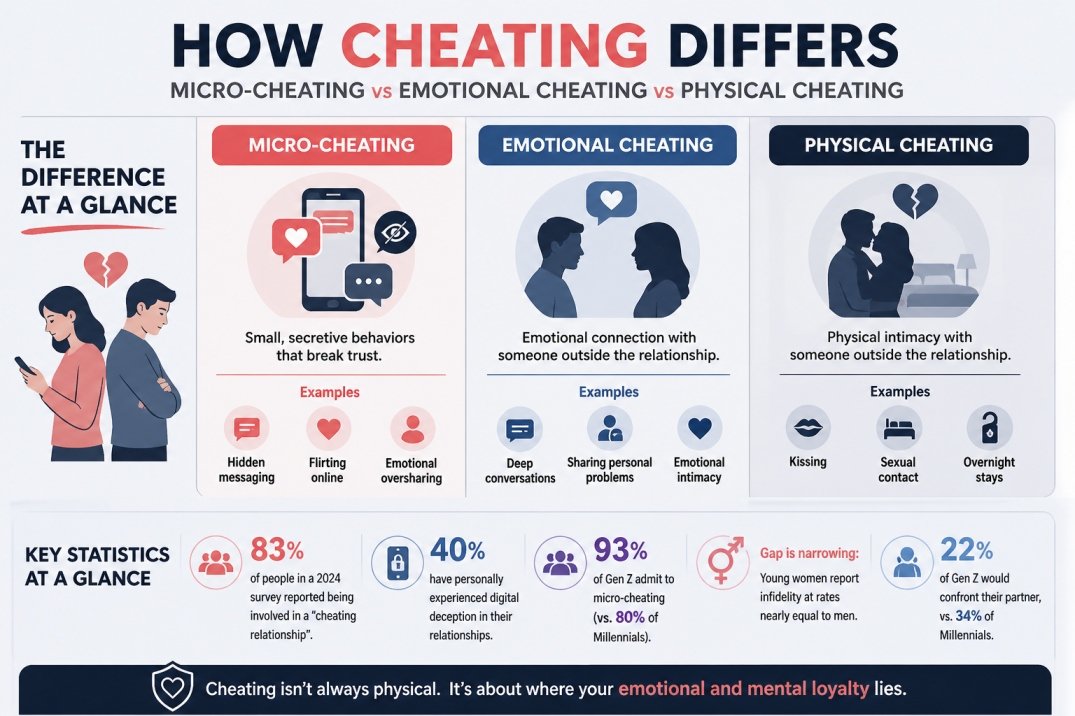
Micro-cheating, emotional cheating, and physical cheating exist on a continuum. The difference lies in emotional involvement and boundary crossing.
| Type | What It Involves | Impact | Visibility | Where It Commonly Happens |
|---|---|---|---|---|
| Micro-Cheating | Subtle, repeated behaviours involving hidden attention or low-level emotional engagement | Builds gradually over time | Hidden or explained as harmless | Frequent chats on WhatsApp or Instagram, replying to the same person’s stories, repeated interactions, casual DMs, workplace conversations becoming more personal |
| Emotional Cheating | Consistent emotional reliance, sharing personal thoughts, seeking validation outside the relationship | High emotional disconnection | Felt strongly, often denied | Long chats, late-night conversations, frequent calls, emotional sharing through messaging apps, workplace or close social connections |
| Physical Cheating | Physical intimacy outside the relationship | Immediate breach of trust | Clear and undeniable | Offline meetings, often initiated through social media, dating apps, or workplace connections |
Micro-Cheating
What it involves: Subtle, repeated behaviours involving hidden attention or low-level emotional engagement
Impact: Builds gradually over time
Visibility: Hidden or explained as harmless
Where it happens: WhatsApp, Instagram, DMs, repeated interactions, workplace conversations
Emotional Cheating
What it involves: Emotional reliance, sharing thoughts, seeking validation outside
Impact: High emotional disconnection
Visibility: Felt strongly, often denied
Where it happens: Calls, long chats, messaging apps, workplace connections
Physical Cheating
What it involves: Physical intimacy outside the relationship
Impact: Immediate breach of trust
Visibility: Clear and undeniable
Where it happens: Offline meetings via apps or workplace
Key insight: In most modern relationships, these patterns begin digitally.
What Counts as Micro-Cheating? (Real-Life Examples)
Micro-cheating includes small behaviours that don’t look like full cheating, but still cross emotional or trust boundaries. In today’s digital environment, most of these behaviours happen through phones, social media, and constant online interaction.
Here are common examples of micro-cheating:
- Secret texting or chatting with someone your partner doesn’t know about
- Flirting in DMs on Instagram, Snapchat, or other social media
- Using dating apps “just to browse” or keeping an active profile
- Repeatedly talking to the same person and building a connection over time
- Late-night chats or calls that are kept private
- Sharing personal problems or emotional details with someone else instead of your partner
- Deleting messages or hiding conversations
- Staying in touch with an ex and interacting regularly online
- Liking, reacting, or engaging consistently with someone you’re attracted to
- Presenting yourself as single or avoiding mentioning your relationship
- Trying to impress or get attention from someone outside your relationship
These behaviours may seem small individually. But when they are repeated, hidden, or emotionally meaningful, they start affecting trust.
👉 Micro-cheating is less about one action and more about a pattern of attention and connection that shifts outside the relationship.
Does Micro-Cheating Count as Betrayal, Even If Nothing Physical Happened?
Yes, it can. Micro-cheating often becomes a form of betrayal when it involves secrecy or emotional attention shifting outside the relationship.
It depends on boundaries and honesty between partners. But if a behaviour creates doubt, insecurity, or emotional distance, it is already affecting trust.
👉 If it has to be hidden, it usually crosses a line.
Why People Engage in Micro-Cheating
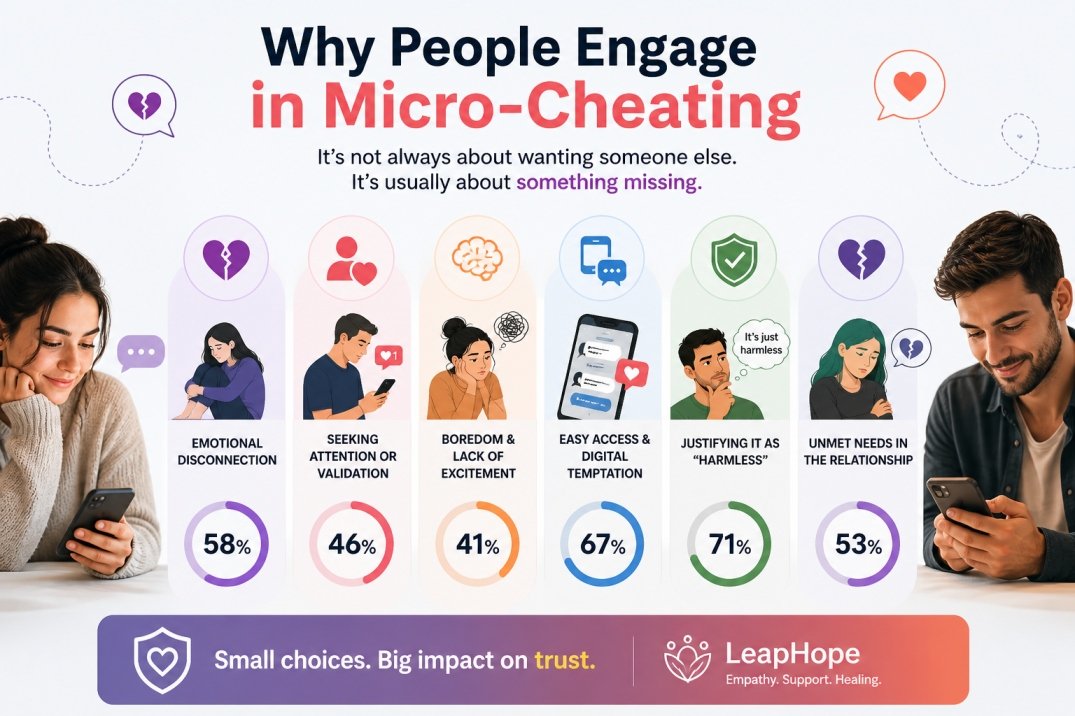
Micro-cheating usually doesn’t happen randomly. It often reflects something missing, avoided, or unresolved in the person or the relationship.
Common reasons include:
- Seeking validation or attention – enjoying the feeling of being noticed, desired, or appreciated
- Emotional gaps in the relationship – looking elsewhere for connection, support, or understanding
- Avoiding conflict – turning to someone else instead of addressing issues directly
- Curiosity or excitement – wanting novelty without fully committing to crossing a line
- Low self-esteem or insecurity – needing reassurance from outside the relationship
- Unclear boundaries – not knowing what is acceptable and testing limits
In some cases, deeper patterns also play a role. People who fear abandonment may seek backup connections, while others may create distance to avoid feeling too emotionally involved.
👉 Micro-cheating is often less about intention and more about what the person is trying to feel, avoid, or replace.
The Mental and Emotional Impact of Micro-Cheating on the Faithful Partner
Micro-cheating doesn’t create one clear moment. It creates ongoing uncertainty, and that starts affecting both how you think and how you feel.
- You start overthinking small details and trying to make sense of them
- Your mind stays alert, looking for patterns or signs
- You feel uneasy, even when you can’t fully explain why
- You begin questioning yourself: “Am I overreacting?”
- Your sense of security in the relationship starts to shift
- You may feel less valued or no longer like the priority
Over time, it’s not just about your partner’s behaviour.
It’s about how it changes your mental clarity and emotional safety in the relationship.
👉 You’re not overreacting, you’re responding to inconsistency and uncertainty.
What Micro-Cheating May Reveal About Your Relationship
Micro-cheating is often less about one behaviour and more about what it reflects underneath the relationship.
- Unmet emotional needs
- Lack of connection or growing distance
- Weak or unclear boundaries
- Communication gaps or avoided conversations
These patterns usually point to deeper issues rather than a single mistake.
👉 Micro-cheating is often a symptom, not the root problem.
In many cases, these issues can be addressed through open conversations or with the support of a online relationship therapist at LeapHope, helping both partners understand what’s really missing and how to rebuild trust.
How to Address Micro-Cheating Without Escalating Conflict
Focus on clarity and small, practical changes rather than confrontation.
- Pause before reacting – don’t raise it in the heat of the moment
- Have one calm, direct conversation – keep it specific, not a list of complaints
- Say how it affects you – “I feel uneasy when messages are hidden” works better than accusations
- Address digital boundaries clearly – what’s okay with DMs, late-night chats, exes, or dating apps
- Limit habits that create distance – reduce unnecessary phone use, avoid private late-night conversations, and keep interactions transparent
- Agree on simple boundaries together – consistency matters more than strict rules
- Focus on understanding, not blaming – look at the pattern, not just the incident
The goal is not to control your partner, but to rebuild clarity, trust, and emotional safety in the relationship.
If conversations keep going in circles or trust feels difficult to rebuild, seeking support through online therapy for psychological concerns or online marriage counselling for relationship issues can help you both address the deeper patterns without escalating conflict.
Final Thought
Micro-cheating may seem small, but it isn’t harmless. Over time, it can quietly affect trust, attention, and emotional connection in a relationship.
It’s easy to focus on labels, whether something “counts” as cheating or not. But what matters more is what the behaviour is doing to the relationship.
👉 It’s not just about whether it’s cheating.
It’s about whether it’s changing your relationship in ways you can’t ignore.