

Many people share this concern in counselling sessions. They struggle with interview anxiety, and it often starts days before the interview. They feel tense, restless, and unable to relax.
During the interview, their mind goes blank. They know the answers but cannot find the right words or tone. This makes them feel stuck and unsure of what to say next.
Their confidence drops quickly in that moment. They may stop speaking, rush their answers, or lose their flow. This experience feels frustrating and confusing.
We hear this from people in the USA, UK, India, and other high-pressure environments. It is not limited to one country or profession. It is a common psychological response to evaluation and pressure.
This article explains the real psychology behind this. It also helps you understand why your mind reacts this way. Then we look at how you can overcome it.
What Interview Anxiety Actually Feels Like in the Moment
Interview anxiety is a form of performance-based stress. It happens when the brain sees evaluation as a threat. This affects both the body and thinking.
Common physical symptoms include increased heart rate, sweating, dry mouth, and muscle tension. Some people may also notice a shaky voice or slight nausea. These are normal stress responses.
Common mental symptoms include blanking out, racing thoughts, and difficulty focusing. You may struggle to organise your answers or recall information. You may also speak too fast or lose your flow.
You may feel slightly disconnected or not fully present. Your mind may go blank during questions even when you know the answer. You may also become very self-conscious while speaking.
There may be a strong urge to finish quickly or escape the situation. This can lead to rushed or incomplete answers. It reduces your ability to respond calmly.
This is not a lack of ability. This is a nervous system response.
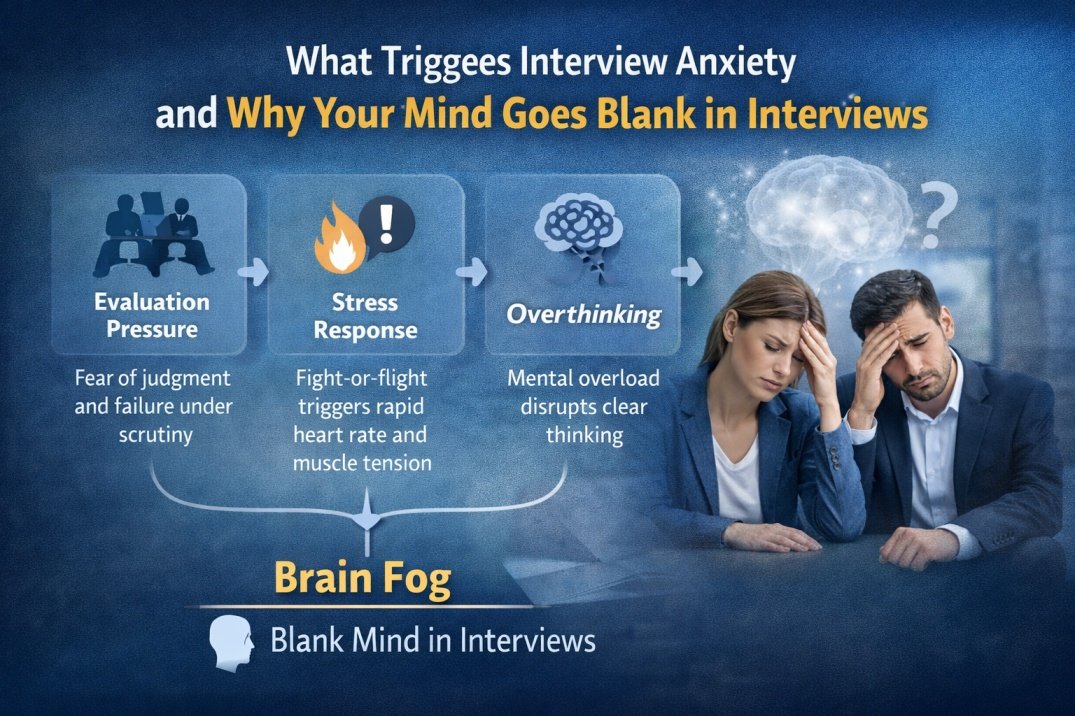
What Triggers Interview Anxiety and Why Your Mind Goes Blank in Interviews (The Psychology Behind It)
Anticipatory Anxiety
Some people notice that anxiety starts before the interview day. This can happen because the brain naturally tries to predict and prepare for uncertain situations. Interviews involve unknown outcomes, which can increase sensitivity to uncertainty in some individuals.
In some cases, this combines with an overthinking pattern. The mind keeps running through possible questions, outcomes, or mistakes in an attempt to feel prepared. This repeated mental simulation can activate stress even before the interview begins.
As this continues, the body may start responding as if the situation is already happening. You may feel tense, distracted, or mentally tired in advance. This early activation can make it harder to stay calm and think clearly during the interview.
Performance-Based Evaluation Anxiety
An interview involves being observed and evaluated. For some people, this can feel like a test of their ability rather than a conversation. This may be stronger in those who have experienced high expectations or frequent criticism.
Because of this, the focus may shift from expressing ideas to avoiding mistakes. You may start filtering your responses too much or holding back what you want to say. This can reduce confidence and interrupt natural communication.
Over time, this pattern increases internal pressure. You may second-guess your words or hesitate before speaking. This makes it harder to respond clearly in the moment.
Self-Focused Attention (Internal Monitoring)
Under pressure, some people become more aware of themselves. They may start noticing their voice, expressions, or how they are coming across. This is more common in those who are sensitive to how others perceive them.
When attention shifts inward, less attention is available for the question. Part of the mind is thinking, while another part is monitoring performance. This divides mental resources.
As a result, thinking becomes slower and less organised. You may lose track of your answer or struggle to build it clearly. This contributes to the feeling of going blank.
Cognitive Overload
Interviews require you to think, recall, and respond at the same time. For some people, especially those who tend to overthink or aim for perfect answers, this can create too many thoughts at once. The brain may struggle to manage all of this together.
Working memory has limited capacity. When too many processes compete, it cannot organise or hold information effectively. This disrupts the flow of thought.
Because of this, you may know what you want to say but cannot structure it properly. This leads to pauses, confusion, or a blank mind.
Attentional Control Disruption
Some people find it difficult to maintain stable focus under stress. Their attention may shift between the question, their internal thoughts, and their anxiety. This can happen more in those who feel easily overwhelmed in high-pressure situations.
This reduces the ability to stay with the question and build a clear response. You may lose track of what you were saying or where you were going. The answer becomes fragmented.
Over time, this pattern affects confidence. You may start expecting that you will lose focus again. This expectation can further disrupt attention during the interview.
Emotional Dominance Over Cognitive Processing
In stressful situations, emotional responses can become stronger than logical thinking. For some people, especially those who experience emotions intensely, this shift can happen quickly. The body reacts before the mind can organise a response.
When this happens, reasoning and structure are reduced. You may respond reactively instead of thoughtfully. This makes it harder to express ideas clearly.
As emotional intensity increases, thinking becomes narrower. This limits your ability to generate or organise answers effectively.
Conditioned Stress Response
Some people develop anxiety around interviews over time. This can happen after stressful experiences or repeated exposure to high-pressure situations. In some cases, it may also come from indirect learning, such as hearing about negative experiences.
The brain begins to associate interviews with discomfort. This creates an automatic response that activates even before the interview starts. The reaction becomes faster and stronger.
Because of this, the same pattern may repeat. You may feel anxious early and struggle again during the interview. This reinforces the cycle of anxiety and blanking out.
What Is an amygdala hijack and Why It Happens in Interviews
An amygdala hijack happens when the brain’s threat detection system reacts faster than your thinking system. In an interview, being observed and evaluated can be interpreted as a social threat. This rapid detection can activate before you consciously process the situation.
Once triggered, the brain shifts priority from thinking to protection. This activates the fight-or-flight response, preparing the body for action rather than reasoning. Physical changes like increased heart rate and shallow breathing begin automatically.
In this state, access to memory and structured thinking becomes limited. You may know the answer but find it hard to retrieve or organise it clearly. Thinking becomes narrower and more reactive instead of flexible.
This is why your mind may feel blank during interviews. The brain is temporarily focused on safety, not performance. This response is automatic and does not reflect your actual ability.
Why Interview Anxiety Happens Even When You’re Well Prepared
Preparation builds knowledge, but performance depends on your mental state. In calm conditions, you can recall and organise answers easily. Under stress, this access changes.
This is known as state-dependent performance. When anxiety increases, the brain does not function the same way as it does during practice. The conditions are different, so retrieval and expression are affected.
Perfectionism can make this worse for some people. You may try to give the perfect answer instead of a clear and simple one. This adds pressure and slows down thinking.
Anxiety can also override logical thinking. Even if you know the answer, the stress response reduces access to memory and clear reasoning. Knowing something and being able to express it under pressure are not the same.
Because of this, you may feel prepared but still struggle during the interview. The issue is not knowledge, but access under stress. This is why your mind can go blank despite preparation.
Does This Happen to You in Public Speaking or Other Situations Too?
Many people experience anxiety like a racing heart, body numbness, and a blank mind during college events such as public speaking, presentations, or speaking in front of a group. This can feel intense even in simple situations where attention is on you.
When you start avoiding these situations, the brain learns to treat them as a threat. Avoidance may give short-term relief, but it strengthens the fear response over time. The mind and body begin to associate speaking in front of others with danger.
Because of this, the same response can show up in interviews later. The brain applies the same threat response to any situation where you are being observed or evaluated. This is why you may feel the same anxiety in interviews.
Some people also experience this in office meetings or social situations. Being asked to speak suddenly can trigger the same reaction. This shows that the response is linked to evaluation and attention, not just interviews.
Why Even Smart and Capable People Experience This
This has nothing to do with intelligence. You may be highly intelligent, a topper, or someone average in academics, and still experience this. Interview anxiety is not linked to how much you know.
It is linked to how your mind responds to evaluation and pressure. Some people are more sensitive to being observed and judged. This sensitivity can affect performance in the moment.
High self-awareness can increase self-monitoring. Perfectionism and overthinking can add pressure while answering. High expectations can make the situation feel more important than it is.
All of this increases mental load and reduces clarity under stress. This is why capable people may still struggle in interviews. It is not incompetence, it is sensitivity to evaluation.
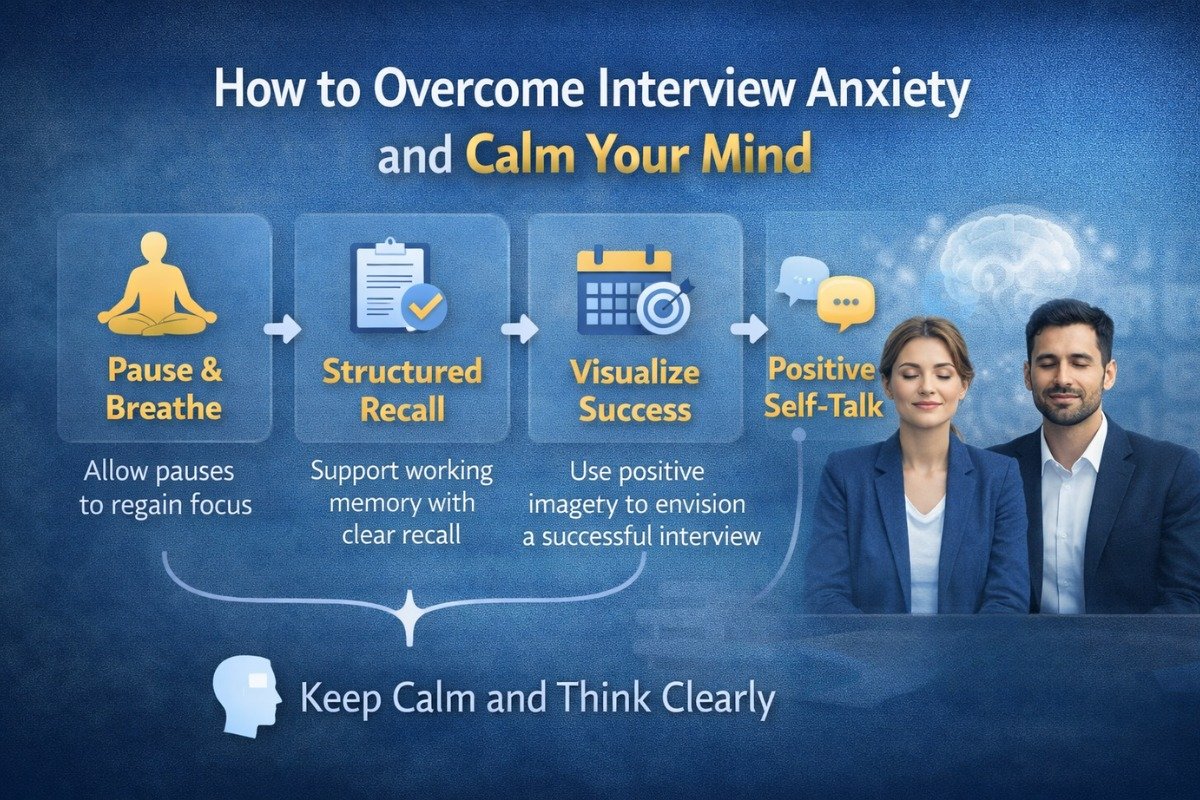
How to Overcome Interview Anxiety – A Psychological Approach
Regulate the stress response before trying to think clearly
When anxiety rises, the brain shifts into a threat state. In this state, memory access and clear thinking reduce. Trying to “think better” without calming the body usually does not work.
Start with slow breathing, around 4–6 breaths per minute, for a few minutes before the interview. Keep your exhale slightly longer than your inhale. Relax your shoulders and jaw to reduce physical tension.
This helps lower the fight-or-flight response and improves access to thinking. Once the body is calmer, your ability to recall and organise answers improves.
Reduce anticipatory activation, not just preparation
Preparation is useful, but repeated mental rehearsal can increase anxiety. When the brain keeps revisiting the event, it starts treating it as an ongoing threat. This leads to early fatigue and tension.
Set a clear boundary for preparation time. For example, prepare once or twice, then stop active thinking about it. If thoughts return, gently redirect your attention to something else.
This reduces anticipatory anxiety and prevents unnecessary stress build-up. You enter the interview with more mental energy and less background tension.
Lower the need to perform perfectly
Perfectionism increases pressure and slows thinking. When you try to give the perfect answer, your brain keeps filtering and correcting itself. This interrupts natural speech.
Shift your goal from “perfect answer” to “clear and relevant answer.” Allow yourself to speak in simple, structured sentences. Accept that small pauses or minor imperfections are normal.
This reduces cognitive load and helps your thinking stay active. You respond more naturally and with better flow.
Shift attention outward to improve processing
When attention turns inward, part of your mental energy goes into monitoring yourself. This reduces the capacity available for thinking and responding. It also increases self-doubt.
Train your attention to stay on the question and the conversation. Listen fully, and focus on understanding what is being asked. Let your response build from that, instead of checking how you sound.
This improves processing speed and clarity. You become more engaged in the conversation rather than stuck in self-observation.
Use structured recall to support working memory
Under stress, working memory becomes less reliable. You may know the answer but struggle to organise it. This creates pauses or incomplete responses.
Use simple frameworks like situation → action → result. Keep your answers in clear steps instead of trying to explain everything at once. This reduces the load on memory.
Structured recall helps you stay organised even under pressure. It supports smoother thinking and clearer communication.
Allow pauses to restore cognitive control
Many people rush because silence feels uncomfortable. This increases mistakes and confusion. Rushing also keeps the brain in a reactive state.
Take a brief pause before answering. Use that time to organise your thoughts into simple points. This helps regain control over your response.
Pauses improve clarity and reduce overload. They also make your communication more structured and confident.
Build tolerance through gradual exposure
Avoidance strengthens anxiety over time. When you avoid speaking situations, the brain continues to treat them as threats. This makes future reactions stronger.
Start with low-pressure situations like speaking with a friend or recording yourself. Gradually move to more challenging situations such as mock interviews or group discussions.
This helps retrain the brain to feel safer in evaluation situations. Over time, the stress response reduces and thinking becomes more stable.
Improve emotional regulation under pressure
Some people experience a rapid rise in emotional intensity during interviews. This can quickly interfere with thinking and speech. Managing this response is important.
Notice early signs like increased heart rate or tension. Use grounding techniques such as focusing on your breath or your physical surroundings. This helps stabilise your state.
Better emotional regulation allows you to stay functional under pressure. It supports clearer thinking and more controlled responses.
These strategies focus on changing how your mind and body respond under pressure. The goal is not to remove anxiety completely, but to stay clear and functional even when some anxiety is present.
When to Seek Professional Help for Interview Anxiety
Consider professional help if you notice:
- Anxiety starting days before the interview
- Mind going blank repeatedly despite preparation
- Strong fear of judgment or rejection
- Avoiding interviews or speaking situations
- Overthinking that you cannot control
- Similar anxiety in meetings or public speaking
A psychologist can help you identify your triggers and change how your mind and body respond. You learn to regulate stress, improve focus, and respond more clearly under pressure. You also practise real scenarios in a safe, structured way.
If you are looking for psychological support, you can explore online therapy with LeapHope. It allows you to work on these patterns from anywhere, at your own pace.
FAQs
Why does my mind go blank during interviews?
Your mind goes blank during interviews because the brain activates a stress response under pressure. This reduces access to memory and clear thinking. You still know the answer, but cannot retrieve it easily in that moment.
Is interview anxiety normal?
Interview anxiety is normal and experienced by many people. It is a natural response to evaluation and pressure. It becomes a concern only when it starts affecting performance or confidence repeatedly.
How do I stop freezing during interviews?
To stop freezing during interviews, focus on calming your body first. Slow breathing, brief pauses, and simple answer structures help reduce pressure. Shifting attention to the question instead of self-monitoring also improves thinking.
Can therapy help with interview anxiety?
Therapy can help with interview anxiety by addressing underlying patterns like fear of judgment, overthinking, and stress responses. It helps you regulate your nervous system and improve performance under pressure. With consistent work, the response becomes more manageable.