
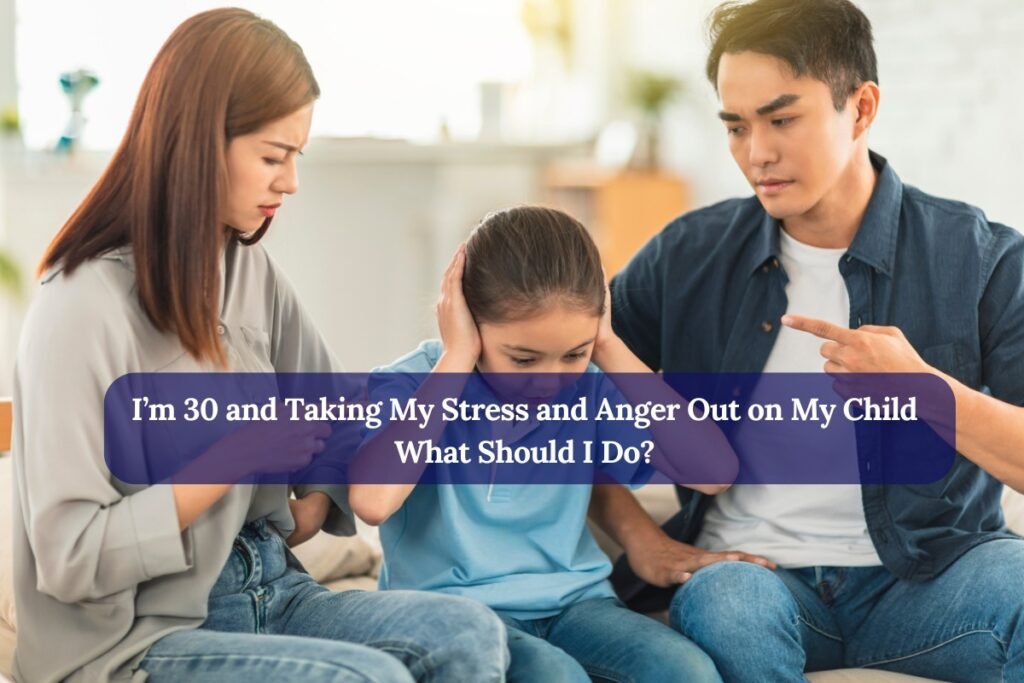
“I take out my stress and anger on my child. I know kids cry, throw tantrums, make a mess; it’s normal. But when it happens, I suddenly shout at my son as if he’s done something terrible. Later I feel awful. He still comes back to me for hugs and love, even after I’ve scolded him so much. I want to be a calm, loving parent and give my children a good upbringing… but I don’t know how to stop.”
– A 30-year-old parent during an online counselling session
If this sounds familiar, you are not alone and you are not an uncaring parent. Many educated, working parents know their young child’s behaviour is normal, yet still react far more strongly than they intend to in the moment. A small mistake, loud crying, or refusal to listen can trigger an outburst that feels bigger than the situation itself.
What makes it especially painful is what comes afterward: the guilt, the worry about your child’s feelings, and the question of why you lost control when you love them so much. The fact that you are concerned is actually a hopeful sign. It means your empathy is intact and you want to do better.
This pattern is less about love and more about overload – stress building up with nowhere to go, then spilling out at home. The good news is that once you understand what’s happening, you can learn to interrupt it and respond differently.
Why You End Up Taking Your Stress Out on Your Child
If you’re around 30, raising a young child, and juggling work, home, finances, and relationships, your day likely leaves you with very little energy by evening. You may genuinely want to be patient and gentle but your emotional reserves are already depleted.
So when your child cries, refuses to cooperate, spills something, or creates more work, the reaction can feel much bigger than the situation. This isn’t because you don’t understand your child. It’s because your system has been under pressure all day with no real recovery time.
Stress Spillover: When Adult Pressure Comes Out at Home
For many young parents, stress comes from everywhere at once.
A mother may be exhausted from office work, commuting, and household responsibilities. A father may be carrying pressure about job performance, finances, or unresolved life issues. By the time you are with your child, your mind and body are already stretched thin.
When your son throws toys, cries loudly, or makes another mess, it can feel like one demand too many. The frustration released at that moment is often not about the child, it is the overflow of everything that came before. Children become the outlet simply because they are present and emotionally safe.
Emotional Flooding: Your Thinking Brain Temporarily Shuts Down
In the moment you snap, your body shifts into a stress response. Muscles tense, breathing shortens, and your voice rises automatically. The part of the brain that helps you pause and think clearly becomes less active, while reactive impulses take over.
This is why you may say things you don’t truly mean or react as if the situation is far more serious than it is. Once the surge passes, clarity returns and so does the guilt.
You Know Better But You Don’t Have the Bandwidth
Many educated parents feel confused because they know children’s behaviour is normal. You may believe in calm parenting and genuinely want to practise it.
But emotional regulation requires energy, not just understanding. When you are sleep-deprived, overstimulated, or mentally overloaded, your ability to use those skills drops sharply. The knowledge is still there, your capacity isn’t.
Why Small Incidents Become the “Last Straw”
The anger is rarely about the spilled drink or the refusal to listen. It’s about an already overloaded system reaching its limit.
By your early thirties, that load often includes work pressure, financial concerns, relationship strain, constant multitasking, and lack of personal time. When your child adds another demand, especially loudly or repeatedly, it can feel like, “I cannot handle one more thing.”
Later, when calm returns, you may wonder why you reacted so strongly. In reality, it wasn’t about that single moment. It was the release of pressure that had been building all day.
Why Even Educated, Working Young Parents Can Lose Control at Home
Many parents in their early thirties feel they should be able to stay calm. You’re responsible, capable at work, and deeply committed to your child so losing your temper at home can feel confusing and shameful.
But this stage of life often brings intense, overlapping pressures. You’re building a career while raising a young child, managing finances, running a household, and maintaining relationships, often with little practical support. Your brain is constantly switching between roles and decisions from morning to night.
Chronic multitasking, sleep deprivation, deadlines, childcare responsibilities, and the invisible mental load of home life leave very little space to recover. Many young families also lack extended family help, so real breaks are rare.
On top of that, modern parents place high expectations on themselves to “do everything right.” When there is no downtime, stress accumulates faster than it can be released.
In simple terms, many young parents aren’t failing; they’re exhausted.
👉 You’re running adult responsibilities on an empty nervous system.
You Shout, Feel Terrible After, Promise to Change, Then It Happens Again
Many parents get stuck in a painful loop they don’t know how to break. Stress builds quietly throughout the day, work pressure, responsibilities, fatigue, worries that never fully switch off. By the time you’re with your child, your tolerance is already low.
Then something small happens: a mess, loud crying, refusal to listen, another demand when you’re exhausted. Your reaction is much bigger than the situation; you shout, snap, or become harsh.
Almost immediately, regret sets in. You may feel guilty, ashamed, or worried about how your child felt. Thoughts like “I’m a terrible parent” or “Why did I do that again?” can take over. You promise yourself you will stay calm next time.
But guilt is exhausting too. Instead of restoring your energy, it drains it further. So when the next stressful moment comes, often very soon, you have even less patience available. Another outburst happens, followed by more regret, and the cycle continues.
Understanding this pattern is important because shame alone does not stop the behaviour. In fact, it often makes change harder by leaving you emotionally depleted.
Are You Damaging Your Child? What Research Actually Shows
After losing your temper, it’s common to worry you may have harmed your child emotionally. The reassuring news is that occasional outbursts do not automatically cause lasting damage.
What matters most is the overall emotional climate at home. Children tend to do well when they experience warmth, safety, and affection most of the time. Research shows that the greatest risk comes from chronic hostility and lack of repair, not isolated incidents. When parents reconnect, apologise, and restore a sense of safety, it helps children recover and maintain trust.
In fact, repair after conflict is a key protective factor. It teaches children that relationships can survive strong emotions and that love is still secure. Studies on parent-child attachment consistently show that being “good enough” and responsive over time matters far more than being perfect (see Harvard University’s Center on the Developing Child)
This doesn’t mean shouting has no effect, but it does mean you have far more power to protect your child than guilt might suggest. A generally loving relationship, combined with efforts to change, is strongly protective.
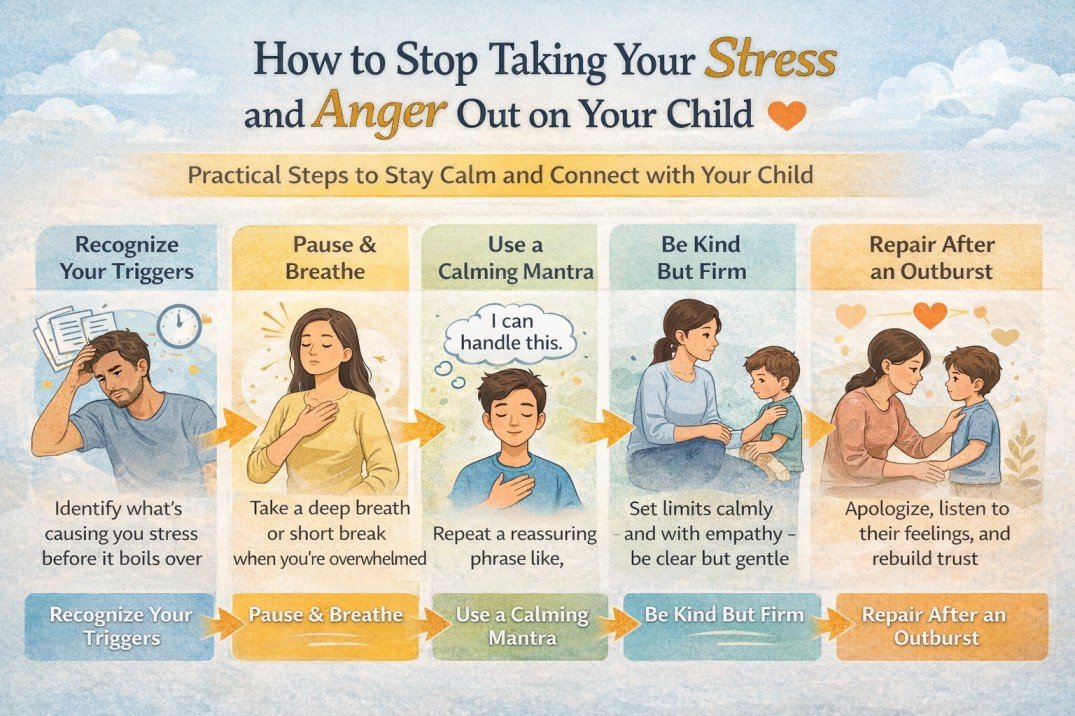
How to Stop Taking Your Stress and Anger Out on Your Child
For many parents around 30, especially those balancing work and caregiving, anger at home is not deliberate; it is an overflow response. A psychologist would focus on regulating the surge itself, not analysing or solving life circumstances in that moment.
The aim is to bring the nervous system back within a manageable range so your reactions don’t escalate.
Below are clinically grounded, in-the-moment regulation steps that reduce the intensity of anger and stress before it spills onto your child.
Regulate Your Body First, Not Your Thoughts
When anger spikes, reasoning alone does not work because the thinking brain is partially offline.
Clinical techniques:
- Slow your exhale (longer out-breath than in-breath)
- Drop your shoulders and unclench your jaw deliberately
- Press your feet firmly into the floor or chair
- Relax your hands instead of pointing or gripping
These actions signal safety to the nervous system and reduce physiological arousal.
Create Immediate Physical Space Without Emotional Withdrawal
A small increase in distance reduces intensity without abandoning the child.
- Take one or two steps back
- Turn slightly sideways instead of face-to-face
- Sit down if you are standing
- Place your hands on a stable surface
Physical repositioning lowers the likelihood of escalation.
Slow the Pace of Everything You Do
Anger accelerates movement, speech, and breathing. Deliberately slowing counters the stress response.
- Speak more slowly than feels natural
- Move your body in controlled, deliberate motions
- Pause before each sentence
- Avoid rapid gestures
Slowing the body helps slow the emotional surge.
Narrow Your Focus to the Present Moment
Overload comes from “everything at once.” Clinically, reducing cognitive load restores control.
- Focus on one object, sound, or action
- Give one simple instruction at a time
- Ignore non-urgent problems temporarily
- Mentally say: “Only this moment matters right now.”
This prevents cascade reactions.
Use Neutral, Low-Intensity Language
Tone matters more than content when emotions are high.
Examples:
- “Stop. I need a moment.”
- “Wait.”
- “We’ll talk in a minute.”
Short phrases prevent impulsive speech while maintaining authority.
Discharge Excess Activation Safely
The body often needs a small outlet for adrenaline.
- Press palms together firmly
- Push against a wall or countertop
- Tighten then release major muscle groups
- Take several strong exhalations
This reduces the urge to release tension through shouting.
Lower Sensory Input
Noise, visual chaos, and movement intensify reactivity.
- Reduce background sound if possible
- Soften your gaze rather than staring intensely
- Turn slightly away from overwhelming stimuli
- Simplify the environment temporarily
Less input allows the brain to stabilise.
Re-Engage Once Your Voice and Body Feel Steadier
Do not resume interaction at peak activation.
Signs you are regulated enough:
- Breathing has slowed
- Voice feels controllable
- Muscles are less tense
- Urge to shout has decreased
Even partial calming significantly reduces harmful reactions.
Core Psychological Principle
👉 Anger outbursts are driven by physiological overload, not lack of love or knowledge.
👉 Regulation works by calming the body first, which allows the thinking brain to come back online.
For many mothers and fathers in their early thirties raising young children, these micro-interventions are far more effective than trying to “stay calm” through willpower alone.
Small reductions in activation can prevent stress from overflowing onto the child and protect the relationship in that moment.
What to Do After You’ve Shouted at Your Child
First, calm yourself before going back. If your voice is still tense, your child will feel it. Take a few breaths, wash your face, or sit for a minute. Then approach gently.
Go close, get to their eye level, and speak softly. You don’t need perfect words, just honest ones.
You can say things like:
“Sorry, I shouted. That was too loud.”
“I got very angry. That was my mistake.”
“I shouldn’t have spoken like that.”
“You didn’t deserve that.”
“I’m sorry. I love you.”
Reassure them they are not bad:
“You’re not a bad boy.”
“I was upset, not angry at you.”
“I still love you.”
If they come close, offer a hug or sit with them. If they don’t, stay nearby so they feel safe.
Repair after anger shows your child that even when things go wrong, the relationship is still secure.
When to Consider Professional Support
If you’re trying to change but still feel stuck, professional support can help. Reaching out is not a failure, it’s a step toward protecting both you and your child.
Individual counselling with an online clinical psychologist at LeapHope is useful when the anger feels hard to control, outbursts are becoming frequent, or guilt and exhaustion linger afterward. It is especially helpful if stress is affecting your sleep, mood, work, or overall wellbeing. The focus is on helping you regulate your reactions and reduce the internal pressure that leads to overflow.
Sessions involving your child may be recommended if your relationship has become tense, your child seems fearful, withdrawn, or unusually clingy, or communication between you feels strained. In such cases, guided interaction can help rebuild safety, trust, and connection in a structured way.
You don’t need to wait for a crisis. Early support often prevents patterns from deepening and helps both parent and child feel calmer and more secure.
Final Thoughts
Losing your temper does not make you a bad parent. It usually means you are overwhelmed and exhausted. Your guilt is not weakness. It shows you care.
Children don’t need perfect parents. They need safe ones most of the time. They need repair when things go wrong. Every small change matters. A pause. A softer voice. A sincere apology. These moments build security.
Change takes practice, not perfection. You can learn new responses. If you want to do better, you already are moving in the right direction.
FAQs
Why do I get so angry at my child even though I love him?
You get so angry at your child even though you love him because you are overwhelmed, not because you don’t care. Stress, exhaustion, and mental overload reduce your patience, so normal child behaviour can trigger a stronger reaction than you intend. The guilt you feel afterward shows your love is still present.
How can I stop shouting at my child when I’m stressed?
You can stop shouting at your child when you’re stressed by pausing as soon as you feel anger rising. Step back, lower your voice, and give yourself a few seconds before speaking. Short phrases like “I need a minute” help you avoid reacting in the heat of the moment.
Will my child remember me yelling?
Your child may remember you yelling if it happens frequently, but occasional yelling is unlikely to cause lasting harm. Children are more affected by ongoing patterns than by single incidents. If you reconnect, comfort them, and maintain a loving relationship, the negative impact is much lower.
How do I apologise to my child after losing my temper?
You can apologise to your child after losing your temper by keeping it simple and sincere. Say something like, “I’m sorry I shouted. That was my mistake. I love you.” Speak calmly, get to their level, and offer comfort if they want it. This helps your child feel safe again and rebuilds trust.