

A 34-year-old man booked an online counselling session with our psychologist and said:
“I’m 34, too lazy to do anything, just drinking and using substances. Can I rebuild my life again?”
He described a daily routine of low energy, poor sleep, doing only essential work, then drinking or using substances at night. Mornings came with guilt and regret. By evening, he was back in the same pattern.
He said comparisons were painful. People his age were moving forward in careers and relationships, while he felt left behind.
He had tried to change many times. He would cut down, make plans, start fresh. It lasted a few days, then he slipped back into the same routine. Each attempt made him feel worse about himself.
He had not given up, but he did not know what to do next.
Many men in their 30s are in a similar situation. And no, 34 is not too late. People rebuild their lives at this age and beyond.
Why You Feel Stuck Even When You Want to Change
Many people around 35 don’t lack desire to change. They think about it often. The problem is the way change is attempted, and the state of mind and body at that time.
You try to fix everything at once
Once you decide to improve your life, you plan a full reset, better sleep, strict routine, quitting substances, exercise, career focus, healthier habits. It works briefly. Then it starts to feel overwhelming and unsustainable. A few missed days turn into stopping completely, and you end up back where you started.
You are already burned out by everyday life
Work pressure, family responsibilities, financial concerns, and constant demands add up over years. Nothing dramatic, just continuous output without real recovery. When you are already tired, adding more effort feels impossible, even if the changes are positive.
Low mood quietly reduces your drive
Not always severe depression, but enough to slow you down. Thinking, planning, and decision-making feel heavier than they should. You keep postponing action, telling yourself you will start properly when you feel better or have more energy.
Stress and substances lower your baseline
Poor sleep, alcohol, or other substances reduce next-day energy, patience, and self-control. You wake up already below your normal capacity, so ordinary tasks feel harder and long-term goals feel out of reach.
Your system has adapted to comfort and relief
If avoidance, distraction, or quick coping methods have been used for a long time, your brain becomes used to escaping discomfort instead of tolerating it. When you try to push yourself suddenly, resistance shows up quickly.
You don’t know how to start in a sustainable way
Many people begin with visible changes, intense workouts, new business plans, strict routines, learning many new things at once. These look productive but don’t build the basics first: sleep, energy, emotional stability, and consistency. Without that foundation, the plan collapses under normal daily stress.
Change usually fails not because you don’t want it, but because the starting point demands more energy than you currently have. Rebuilding capacity comes before rebuilding life.
Laziness or Something Deeper? Understanding What’s Really Happening
Many adults call themselves “lazy” because it feels like the only explanation. But very different problems can produce the same outward behaviour, low energy, postponing things, staying in comfort zones. If you don’t identify the real cause, you may keep using the wrong solution.

- True rest vs avoidance
Real rest leaves you calmer or slightly recharged. Avoidance leaves you restless, guilty, or mentally noisy because the actual problem is still there. - Burnout vs apathy
Burnout comes from overload. You still care, but you have nothing left to give. Apathy feels like not caring at all, even about things that should matter. - Depression vs lack of discipline
With poor discipline, you can still act when pressure is high. With depression, even important tasks feel heavy and slow, as if the internal engine isn’t starting. - Anxiety-driven procrastination
Some delays come from fear, fear of failure, criticism, or making things worse. Putting it off reduces anxiety in the moment, which reinforces the habit. - Learned helplessness
After repeated failures or disappointments, the brain stops expecting effort to pay off. You may think, “Why try? It probably won’t work anyway,” even when opportunities exist. - Executive dysfunction
You know what to do but struggle to organise, start, or sequence tasks. Planning feels confusing, and starting feels unusually difficult, not because you don’t care. - Emotional exhaustion
When you’ve been carrying stress, conflict, or pressure for a long time, your capacity to engage drops. You may withdraw simply because you have no emotional space left.
The key point: what looks like laziness is often fatigue, overload, low mood, fear, or depleted mental capacity. Treating it as a character flaw usually makes the problem worse, not better.
How Substance Use Around 35 Quietly Makes Everything Harder
For many adults, substance use doesn’t look dramatic or out of control. It often looks “manageable” – something to relax, sleep, switch off, or get through stress. You may still be working, meeting responsibilities, and appearing fine on the outside.
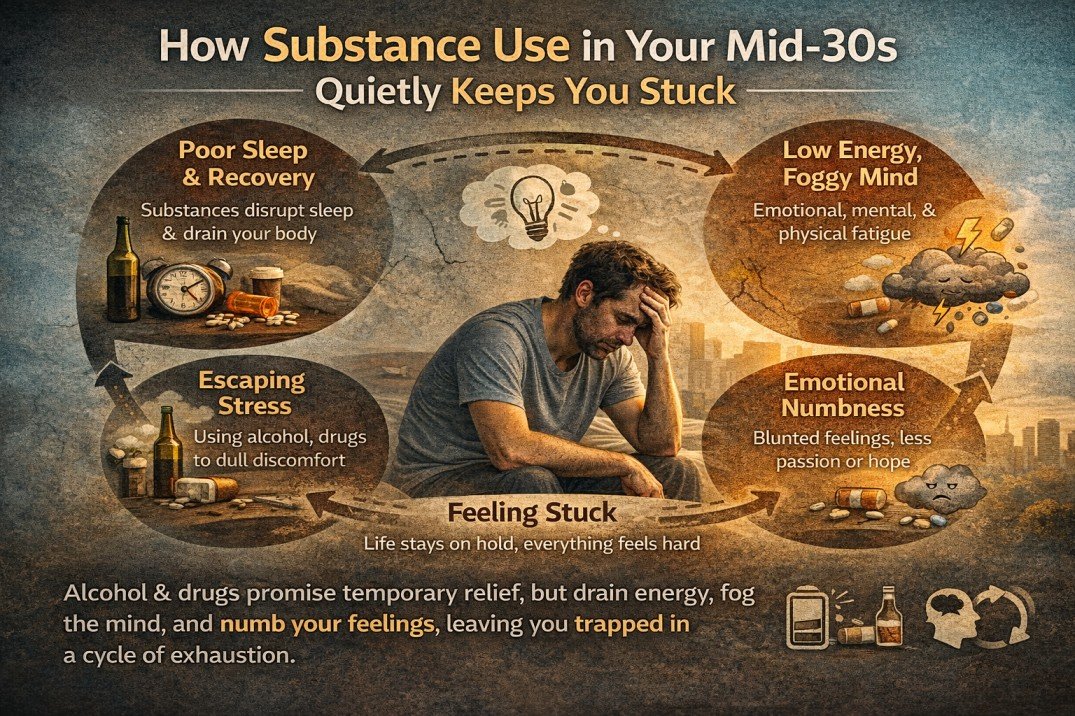
But over time, it quietly lowers your physical and mental baseline.
- Temporary relief → long-term depletion
It reduces stress in the moment, but drains energy afterward. The next day starts with less capacity than before. - Reduced motivation and reward response
Regular use can dull natural drive. Ordinary activities feel flat or not worth the effort compared to the quick relief substances provide. - Sleep disturbance
Even if it helps you fall asleep, sleep quality is often poorer. You wake up tired, foggy, or unrested, which affects the entire day. - Emotional numbing
Difficult feelings become muted, but so do positive ones. Over time, life feels less engaging or meaningful. - Increased anxiety or low mood afterward
As the effects wear off, irritability, worry, or low mood can rebound, especially with alcohol or stimulants. - Reinforcing avoidance
Because substances reduce discomfort quickly, they become the default way to cope instead of addressing problems directly.
Many people at this stage describe a “functional” pattern:
“I can still work and handle basics, but inside I’m not okay.”
That gap between external functioning and internal strain often widens slowly, making it harder to notice how much capacity has been lost until motivation, health, or mood drops significantly.
The Shame Cycle That Keeps You Trapped
Around the mid-30s, shame cycle often hits harder because life is supposed to feel “settled” by now. When stress, emptiness, or pressure builds, you may turn to drinking, substances, or avoidance just to get through the day. It gives short relief, a few hours where you don’t have to think.
Afterward comes regret, not just about the behaviour, but about time, responsibility, and the feeling of falling behind. You may think about career, health, finances, family, or where you expected to be by this age. That mental load drains energy the next day, making it harder to face things directly.
With less energy and more self-criticism, avoidance increases. You postpone tasks, withdraw, or repeat the same coping habit to escape the discomfort again. The cycle feeds itself.
At this stage of life, shame is powerful because it is tied to identity, not just actions – “I should know better by now,” “I don’t have time to waste,” or “Others are moving ahead.” That shame reduces action, which keeps the pattern going.
Why Your 30s Can Feel Especially Overwhelming
In your 30s, pressure often comes from several directions at once, and there is less room to ignore problems without consequences.
- Work feels higher-stakes — you are expected to be stable, progressing, or established, not still “figuring things out.”
- Money pressures are real and constant — bills, loans, housing costs, or supporting family leave little mental space.
- It’s harder not to compare — many people your age appear settled, which can make your own situation feel urgent or inadequate.
- Expectations increase — from family, society, or yourself about where you should be by now.
- Relationships can become a source of stress or loneliness — whether you are managing conflict, separation, or being alone when you didn’t expect to be.
- Mistakes feel costlier — there is less sense that you can “waste a few years” and easily recover.
- Awareness of time becomes sharper — habits, health, and finances no longer feel distant or abstract.
When these pressures combine, even everyday problems can feel heavy. It’s not a lack of strength; it’s the weight of responsibilities and expectations accumulating at the same stage of life.
Signs Your Situation Needs Attention, Not Self-Judgment
These signs don’t mean you are weak or broken. They simply indicate that something is not working and may need support or change.
- You rely more on alcohol or substances to relax, sleep, or cope than you used to
- Things you once enjoyed no longer feel interesting or worth the effort
- You keep postponing responsibilities because they feel too heavy to face
- Your physical health, sleep, or mental wellbeing has been gradually declining
- You have withdrawn from friends, social life, or people who used to matter
- A sense of hopelessness or “what’s the point” shows up frequently
- You feel like time is passing but your life is not moving forward
If several of these feel familiar, it does not mean you have failed. It means you may be depleted, overwhelmed, or stuck in patterns that are difficult to break alone. Recognising this is not self-criticism, it is the first step toward change.
How to Start Getting Your Life Back on Track in Your Mid-30s (Without Overwhelming Yourself)
By your mid-30s, these patterns are usually not temporary. Laziness, burnout, or substance use may have shaped your routine, energy, sleep, and responsibilities for years. The challenge is not just starting change, but undoing what your mind and body have adapted to. Sudden, extreme plans often fail because they ignore this reality. Stability has to come first.
Bring Your Sleep and Daily Routine Back to a Steady Rhythm
If you’ve trained your body to sleep at random times, stay in bed for long hours, or spend most of the day in one place, motivation alone won’t fix it. Your system is used to that pattern.
Start with sleep. Aim for 7–8 hours at night at roughly the same time daily. Avoid phone use before sleeping and right after waking.
Add basic daytime structure. Get morning sunlight, take a short walk, eat proper meals, and keep moving instead of staying in bed or on the couch.
At work, take small breaks, stand, walk, and talk to people. Movement and interaction help restore alertness.
Reduce contact with people or situations that regularly lead to drinking or substance use while you stabilise.
The goal is simple: bring back a normal sleep cycle and daily routine. Once that stabilises, energy and functioning usually improve.
Reduce What’s Draining You Before Adding New Goals
By your mid-30s, exhaustion is often not from one big problem but from constant background load, unfinished tasks, ongoing worries, difficult relationships, decision fatigue, irregular routines, and things you keep “mentally open.” Your mind stays occupied even when you are doing nothing.
Trying to add improvement goals on top of this usually increases pressure, not progress. The brain reads it as more demand, so avoidance rises.
Start by lowering load, not raising standards. Close small open loops, postpone non-essential commitments, create boundaries where possible, and reduce exposure to situations that reliably leave you depleted or triggered.
When mental load drops, you regain usable energy and attention. Without that space, new plans rarely hold because your system is already overloaded.
Start Doing Small Things Even If You Don’t Feel Ready
When you’ve been stuck for a long time, starting feels harder than doing. The moment you think about a task, your mind focuses on effort and discomfort, so you delay.
Start with actions that are too small to argue with. The goal is to break the “I’ll do it later” pattern, not to be productive.
For example: get out of bed when you wake up, take a shower, step outside for 5 minutes, wash a few dishes, reply to one message, clear one small area, walk to a nearby shop instead of ordering.
These actions seem minor, but they rebuild follow-through. Each small start lowers resistance to the next one. Over time, doing replaces postponing.

Decide What Your Realistic Daily Minimum Is
When life has been unstable for a while, aiming for an ideal routine usually leads to failure. On low-energy days, you end up doing nothing because the target feels too high.
Define a bare-minimum day that keeps your life functioning even when you feel tired or unmotivated.
For example: get up by a fixed time, bathe, eat proper meals, go to work or handle essentials, do one important task, and sleep on time.
If you complete this minimum, the day counts as stable, not wasted. Extra effort is optional. Consistency at this level rebuilds control and prevents long downward spirals.
Create Structure So You Don’t Have to Rely on Willpower
When you’re burned out or depleted, decisions themselves feel tiring. If every task depends on “feeling like it,” most things won’t happen.
Structure reduces the need to decide. Fixed times, simple routines, alarms, written lists, or doing the same task at the same point each day turn actions into habits rather than choices.
For example: shower right after waking, eat at set times, check emails only during specific slots, prepare clothes the night before, schedule a daily walk after work.
When the routine decides for you, resistance drops. You act because it’s what happens at that time, not because you feel motivated.
Learn How to Recover From Bad Days Without Giving Up
When progress is fragile, one off-day can undo everything. You miss a routine, overuse substances, skip work, or stay in bed, then it feels like you’ve failed, so you stop trying.
The key is to treat slips as interruptions, not endings. Return to your minimum routine the next day instead of waiting for a “perfect restart.”
For example: if you slept late, still wake at your usual time the next day; if you drank heavily, focus on hydration, food, and sleep rather than self-criticism; if you avoided tasks, complete one small responsibility to re-enter normal flow.
Consistency is built from quick recovery, not perfection.
Understand What Leads You to Use, Not Just the Use Itself
Substance use rarely happens randomly. It usually follows a pattern, a certain time of day, emotional state, level of fatigue, loneliness, boredom, or stress spike.
Pay attention to what comes right before the urge. For many people, it’s evening exhaustion, being alone after work, conflict, or difficulty switching off at night.
Once you see the pattern, you can change the situation instead of fighting the urge directly. For example: plan something outside the house during the usual use time, eat earlier, call someone, go for a walk, or keep yourself in a different environment.
Managing triggers reduces pressure on willpower.
Slowly Rebuild Your Capacity for Effort
If you’ve been inactive, burned out, or stuck in low-effort routines, your tolerance for sustained effort drops. Tasks that once felt normal now feel tiring or overwhelming.
Trying to jump straight into intense workouts, long work hours, or major projects often backfires. You exhaust yourself quickly, then avoid everything again.
Increase effort in small steps. For example: walk 10 minutes instead of planning an hour at the gym, work in short focused blocks, add one extra responsibility at a time.
Your stamina, physical and mental, returns gradually. Pushing too hard too soon usually resets progress.
Add One Meaningful Activity That Reconnects You to Life
When your routine has narrowed to work, screens, and coping, days start to feel empty and repetitive. Adding one meaningful activity can break that loop and bring back a sense of engagement.
This doesn’t have to be formal self-improvement. It can be something that uses your mind, skills, or connection with others. For example: learning through videos, making videos even if you never post them, calling an old friend, helping someone with a task, fixing things at home, or completing long-pending small jobs.
These activities remind you that you can still create, contribute, and interact, not just consume or escape. They also bring variety into days that otherwise feel the same.
Start with one such activity done regularly. It helps restore interest, confidence, and a sense that your time is being used for something real.
When Professional Help Can Make a Real Difference
If you have been stuck for a long time, tried multiple times to change, or feel you are losing control over habits, support from a psychologist can speed up recovery. Therapy is not only for severe problems, it helps when patterns are hard to break alone.
A professional can identify what is actually driving the cycle: burnout, low mood, anxiety, unresolved stress, sleep disruption, substance dependence, or a combination. They also help you build a realistic plan, monitor progress, and adjust when things slip.
Many people find relief simply from talking openly without judgment. It reduces isolation and replaces trial-and-error with guided steps.
Seeking help is not a sign that you cannot handle life. It is a practical step when self-directed efforts are not working.
Rebuilding Motivation When You Feel Numb or Exhausted
Feeling numb, flat, or exhausted at this stage is common. It does not always mean something is physically wrong. Often your system is depleted and under-stimulated at the same time.
You may keep thinking, “I don’t feel like it,” “I’m already tired,” or “What’s the point today?” If you wait for those feelings to disappear, you may wait indefinitely.
The useful shift is to act alongside the feeling, not after it. Tell yourself: “I feel exhausted, but I’m still going to do this small thing.” This trains your brain that action is possible even in a low state.
If you are medically healthy, the exhaustion is often more mental than physical. Gentle movement and engagement usually increase energy after you begin, even if it feels difficult at first.
You are not trying to force peak performance, only to break the link between “I feel bad” and “I do nothing.” Over time, your mind learns that feelings can exist without controlling behaviour, and motivation slowly returns.
How to Address Substance Use in a Realistic Way
Substance use usually serves a purpose — relaxing, sleeping, escaping stress, or filling empty time. That’s why stopping by willpower alone rarely works.
Reduce use gradually rather than forcing sudden change (unless medically advised). Even small cuts improve sleep, mood, and clarity.
Notice patterns — when, where, and in what state you use. Intervening earlier is easier than resisting at peak urge.
Replace the function, not just the substance. If you use to unwind, create another wind-down routine. If you use out of boredom or loneliness, add activity or contact at that time.
Tracking use makes it less automatic and more conscious.
Avoid isolation. Having one safe person aware of your efforts can help maintain control.
If use feels difficult to manage, professional support can help address underlying issues and provide structured strategies (for evidence-based guidance, see the National Institute on Drug Abuse resource on treatment. The aim is regained control and stability, not perfection.
When Professional Help Can Make a Huge Difference
For the 34-year-old client we mentioned, change began when he stopped trying to fix everything alone and spoke openly about what was happening. Therapy helped identify the real drivers behind the “laziness” – disrupted sleep, low mood, avoidance, and substance use as coping.
We focused on stabilising his routine, reducing triggers, and rebuilding daily functioning step by step. Underlying anxiety and depressive symptoms were addressed alongside behaviour change.
Regular sessions also provided accountability without judgment. Slips were not treated as failure, but as part of the process, which helped him stay engaged instead of giving up.
If you feel stuck despite repeated attempts to change, working with an online psychologist can provide clarity, structure, and support tailored to your situation. You can seek help privately from home and start rebuilding at a pace that feels manageable.
Frequently Asked Questions
How do I stop being lazy and do something with my life?
To stop being lazy and start doing something with your life, stabilise your daily routine first rather than forcing motivation. Poor sleep, burnout, or unhealthy coping habits reduce your ability to act. Begin with small, consistent actions that keep life functioning, fixed wake time, basic self-care, one meaningful task per day. Motivation usually returns after action begins.
What if I want to change but can’t start?
If you want to change but can’t start, the starting point is likely too overwhelming or your energy is low. Reduce the task until it feels immediately doable. Very small actions break the freeze response and rebuild momentum.
Why do I feel too lazy to fix my life even when I want to?
Feeling too lazy despite wanting change often reflects exhaustion, low mood, stress overload, or avoidance patterns, not lack of desire. When effort feels costly, the brain postpones action automatically. Restoring energy and reducing pressure helps restart movement.
How can I become consistent when I keep giving up?
To become consistent, set a realistic daily minimum instead of aiming for perfect days. Tasks should be small enough to continue even when tired or stressed. Structure and routine matter more than intensity.
How do I rebuild my life after years of bad habits?
Rebuilding your life after years of bad habits starts with stability, regular sleep, reduced harmful patterns, and basic functioning. Increase effort gradually as capacity improves. Sudden extreme changes rarely last.