Reviewed by: Sana Naqshbandi
A 27-year-old student recently came to LeapHope after moving to the United States for higher studies. The breakup had happened shortly before she left.
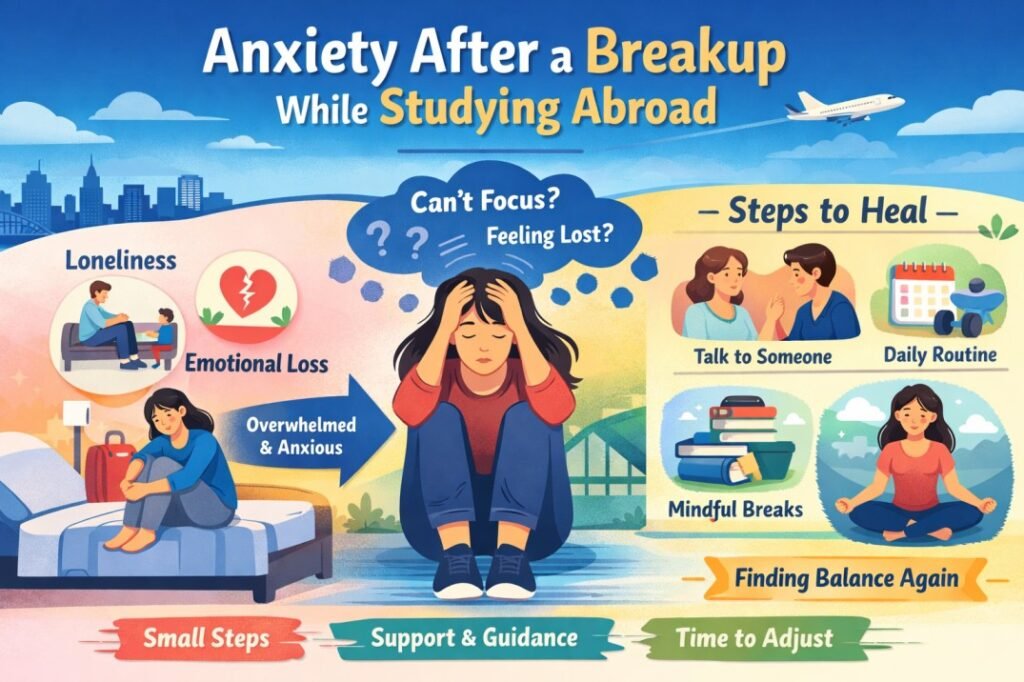
She had experienced anxiety before, but after arriving in the US, things became harder. She felt lonely, kept going back to the relationship in her mind and struggled to concentrate on coursework. What was supposed to be an exciting new chapter had started feeling emotionally overwhelming.
This situation is not limited to one student. Some relationships end before an international move because one partner does not want long distance, future plans become uncertain, financial pressure changes priorities, or one person wants to focus on studies or career.
You may still go ahead with the move believing the new country will help you move forward.
Then you arrive and realise the heartbreak came with you.
Why Can a Breakup Feel Worse After You Move Abroad?
Before leaving, you may be too busy to fully feel what has happened. There are applications, visas, packing, family goodbyes, travel plans, accommodation and dozens of practical things demanding your attention.
The move itself can temporarily feel like progress.
Then life slows down.
You are in a new room, a new university and a new country. The people who normally know when something is wrong are far away. Your familiar places and routines are gone, and the person you may have spoken to every day is gone too.
This is one reason a breakup can sometimes start hurting more after the move rather than immediately after it.
You may not only be missing your ex. You may also be missing the version of your life in which you felt known, supported and emotionally settled.
If the relationship itself is the part you are finding hardest to process, breakup counselling can help you work through the loss without treating it as something you should simply forget.
“I Came Here for My Future. Why Can’t I Focus on It?”
This is one of the hardest parts for many students.
You know why you moved. You may have worked for years to get admission. Your family may have spent significant money. You may have left a job, home or comfortable life because this degree mattered to you.
So when you cannot concentrate, another emotion appears alongside the heartbreak: guilt.
You start thinking, “Why am I allowing a relationship to affect something this important?”
But caring about your future does not automatically switch off emotional loss.
You might open your laptop, read for a few minutes and suddenly remember something your ex said. Then you wonder what they are doing, whether they have moved on, or whether the breakup could have ended differently.
You check your phone. Maybe you look at an old conversation or social-media account.
An hour disappears.
Then you realise you have barely studied. Now you are anxious about both the breakup and the work you have not completed.
The harder you try to force concentration, the more frustrated you become. Eventually even opening your coursework can trigger anxiety because it reminds you how far behind you feel.
That is not the same as simply being unmotivated.

The Breakup May Have Removed Your Main Emotional Support
Your ex may not have been physically living with you abroad, but they may still have been the person you expected to call after class, tell about your new city, complain to when something went wrong or speak to when you felt homesick.
Then the relationship ends.
Suddenly the new country feels much quieter.
You may call your parents every day and speak to friends back home regularly. That support matters, but it does not completely replace having someone nearby to eat with, study beside or meet after class.
Recent research involving international students receiving counselling has also found an important relationship between perceived social support and psychological and academic distress. Read the PubMed research on social support and counselling for international students
This is why you can speak to people back home every day and still feel lonely where you are.
You do not necessarily need a large new social circle immediately. One classmate you regularly study with, one person you can get coffee with, or even one familiar place you go after lectures can start making the new country feel less emotionally empty.
How Do You Study When You Are Not Emotionally Okay Yet?
You do not have to be completely over the breakup before you can start functioning again.
But you may need to change what you expect from yourself for a while.
If concentration is poor, forcing yourself through three-hour study sessions may only create more frustration. Work in shorter blocks and decide what genuinely needs to be completed today.
If checking your ex is one of the things repeatedly pulling you away from your work, keep your phone somewhere else during those study periods.
Do not make the goal, “I will not think about the breakup today.”
Make it, “For the next 30 minutes, whenever my mind goes back there, I will return to this task.”
If studying alone in your room leads to hours of rumination, use the library, a campus study area or another environment where you are less likely to disappear into your thoughts.
You may still feel sad there. The purpose is not to remove the emotion. It is to protect enough of your functioning while the emotional intensity starts settling.
And if you are already missing classes, falling behind on assignments or struggling academically, contact your professor, academic adviser or university student-support service early rather than waiting until the problem becomes much harder to recover from.
What Usually Makes This Situation Harder?
A few reactions are understandable but can keep you emotionally stuck:
- Expecting the move itself to make you forget the relationship. A new country creates distraction, but distraction is not the same as processing a loss.
- Checking your ex whenever loneliness becomes uncomfortable. It may give temporary connection or information, but it can restart rumination just before studying, sleeping or going to class.
- Using guilt to force yourself to perform. Thoughts such as “my parents spent so much money” or “I came here for this degree” may increase pressure without restoring concentration.
- Isolating because you do not feel like yourself. Long periods alone can give breakup thoughts even more room when you already lack familiar people nearby.
- Making a permanent decision during the most intense part of the distress. Wanting to leave the course or return home may be understandable, but first separate the desire to escape today’s pain from your longer-term decision about studying abroad.
“I Just Want to Go Home”
Home can start representing everything that currently feels missing: family, friends, familiar food, people who understand you and a place where daily life does not require so much effort.
You may start believing everything would improve if you simply booked a flight back.
Sometimes returning home may eventually be the right decision. Sometimes it may not.
The important thing is not to treat the urge itself as proof that studying abroad was a mistake.
Look at your actual functioning. Are you eating and sleeping? Are you attending classes? Can you complete basic tasks? Is anxiety gradually settling or getting worse? Do you have anyone locally you can contact? Have you spoken to the university about support?
Also ask yourself whether you are considering the move clearly or mainly looking for immediate relief from heartbreak.
If you are safe and still functioning, giving yourself some time before making a major decision may help. If your functioning is deteriorating, however, simply telling yourself to “push through” may not be enough.
What If Nothing You Try Is Working?
Feeling sad, distracted or lonely after a breakup does not automatically mean something is clinically wrong.
But pay attention if weeks are passing and you are becoming less able to function rather than gradually more stable.
Repeatedly missing classes, being unable to complete coursework, experiencing frequent panic, sleeping very poorly, withdrawing from almost everyone, or spending much of the day replaying the relationship deserves more attention.
This matters even more if anxiety was already part of your life before you moved.
At that point, several things may have become mixed together: breakup grief, pre-existing anxiety, loneliness, academic pressure and the stress of adjusting to another country.
If anxiety itself is becoming difficult to manage, online anxiety counselling can help identify what is maintaining it instead of assuming every symptom is simply part of the breakup.
How a Psychologist Can Help When the Breakup Is Affecting Your Life Abroad
Therapy is not about telling you to forget the relationship or convincing you that the breakup was “for the best.”
A psychologist can help separate problems that have become tangled together.
Maybe you need to process the relationship itself. Maybe anxious thoughts are keeping you stuck in constant replaying and checking. Maybe your biggest difficulty is rebuilding concentration, sleep and daily structure. Or perhaps the loss has exposed how isolated you currently feel in the new country.
Those problems need different responses.
For someone living abroad, online therapy can also remove some practical barriers to getting support. LeapHope’s international online therapy is designed for people seeking psychological support while living outside their home country.
The aim is not to make the breakup stop mattering.
It is to help you process what happened without allowing it to take over the life you moved abroad to build.
Final Thoughts
You can be grateful for the opportunity to study abroad and still be struggling badly right now.
You can understand why the relationship ended and still miss the person. You can care deeply about your degree and still find it difficult to concentrate for a while.
Those experiences can exist together.
But if the heartbreak is no longer only painful and is now interfering with your studies, sleep, daily routine or ability to function abroad, it may be time to stop treating it as something you should simply “get over.”
Understanding what is happening, rebuilding some stability where you are and getting professional support when your own attempts are no longer working can help you move forward without pretending the loss did not matter.