Last Updated on October 3, 2026
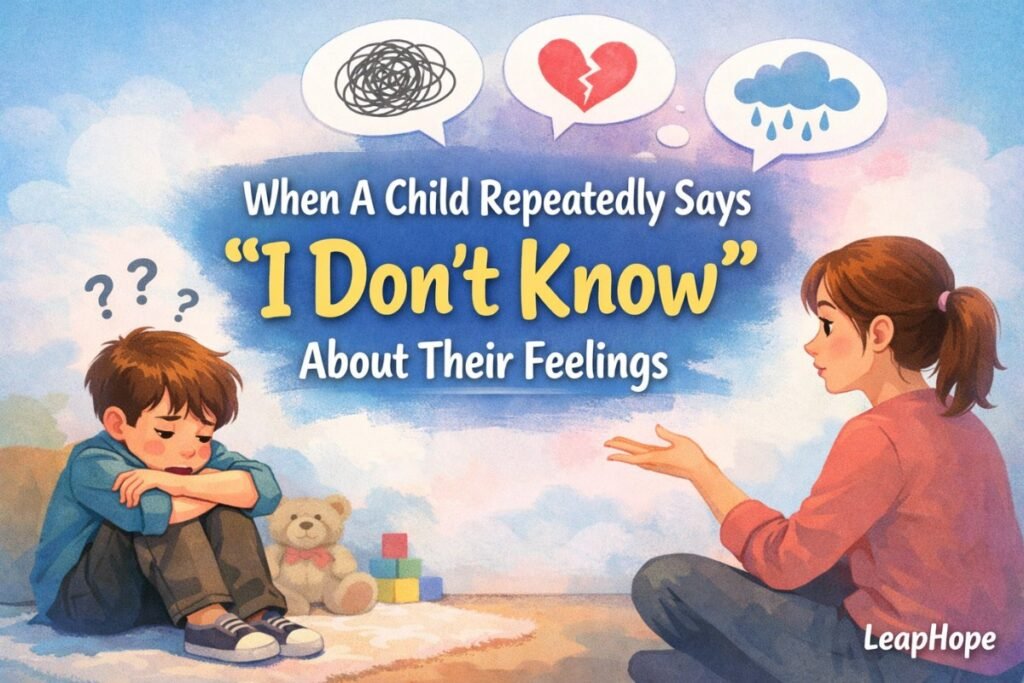
Your child is crying, so you ask, “Why are you crying?” They reply, “I don’t know.” You ask whether they are sad, angry or worried, but you get the same answer.
Or your child comes home unusually quiet. You ask whether something happened at school, and again they say, “I don’t know.”
For parents, this can be confusing. The emotion may look obvious from the outside, yet your child seems unable to explain it. Sometimes they genuinely do not know what they are feeling. Sometimes they know they are upset but cannot understand why. At other times, they may know more than they are ready or able to tell you.
Why Does My Child Keep Saying “I Don’t Know” About Their Feelings?
They Feel Something but Cannot Identify the Emotion
Feeling an emotion and knowing exactly what that emotion is are different skills.
Your child may know that something feels uncomfortable without being able to decide whether they are sad, embarrassed, disappointed, worried or angry. When you ask, “Are you sad?” their “I don’t know” may therefore be genuine.
Children become better at recognising and distinguishing emotions as their emotional development progresses. More complex feelings can be especially difficult to identify because several emotions may be happening at the same time.
They Know They Are Upset but Do Not Know Why
A child can recognise that they are upset without clearly understanding what caused the feeling.
For example, they may start crying after coming home from school. Nothing dramatic happened immediately before the tears, so when you ask, “Why are you crying?” they genuinely cannot give you one clear reason.
Several smaller experiences may have built up during the day. They may have felt left out, struggled with schoolwork, been embarrassed by something, or simply become emotionally overloaded.
Understanding what you feel and understanding why you feel it are not exactly the same ability.
Several Emotions May Be Happening Together
Sometimes the parent offers one label, but the child’s experience is more complicated.
You ask, “Are you angry?”
Your child may actually feel angry, hurt, embarrassed and disappointed at the same time. None of those words alone feels completely right, so “I don’t know” becomes the easiest answer.
Psychologists sometimes refer to the ability to distinguish closely related emotions as emotion differentiation. This ability develops gradually, and children may initially use broad words such as “bad,” “sad” or “angry” for several different emotional experiences.
They Know What They Feel but Cannot Explain It
Some children understand their emotions better than they can communicate them.
They may know something hurt their feelings but struggle to organise the experience into words. A child might remember exactly what happened at school but still be unable to answer, “How did that make you feel?”
This is slightly different from not knowing the emotion at all. Our guide on why some children struggle to express their emotions looks more closely at the difference between recognising an emotion, naming it and communicating it.

Strong Emotions Can Make Answering Harder
Timing matters.
When a child is crying intensely, extremely angry or emotionally overwhelmed, answering questions requires them to organise thoughts while their attention is already focused on the emotional experience.
The Child Mind Institute explains that recognising and naming feelings are emotional skills children develop over time. A child may therefore understand much more once their emotional intensity has reduced.
You may notice that the same child who says “I don’t know” during a difficult moment can explain what happened later that evening.
If they can talk once calm, the problem may be less about not understanding emotions and more about being unable to explain them while overwhelmed.
Sometimes “I Don’t Know” Means “I’m Not Ready to Tell You”
Not every “I don’t know” means genuine confusion.
Sometimes children know what happened but feel embarrassed, worried about getting into trouble, afraid of disappointing a parent or uncomfortable discussing the subject.
Older children may also want some privacy before talking.
This is why it is difficult to know what “I don’t know” means from the words alone. A child who genuinely cannot identify a feeling and a child who does not want to discuss it may give exactly the same answer.
When Should You Speak to a Psychologist?
Occasionally saying “I don’t know” when asked about emotions is not usually concerning by itself. What matters is whether your child repeatedly struggles to understand or communicate their emotional experiences and whether the pattern is affecting everyday life.
It may be worth seeking professional guidance if your child:
- almost never seems able to identify how they feel
- still cannot explain feelings after they have calmed down
- becomes extremely distressed whenever emotions are discussed
- has suddenly become much less open than before
- increasingly withdraws from parents or other trusted adults
- shows broader communication or developmental difficulties
- has significant changes in behaviour, sleep, school performance or relationships
If you are seeing changes across several areas, our guide on when parents should worry about a child’s emotional struggles explains the wider signs worth noticing.
A psychologist would not judge the child from the phrase “I don’t know” alone. They would look at whether the difficulty lies in recognising emotions, understanding what caused them, finding words, regulating strong feelings or feeling comfortable enough to communicate.
When the pattern is persistent or causing significant distress, online child and teen counselling can help parents understand what may be happening and whether additional assessment or support is appropriate.
Final Thoughts
When your child says “I don’t know” after you ask “Why are you crying?”, “Are you sad?” or “What happened?”, try not to assume that every answer means the same thing.
Sometimes your child genuinely cannot identify what they feel. Sometimes they know they are upset but cannot understand the reason. Sometimes they cannot find the words while overwhelmed, and sometimes they are simply not ready to talk.
What matters most is the wider pattern: whether your child can explain things later, whether this happens occasionally or almost every time emotions come up, and whether their ability to understand and communicate feelings is affecting everyday life.