
Last Updated on October 3, 2026
Your child is clearly upset. You ask what happened, but they cannot explain it. They may say “I don’t know,” become frustrated, go quiet, or simply repeat that they feel “bad” or “angry.”
This does not always mean your child is refusing to talk.
Feeling an emotion and being able to explain it are different psychological skills. A child first has to notice what they are feeling, recognise the emotion, separate it from similar feelings, find words for it and then communicate it to someone else.
Difficulty at any one of these stages can make emotional conversations surprisingly hard.
Why Does My Child Struggle to Express Their Emotions?
They Feel Something but Cannot Clearly Identify It
Children can experience strong emotions before they can accurately understand what those emotions are.
A child may know that something feels uncomfortable without knowing whether the feeling is embarrassment, disappointment, jealousy, fear or anger.
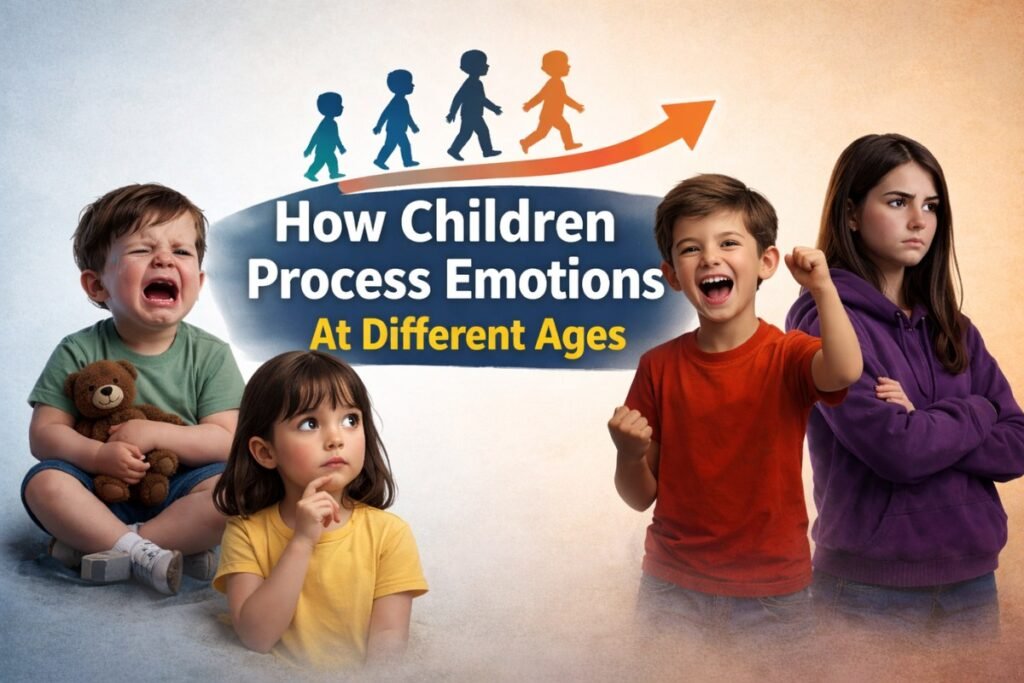
These abilities become more sophisticated as children’s emotional development progresses. Younger children especially may use one familiar emotion, such as “angry,” to describe several different internal experiences.
The feeling is real. The difficulty may be identifying it precisely.
They Know Something Is Wrong but Cannot Find the Words
Some children understand more internally than they can communicate verbally.
Research has found close links between language development and children’s ability to understand and recognise emotions. A child may therefore know that an experience affected them but struggle to convert that experience into a clear explanation.
This can sometimes look like avoidance.
A parent asks, “Why are you upset?”
The child genuinely may not know how to answer.
The problem is not necessarily that they do not want to tell you. They may not yet have the language needed to describe what is happening inside them.
Different Emotions May All Feel Like “Angry,” “Sad” or “Bad”
Psychologists sometimes refer to the ability to distinguish between similar emotions as emotion differentiation.
An adult might recognise:
“I was disappointed, then embarrassed, and now I’m irritated.”
A child may experience the same combination simply as:
“I’m angry.”
Being able to separate emotions into more specific experiences develops over time.
This matters because children generally find it easier to communicate and manage an emotion once they understand what they are actually feeling.
Strong Emotions Can Make Talking Harder
Sometimes a child can understand their feelings when calm but cannot explain anything while emotionally overwhelmed.
During an intense moment, crying, shouting, withdrawing or freezing may happen before the child can organise their thoughts into words. The American Academy of Pediatrics also notes that children can become overwhelmed by strong emotions before they have the skills to manage them effectively.
You may notice an important difference later.
A child who said nothing during an argument may explain an hour later that they felt left out, frightened or embarrassed.
That suggests the difficulty may be less about understanding emotions generally and more about accessing language while emotionally activated.
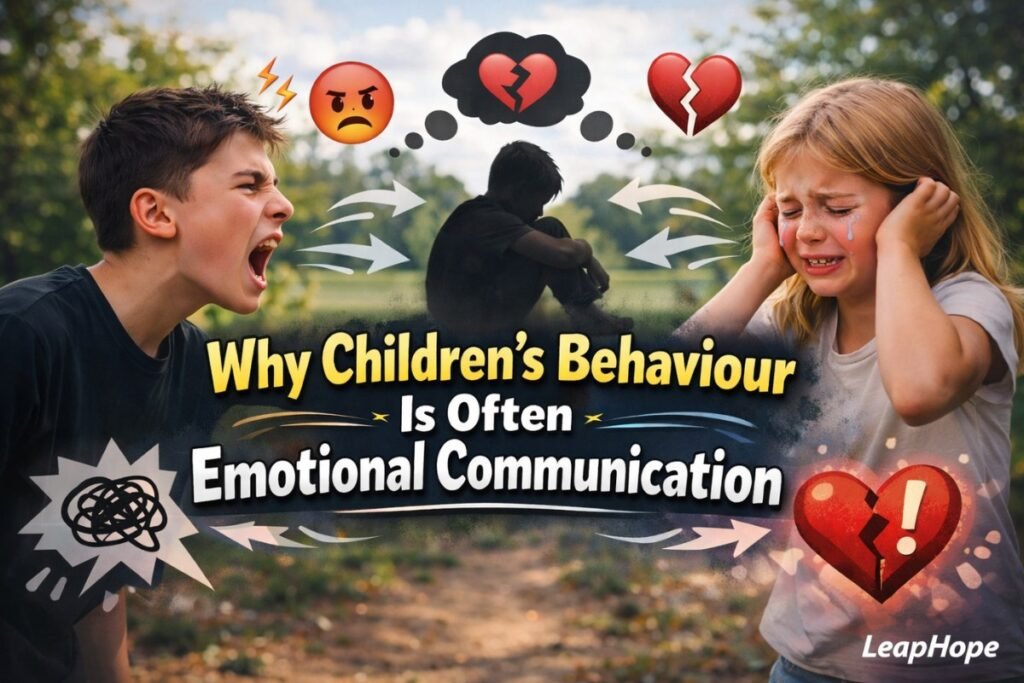
Sometimes those feelings also appear through crying, anger, refusal or other behaviour. We explain that pattern separately in why children sometimes express emotions through behaviour.
Some Children Have Persistent Difficulty Identifying and Describing Feelings
Psychology also recognises a pattern called alexithymia, which involves difficulty identifying and describing emotions.
That does not mean a person has no feelings.
However, parents should be cautious about applying this label to a child. Emotional awareness and language are still developing throughout childhood, and difficulty talking about feelings alone is not enough to conclude that a child has alexithymia.
What matters more is whether the difficulty is persistent, noticeably affects everyday life and appears alongside other emotional, communication or developmental concerns.
What If My Child Always Says “I Don’t Know”?
Sometimes “I don’t know” really does mean that.
Your child may know that something feels wrong without yet being able to identify or organise the experience clearly enough to explain it.
Other times, children may use the phrase because they feel overwhelmed, uncomfortable or unsure how to respond.
If this is the main pattern you are seeing, read our separate guide on why children repeatedly say “I don’t know” about their feelings.
When Should Difficulty Expressing Emotions Concern Parents?
Occasional difficulty explaining feelings is common.
It deserves closer attention when the pattern is persistent and begins affecting your child’s relationships, behaviour or everyday functioning.
You may want professional guidance if your child:
- rarely seems able to identify what they feel, even when calm
- becomes highly distressed whenever emotions are discussed
- has much greater difficulty expressing feelings than their general language ability would suggest
- consistently shuts down with trusted adults
- suddenly becomes much less emotionally communicative than before
- has broader communication, behavioural or developmental concerns
The aim is not to diagnose a child from one behaviour. A psychologist looks at the wider pattern, including emotional awareness, language, regulation, communication and development.
How Can a Psychologist Help Understand the Difficulty?
A psychologist may explore where emotional communication is becoming difficult.
For one child, the main issue may be recognising emotions. For another, it may be finding language. Another child may understand their feelings well when calm but become unable to communicate once overwhelmed.
Understanding where the process breaks down is often more useful than simply telling a child to “talk about their feelings.”
If the difficulty is persistent or affecting daily life, online child and teen counselling can help parents understand the broader pattern and whether further assessment or support would be useful.
Final Thoughts
A child who struggles to express emotions is not necessarily hiding something or refusing to communicate.
Sometimes they feel the emotion clearly but cannot yet identify it. Sometimes they know what they feel but cannot find the words. And sometimes those words disappear when the emotion becomes too intense.
The important question is not simply whether your child talks about feelings. It is where they seem to struggle between feeling an emotion and being able to communicate it.