Last Updated on August 26, 2026
Clinical Review: Aradhana Gambhir — Senior Psychologist with 25+ years of counselling experience.
Self-sabotage in relationships rarely looks dramatic. It often shows up in small reactions: checking your partner’s activity, reading too much into a delayed reply, becoming distant after a good week, or starting a fight when the relationship finally feels calm.
You can love your partner and still react in ways that create distance. Fear of rejection, low self-worth, past betrayal, relationship anxiety, or discomfort with closeness can make protection feel more urgent than connection.
The difficult part is that self-sabotage often feels reasonable while it is happening. You believe you are protecting yourself, checking something important, or preparing for disappointment.
What Is Self-Sabotage in a Relationship?
Self-sabotage in a relationship means repeatedly behaving in ways that damage closeness, trust, or stability even though you want the relationship to work.
It can include withdrawing, testing your partner, constantly looking for signs of rejection, creating unnecessary conflict, or assuming the worst before you have enough evidence.
Self-sabotage is not a diagnosis. It is a pattern worth examining when your fear and your behaviour repeatedly create the outcome you were trying to avoid.
Am I Self-Sabotaging My Relationship or Just Not Interested?
The difference often becomes clearer when you look at what happens emotionally.
When you are simply losing interest, distance can feel natural. You are less motivated to repair things, less curious about your partner, and less emotionally affected by the possibility of the relationship ending.
Self-sabotage usually contains more conflict inside you. You want closeness, but closeness also makes you anxious.
You can miss your partner and still ignore their message. You can want reassurance and still act cold instead of asking for it.
You can want the relationship and still search for reasons it will fail.
8 Signs of Self-Sabotage in Relationships
1. You Read Threat Into Small Changes
Your partner replies later than usual. Their message is shorter. They do not react to your story, or you notice they were online without replying.
A small change quickly becomes:
“They are losing interest.”
“Something is wrong.”
“They must be talking to someone else.”
The problem is not noticing changes. The problem is deciding what those changes mean before you have enough information.
This pattern can become stronger when low self-esteem affects how you see yourself. If you already fear that you are not enough, ordinary uncertainty can start feeling like proof.
2. You Test Your Partner Instead of Asking Directly
You want reassurance, but asking for it feels too vulnerable.
So you delay your reply to see if they message again. You become cold to see whether they notice, post something to provoke jealousy, or say “maybe we should break up” to test whether they fight for you.
The emotional need is real. The method creates confusion.
Instead of finding out whether your partner cares, you create a situation where both of you become defensive.
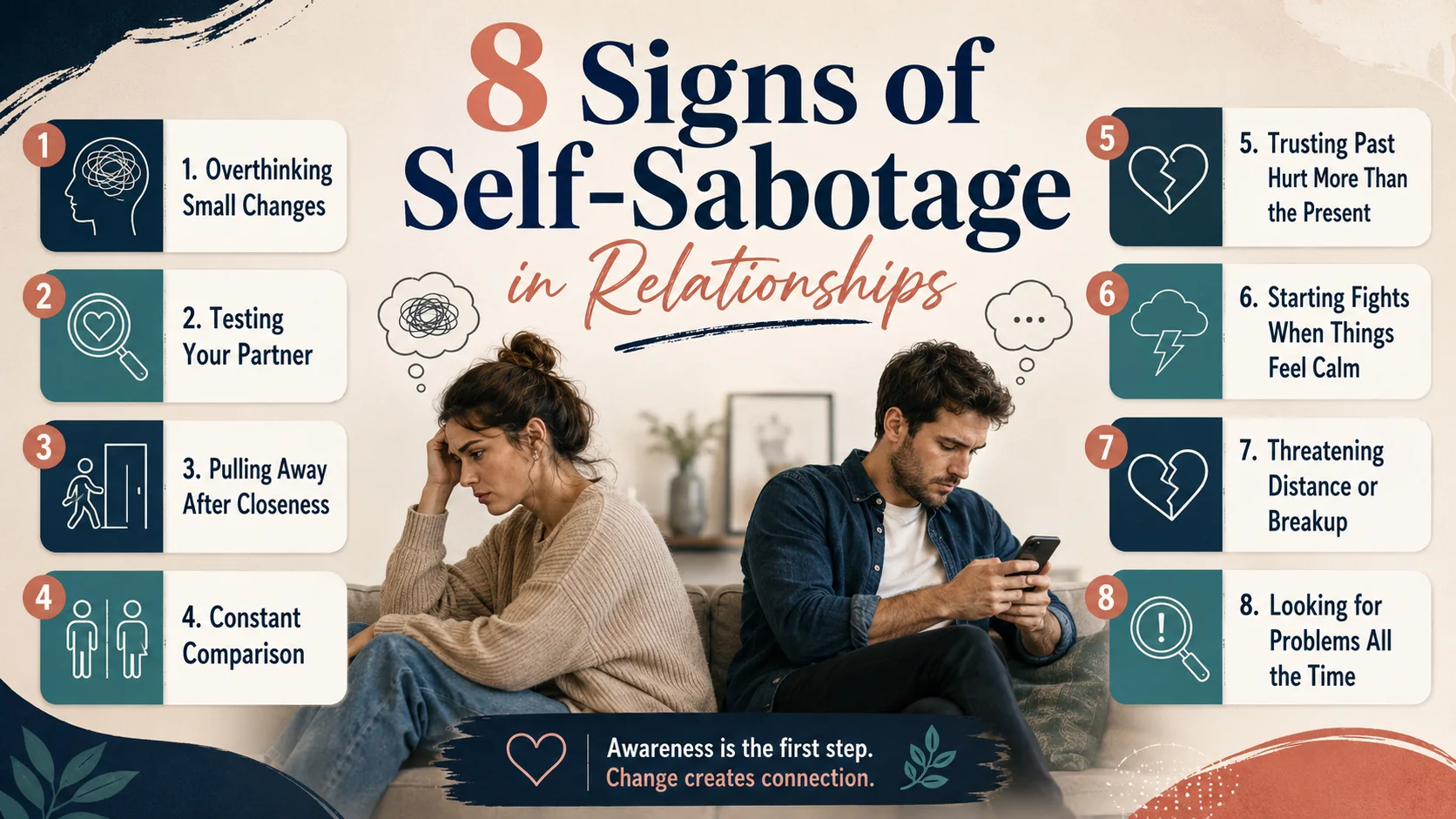
3. You Pull Away When Closeness Increases
Everything is going well, and then you suddenly need distance.
You stop sharing as much. Replies become shorter, affection drops, or you begin focusing on your partner’s flaws after the relationship becomes more serious.
Closeness can feel uncomfortable when vulnerability has previously led to hurt, disappointment, or rejection.
This is one way fear of intimacy in relationships can show up. You want emotional connection, but part of you also associates it with risk.
4. You Compare Yourself and Look for Reasons They Will Leave
Social media gives you endless material for comparison.
You notice who your partner follows, who likes their posts, how their ex looks, or how other couples appear online. Instead of enjoying your own relationship, you start checking whether someone else seems more attractive, successful, confident, or interesting.
That comparison can turn into surveillance.
A 2025 longitudinal study linked social-media jealousy with greater electronic partner surveillance and lower relationship satisfaction over time. You can read the research through the Journal of Marital and Family Therapy.
The issue is not noticing something online. It is when online checking becomes your main way of trying to feel secure.
5. You Carry Old Betrayal Into the Current Relationship
A previous partner lied, cheated, disappeared, hid conversations, or repeatedly broke trust.
Now a delayed reply, private phone screen, new follower, or unexpected change in routine can trigger the same fear.
Your current partner may not have caused the original wound, but the current relationship starts carrying it.
Healing does not mean ignoring genuine concerns. It means separating what your partner is doing now from what someone else did before.
If trust has actually been damaged in your current relationship, the work is different. Rebuilding trust after betrayal requires accountability and consistent behaviour, not simply telling yourself to stop overthinking.
6. You Create Conflict When Things Feel Too Calm
Some couples notice that their biggest arguments happen after a period when everything has been going well.
The calm itself starts feeling unfamiliar. You become alert, look for what could go wrong, bring up an old issue, or turn a minor concern into a bigger fight.
Chaos can feel more predictable than stability when past relationships were full of uncertainty.
You are not consciously trying to ruin a good period. You are returning to an emotional state that feels more familiar.
7. You Threaten Distance Before You Can Be Rejected
You feel hurt and immediately think about leaving.
You say:
“Fine, then maybe we should end this.”
“I don’t need this relationship.”
“Do whatever you want.”
Sometimes the real message underneath is:
“Show me that I matter.”
Threatening breakup can temporarily give you a sense of control. Repeatedly using the relationship itself as leverage, however, can make your partner stop feeling secure inside it.
8. You Keep Searching for Problems Even When the Relationship Is Stable
You watch relationship reels about cheating, narcissism, red flags, attachment styles, toxic partners, and signs someone is losing interest.
Useful information can help you recognise unhealthy behaviour. Constant exposure can also leave you scanning your own relationship for danger all day.
A normal disagreement becomes a “red flag.” A quiet evening becomes emotional withdrawal.
You stop asking, “What actually happened between us?” and start asking, “Which online warning does this fit?”
That can make a basically stable relationship feel constantly under investigation.
Why Do People Self-Sabotage Relationships?
Self-sabotage usually has a function. The behaviour is trying to protect you from something.
Common reasons include:
- fear of being abandoned
- fear of becoming emotionally dependent
- low self-worth
- previous betrayal or rejection
- growing up around unstable relationships
- relationship anxiety
- difficulty trusting
- fear of losing control
- believing closeness will eventually lead to hurt
The behaviour becomes a problem when protection starts creating the same distance you fear.
For example:
fear of rejection → checking for danger → negative interpretation → withdrawal or accusation → partner becomes defensive → more distance → “I knew something was wrong.”
That cycle can continue even when both partners still care about each other.
Am I Self-Sabotaging or Is Something Actually Wrong With My Relationship?
This distinction matters.
Questioning your relationship is not automatically self-sabotage. Anxiety should not be used to explain away real problems.
Your concern deserves to be taken seriously when there is a repeated pattern of:
- lying
- secrecy
- cheating
- hidden online behaviour
- disrespect
- controlling behaviour
- broken boundaries
- emotional neglect
- promises that repeatedly lead to no change
Self-sabotage is more likely when your reaction repeatedly becomes much larger than the available evidence.
If the same problems continue despite honest conversations and genuine effort, it can also help to look at the signs a relationship may be beyond repair instead of assuming every doubt comes from anxiety.
How to Stop Self-Sabotage in Relationships
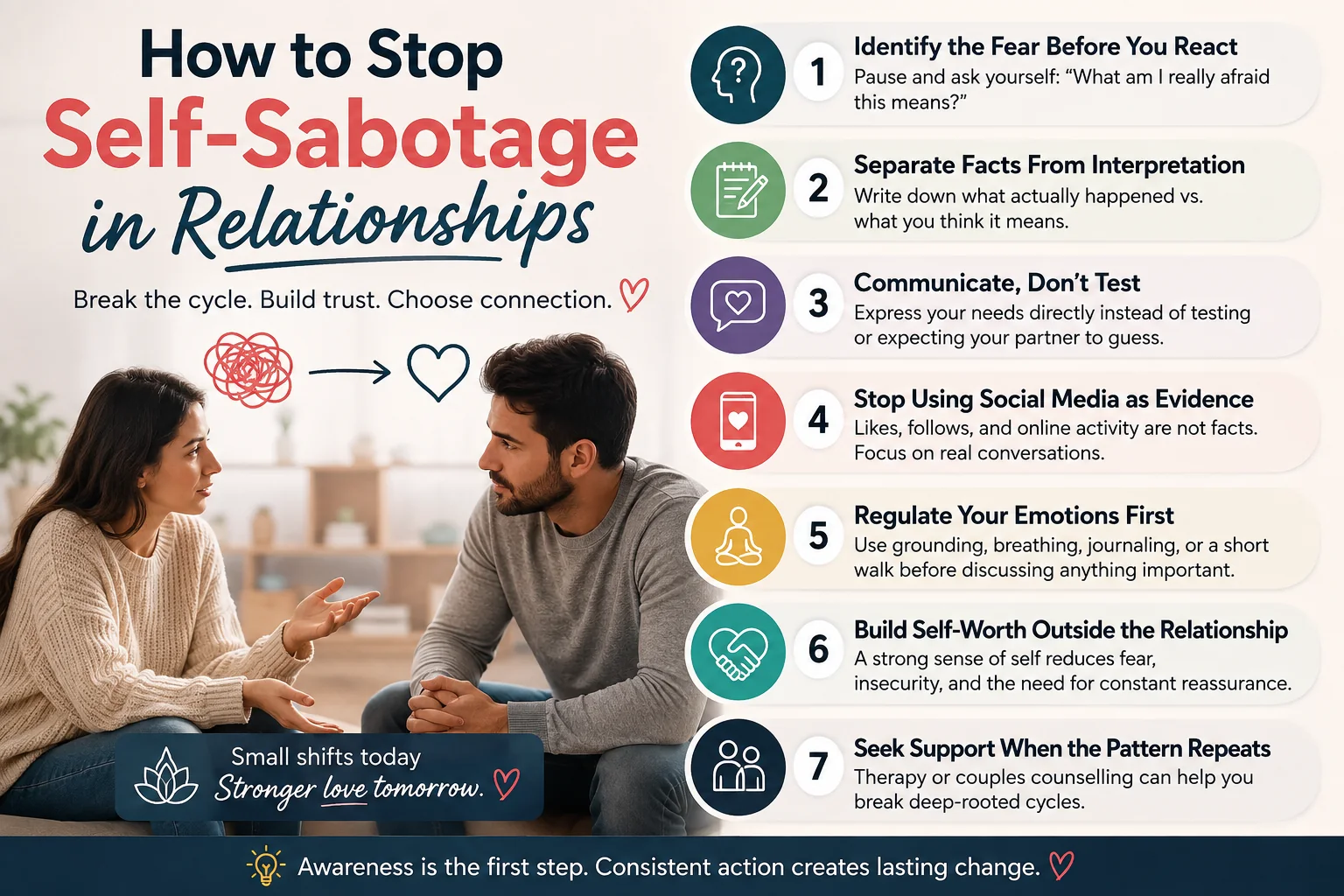
1. Identify the Fear Before Acting on It
Before sending the accusation, blocking your partner, checking their account again, or threatening breakup, ask:
“What am I afraid this means?”
The answer is often clearer than the argument.
You may be afraid of losing them, being replaced, looking foolish, being lied to again, or becoming too dependent.
2. Separate Facts From Interpretation
Write down what actually happened.
Then write down what you believe it means.
For example:
Fact: They replied three hours later.
Interpretation: They are losing interest.
That distinction can stop one incomplete piece of information from turning into a full relationship crisis.
3. Say the Need Instead of Testing It
Replace:
“Whatever. Do what you want.”
with:
“I felt insecure when that happened, and I need some clarity.”
Replace delayed replies designed to provoke a reaction with direct communication.
Directness feels more vulnerable, but it creates far less confusion.
4. Stop Using Social Media as Relationship Evidence
A like, follow, view, online status, or delayed reaction can provide information. It does not automatically provide meaning.
If something genuinely concerns you, discuss the behaviour directly instead of building a case from digital clues.
If online behaviour itself has damaged trust, agree on clear boundaries rather than repeatedly checking.
5. Work on the Pattern, Not Only the Latest Argument
If the same cycle keeps repeating, another promise to “stop overthinking” usually will not solve it.
Look at what happens before the reaction, what you believe the situation means, and what you do to protect yourself.
Relationship counselling can help couples identify these cycles when both partners keep getting pulled into the same pattern.
If Your Partner Is Self-Sabotaging the Relationship
Watching a partner repeatedly pull away can be confusing.
One week they want closeness. The next week they question the relationship, become suspicious, withdraw, or start another fight.
You can respond with empathy without taking responsibility for every reaction.
Be clear about what you are willing to discuss and what behaviour is not acceptable. Reassurance can help, but endless reassurance will not fix a pattern that your partner refuses to examine.
Avoid chasing every withdrawal or proving your love every time they test you.
A useful position is:
“I want to understand what is happening, but we cannot keep solving fear by hurting the relationship.”
When Couples Therapy Can Help
Couples therapy can help when self-sabotage has become a repeated cycle rather than an occasional reaction.
A psychologist can look at the trigger, what each partner believes it means, how both respond, and what happens after the conflict.
The work can include rebuilding trust, reducing reassurance-seeking, communicating needs directly, handling digital boundaries, regulating anxiety, and learning how to stay emotionally present when closeness feels uncomfortable.
The aim is not to eliminate every relationship fear. It is to stop fear from making important decisions for you.
Final Thoughts
Self-sabotage in relationships often begins as protection.
You do not want to be rejected, betrayed, controlled, embarrassed, or hurt again. So you check, withdraw, test, compare, accuse, or leave first.
The problem is that these behaviours can slowly create the distance you were trying to prevent.
If you keep wondering, “Am I sabotaging my relationship?”, look at the pattern rather than one argument.
Ask what you feared, what you assumed, and what you did next.
That is often where self-sabotage becomes visible and where change can begin.
FAQs
What does self-sabotage in a relationship look like?
Self-sabotage in a relationship can look like testing your partner, withdrawing after closeness, overthinking small changes, creating jealousy, threatening breakup, checking online activity, or repeatedly looking for problems even when the relationship is stable.
What are signs he is sabotaging the relationship?
Signs he is sabotaging the relationship can include pulling away when things become serious, repeatedly questioning the relationship, testing your commitment, creating unnecessary conflict, becoming suspicious without evidence, or threatening distance whenever he feels vulnerable.
What are signs she is sabotaging the relationship?
Signs she is sabotaging the relationship can include overanalysing small changes, repeatedly seeking reassurance, becoming distant after emotional closeness, testing your commitment, comparing herself with others, or starting conflict when she fears rejection.
Do I want to break up or am I self-sabotaging?
If you want to break up because of repeated lying, disrespect, betrayal, or unmet needs, the relationship itself may be the problem. Self-sabotage is more likely when fear repeatedly creates doubts despite a generally safe relationship.
How do I deal with a self-sabotaging partner?
To deal with a self-sabotaging partner, stay clear about your boundaries, communicate directly, and avoid endlessly proving your love after every test or withdrawal. Support can help, but your partner also needs to recognise and work on the pattern.