
Last Updated on October 24, 2026
Does your child get angry over small things, lose control when told no, or seem irritated most of the day? You might be wondering whether this is normal for their age or a sign of something else.
Sometimes, unusually frequent anger and irritability may be related to disruptive mood dysregulation disorder (DMDD).
In this article, we’ll explain what DMDD looks like in children, how it differs from other conditions, and what parents can do to help.
What Is DMDD in Kids?
Disruptive mood dysregulation disorder (DMDD) is a childhood mood disorder marked by frequent, severe temper outbursts and an angry or irritable mood that continues between them.
For example, a nine-year-old might scream and throw things when asked to stop playing a video game. The outburst itself is concerning, but what makes DMDD different is that the child may remain unusually irritable even after the argument ends.
DMDD is not simply a child having a bad temper. It involves a long-lasting pattern that is more severe than expected for the child’s age and affects life at home, school or with friends.
Although DMDD belongs to the depressive disorders category, children with it do not necessarily appear sad.
What Are the Signs and Symptoms of DMDD in Children?
Doctors and child mental health professionals look for several signs occurring together:
- Severe outbursts: Screaming, shouting, verbal aggression or physical aggression that is out of proportion to what happened.
- Frequent episodes: Outbursts occur, on average, at least three times a week.
- Irritability between outbursts: The child seems angry or easily annoyed most of the day, nearly every day.
- Symptoms lasting a year or longer: The pattern continues for at least 12 months, with no break of three or more consecutive months without the relevant symptoms.
- Difficulties in different settings: Problems occur in at least two places or social settings, such as home, school or with friends, and are severe in at least one.
The outbursts must also be more severe than expected for the child’s developmental age.
A few difficult days, frequent arguing or occasional tantrums are not enough to diagnose DMDD.
How Is DMDD Different From Normal Childhood Anger?
Every child gets frustrated. The difference is how severe, frequent and long-lasting the anger becomes.
| Normal childhood anger | Possible DMDD |
|---|---|
| The child gets upset after a disappointment | Even relatively small frustrations can lead to extreme outbursts |
| Their usual mood returns after they calm down | They remain unusually irritable between outbursts |
| Anger occurs occasionally | Severe outbursts happen repeatedly over many months |
| Most activities and relationships continue as usual | Anger regularly disrupts school, friendships or family life |
For instance, one child may complain when a planned outing is cancelled but settle down after a while. Another may react with extreme anger and continue snapping at everyone for hours.
Neither incident alone proves DMDD. What matters is the pattern over time.
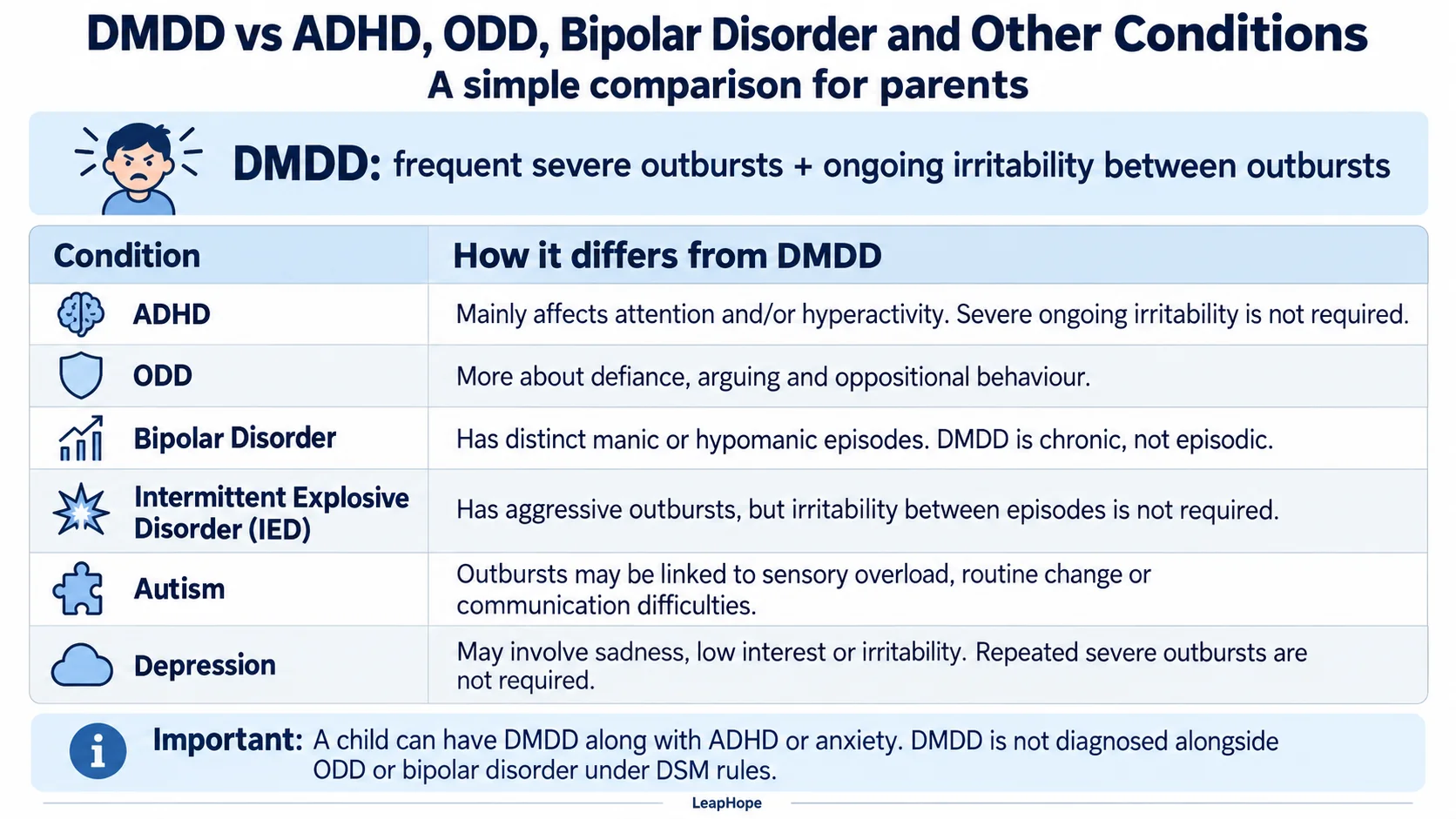
DMDD vs ADHD, ODD, Bipolar Disorder and Other Conditions
Anger and emotional outbursts can appear in several childhood conditions. These are the main differences.
| Condition | How it differs from DMDD |
|---|---|
| ADHD | Mainly involves inattention, hyperactivity and/or impulsivity. Children may become frustrated easily, but constant severe irritability is not required for ADHD. |
| ODD | Involves angry or irritable mood, defiance, arguing and sometimes vindictiveness. DMDD has stricter requirements for persistent irritability and severe outbursts. |
| Bipolar disorder | Involves distinct episodes of mania or hypomania. DMDD involves ongoing irritability without those manic or hypomanic episodes. |
| Intermittent explosive disorder (IED) | Causes recurrent aggressive outbursts, but an irritable mood between episodes is not required. |
| Autism | Outbursts may be connected to sensory overload, communication difficulties or unexpected changes. Autism is a neurodevelopmental condition. |
| Depression | May involve sadness, loss of interest, low energy or irritability. Repeated severe outbursts are not required for a depression diagnosis. |
A child can have DMDD alongside ADHD or anxiety. However, DMDD is not diagnosed alongside ODD or bipolar disorder under DSM diagnostic rules.
These differences are sometimes difficult to recognise without speaking to the child, parents and teachers.
What Causes DMDD in Children?
Researchers have not identified an exact cause of DMDD. Current evidence suggests that biological and environmental factors may play a role.
Areas being studied include:
- Frustration processing: Some children with severe irritability show differences in how they respond when a goal is blocked or something does not go as expected.
- Emotional processing: Research has found differences in how some affected children interpret and respond to emotional information.
- Brain functioning: Researchers are studying brain systems involved in emotional responses, attention and frustration.
- Genetic and environmental influences: These may contribute to vulnerability, but their precise roles in DMDD are not yet established.
Having ADHD, experiencing stress or struggling with schoolwork does not automatically mean a child has or will develop DMDD.
There is no established evidence that one parenting style, excessive screen time or a single stressful experience directly causes DMDD.
How Is DMDD Diagnosed?
A qualified child mental health professional assesses the child’s symptoms, development and behaviour across different settings.
The assessment generally includes:
- Discussing the child’s mood, outbursts and behaviour with parents.
- Gathering information from teachers or other people who know the child.
- Checking how long the symptoms have been present and how they affect everyday life.
- Considering ADHD, autism, anxiety, depression and other possible explanations.
For a DMDD diagnosis, symptoms must begin before age 10. The diagnosis cannot be made before age six and must first be made before age 18.
There is no single blood test, brain scan or online quiz that can confirm DMDD.
How Is DMDD Treated in Children?
Treatment aims to reduce severe outbursts and help children manage frustration more effectively.
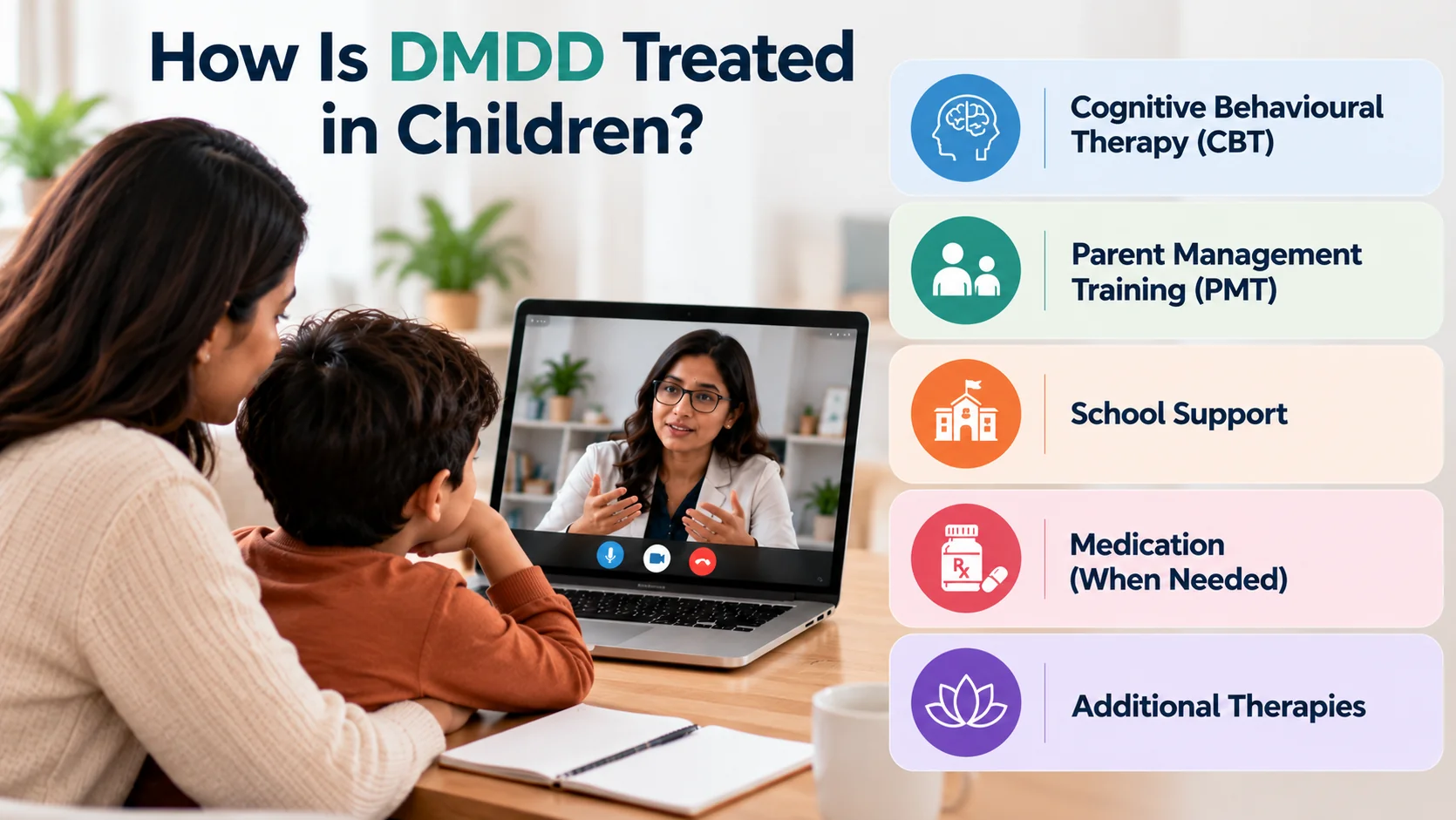
The main approaches include:
Cognitive Behavioural Therapy (CBT): Children may learn to recognise frustration, examine thoughts that increase anger and practise different ways of responding.
Behavioural parent training: Parents learn how to respond consistently, reinforce helpful behaviour and avoid responses that may unintentionally escalate or maintain outbursts.
School support: Teachers and parents may work together on specific classroom difficulties, consistent responses and agreed strategies.
Medication: A child psychiatrist may prescribe medication for severe symptoms or co-occurring conditions when appropriate. No medication is currently approved by the US FDA specifically for DMDD.
Because studies focused specifically on DMDD remain limited, treatment plans often draw on approaches used for severe childhood irritability and related conditions.
How Can Parents Help a Child With DMDD at Home?
Approaches used in behavioural parent training can help parents respond more effectively.
- Identify patterns. Keep a brief record of what happened before an outburst, how your child responded and what happened afterwards. Share it with the clinician.
- Praise the behaviour you want repeated. If your child accepts a limit or asks for help instead of screaming, acknowledge that specific action straight away.
- Keep rules consistent. Agree on clear expectations with other caregivers. Avoid repeatedly changing a limit simply to stop an outburst.
- Stay brief during an outburst. Avoid lectures or arguments while your child is highly upset. Focus on safety and discuss the problem afterwards.
- Practise skills when your child is calm. Rehearse ways to ask for a break, handle losing or respond to disappointment, preferably using strategies developed with their therapist.
- Review what works. Tell the treating professional which situations are improving and which continue to cause problems.
These strategies are intended to support treatment. Parents should not be expected to manage severe aggression or significant emotional difficulties entirely on their own.
When Should Parents Seek Professional Help?
You do not need to wait a full year before asking for help with your child’s anger.
Consider an assessment if:
- Your child has severe outbursts several times a week.
- They remain angry or irritated on most days, even between arguments.
- Teachers report repeated problems with classmates or school activities.
- Outbursts involve hitting, threats or damaging things.
- Everyday family activities have become difficult because of repeated emotional episodes.
An assessment does not mean your child will receive a DMDD diagnosis. It can help establish whether the problem involves mood, attention, anxiety, developmental needs or another concern.
If a child poses an immediate danger to themselves or others, seek urgent local emergency or mental health care.
Where Can Parents Find Support?
At LeapHope, parents can speak with psychologists about their child’s anger, emotional outbursts and behaviour at home or school. The first step may involve understanding the child’s difficulties and deciding whether parent guidance, child counselling or further clinical assessment is appropriate.
You can explore:
- Child Behaviour Counselling — for repeated outbursts, aggression and behaviour concerns.
- Online Child Psychologists in India — to explore child-focused psychological support.
- Parenting Counselling — for help with parental responses, boundaries and recurring conflicts.
- Child Depression Counselling — if persistent sadness, withdrawal or loss of interest is also a concern.
LeapHope provides online counselling for families in Delhi NCR, Mumbai, Bengaluru and other parts of India, as well as families living in the USA, UK, Canada, UAE and elsewhere.
Online counselling may help with parent guidance and suitable psychological interventions. Some children will also need in-person assessment or specialist psychiatric care.
Let’s Recap
Children get angry for many reasons, and occasional outbursts are not a sign of DMDD.
The condition becomes a possibility when severe outbursts happen frequently, the child remains irritable between them, and the pattern continues over many months.
The same behaviours can also have other explanations. If you are concerned, observing what happens and speaking with a child mental health professional is a useful place to start.
You don’t have to work out the diagnosis yourself. What matters is understanding what your child is struggling with and finding ways to help.
Clinical References
- National Institute of Mental Health (NIMH). Disruptive Mood Dysregulation Disorder: The Basics. https://www.nimh.nih.gov/health/publications/disruptive-mood-dysregulation-disorder
- American Academy of Child and Adolescent Psychiatry (AACAP). Disruptive Mood Dysregulation Disorder (DMDD). https://www.aacap.org/AACAP/Families_and_Youth/Facts_for_Families/FFF-Guide/Disruptive-Mood-Dysregulation-Disorder-_DMDD_-110.aspx
- Yale Medicine. Disruptive Mood Dysregulation Disorder. https://www.yalemedicine.org/conditions/disruptive-mood-dysregulation-disorder
- National Institute of Mental Health. Disruptive Mood Dysregulation Disorder — Research and Treatment. https://www.nimh.nih.gov/health/topics/disruptive-mood-dysregulation-disorder-dmdd