
At LeapHope, we often work with wives from different parts of the world who come with a similar concern. They are not just complaining about their mother-in-law, they are describing a deeper pain of feeling alone in their own marriage. Many of them say things like, “He never stands up for me,” or “I feel like I come second in my own relationship.”
They talk about important life moments, their wedding, their first home, even their fertility journey, and how those experiences did not feel fully theirs. Instead of feeling supported, they felt overshadowed, unheard, and emotionally unprotected. Over time, this does not remain a small issue, it slowly turns into resentment, distance, and a sense of disconnection from their partner.
If this feels familiar, it is important to understand that these feelings are not wrong or exaggerated. Wanting your husband to stand beside you, especially when you feel uncomfortable or hurt, is a basic need in a marriage. This is not about being “too emotional,” it is about needing emotional safety, respect, and partnership.
In this article, our marriage counselor will help you understand what is actually happening beneath the surface. We will look at where your feelings are valid, where you may need grounding, and what practical steps can help you protect your marriage without losing yourself in the process.
What Happens When a Husband Prioritises His Mother Over His Wife
When a husband prioritizes his mother over his wife for long, it does not stay limited to a few uncomfortable situations. It starts affecting how the wife feels in the relationship and how she connects with her partner. The impact is gradual, but it becomes deeper with time.
Here are some ways this begins to show up in her experience:
- Feeling unsupported in key moments creates an emotional gap between her and her husband
- Repeatedly being asked to adjust leads to quiet resentment that starts affecting daily interactions
- When her concerns are dismissed, she begins to withdraw instead of communicating openly
- Lack of support in front of others makes her question her husband’s loyalty and commitment
- Not feeling emotionally protected reduces trust and weakens the connection between them
- Ongoing stress from these situations affects her mental wellbeing and overall peace
- Over time, emotional distance can also impact physical closeness and intimacy
The longer this continues, the more it changes how she sees the relationship. What once felt like a partnership may begin to feel like a space where she has to constantly adjust, rather than feel secure and supported.
Where the Wife Is Right, and Where She Might Be Overreacting
Before trying to fix the situation, it is important for the wife to clearly understand what she is right about and where her reactions may be getting stronger due to repeated hurt. This is not about blaming her, it is about helping her respond in a way that actually improves the situation.
Where the Wife Is Right
The wife is right if:
- She feels dismissed as being “too emotional” instead of being supported when she tries to express what she is going through
- She feels that her husband is focusing on “how she should manage her emotions” instead of addressing what is actually hurting her
- She feels that his mother’s behaviour is affecting her mental and even physical health, yet she is still expected to engage normally
- She feels alone and abandoned in situations where she needed her husband to stand beside her
- She feels bitter about important moments she cannot get back because she did not feel supported or protected
- She is asking a very different question than her husband, she is asking how the interference can stop and how the marriage can be protected, not how she can adjust more
In these situations, the wife is not overreacting. She is clearly identifying a problem that is affecting her emotional safety and the stability of the marriage.
At this point, the wife may not always be sure if what she is feeling is valid or if she is overreacting. Instead of guessing, it helps to pause and ask herself a few clear questions:
- Do I feel disrespected by my husband’s family in certain situations?
- Do I wish my husband would defend or support me more when needed?
- Do I want more time with my husband without family involvement?
- Do I feel that our personal matters are being shared or influenced by others?
- Do I feel heard and understood when I express my emotions?
- Do I feel resentment building because of how things are handled?
- Do I feel insecure about my place in the relationship?
- Are there boundaries I feel are missing but have not clearly expressed yet?
If the answer to most of these is yes, the issue is not small. It means something in the relationship needs attention, not silence.
Where the Wife Might Be Overreacting
The wife might be overreacting if:
- She expects her husband to confront his mother in every situation, even when it may create unnecessary escalation
- She assumes that every disagreement means her husband is choosing his mother over her
- She reacts strongly in the present moment because of past unresolved hurt
- She expects immediate and complete change in behaviour that has existed for years
In these situations, the reaction may be stronger than what the moment actually requires, even though the feelings behind it are completely real.
The wife is not wrong here. Wanting support and protection in a marriage is basic, not excessive. When she feels dismissed or emotionally affected, the issue is not her reaction, it is what she is going through.
A husband avoiding conflict outside while his wife is struggling inside is not balance. It only shifts the burden onto her.
A wife is a partner, not someone who keeps adjusting to maintain peace. If she does not feel supported, it becomes difficult for her to feel safe or accepting towards his family. At some point, the husband has to take accountability and show where his priority lies.
First, the Wife Needs to Stabilise Her Mental and Emotional Health
Before trying to fix the marriage or change anything around you, as a wife, you need to stabilise your own mental and emotional state first. When you have been dealing with repeated hurt, dismissal, or stress, it affects not just your emotions but also your thinking, reactions, and overall wellbeing.

Here is what you need to focus on:
- Acknowledge what you are feeling instead of suppressing it
Stop telling yourself to “just adjust” or “ignore it.” What you are feeling is real, and it needs attention. - Reduce emotional overload where possible
You do not have to engage in every situation or conversation. Stepping back from what drains you is necessary, not selfish. - Take care of your basic mental and physical routine
Stress affects sleep, energy, and focus. Try to bring some structure back into your day, even small routines can help stabilise you. - Limit overthinking and mental replay
Repeating the same situations in your mind will only increase stress. Bring your focus back to what is in your control right now. - Find a safe space to express yourself
Talk to someone you trust or write things down. You need a space where you are not judged or dismissed. - Consider therapy if it feels too heavy to handle alone
If you feel constantly drained, anxious, or stuck, online therapy can help you process what you are going through and give you clarity. You do not have to manage everything on your own.
Stabilising yourself does not mean accepting everything or staying silent. It means you are strengthening yourself so that when you deal with the situation, you do it with clarity, not exhaustion.
How the Wife Can Set Boundaries When the Husband Prioritises His Mother Over Her
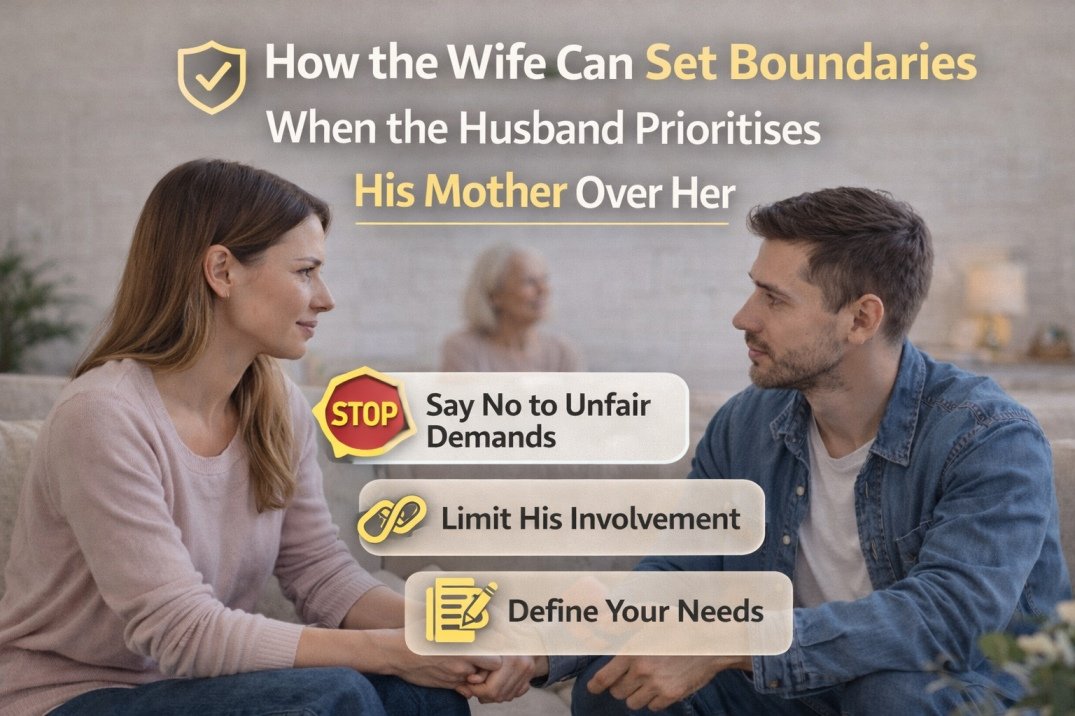
Before the wife starts setting boundaries, one thing needs to be clear. This is not about becoming cold, distant, or bitter. Boundaries are not meant to break relationships, they are meant to make them healthier and more respectful.
The wife can remain warm, respectful, and involved in the family while being clear about what she is not comfortable with. Saying no does not have to come with anger. It can be said calmly and politely, without guilt.
At the same time, suppressing everything or reacting with frustration will only make things worse. Silent resentment creates distance, and repeated arguments create resistance. The goal is not to fight, but to bring clarity.
Be Clear About What Is Actually Crossing the Line
The wife should not wait until everything builds up. Instead of reacting after feeling hurt, she can notice patterns early and address one specific issue at a time.
When she speaks, it helps to stay focused on one situation instead of bringing up everything at once. This keeps the conversation clear and prevents it from turning into an emotional outburst.
Separate Family Involvement From Marriage Interference
The wife does not need to reject family involvement completely. What matters is how she communicates the difference without sounding defensive.
She can calmly explain that some areas feel too personal and need to stay between the couple. Keeping the tone neutral and not critical helps the husband hear this as a need, not an attack on his family.
Stop Handling Everything Alone
Instead of silently adjusting or fixing situations, the wife needs to pause and allow space for her husband to respond.
This does not mean confronting him repeatedly. It means not stepping in immediately to manage everything. When she stops over-handling, it naturally brings attention to where support is missing.
Tell the Husband Clearly Where Support Is Needed
The wife does not need to explain everything in detail. What works better is saying clearly what affected her and where she needed support.
Choosing the right moment matters. A calm conversation outside the situation is more effective than trying to explain things during an argument.
Reduce Exposure Where Needed
If certain situations keep repeating, the wife does not have to engage fully every time.
She can quietly step back from conversations or situations that affect her, without making it dramatic. This protects her energy and reduces unnecessary stress without creating conflict.
Stay Consistent, Even When It Feels Uncomfortable
The wife may feel tempted to go back to adjusting just to avoid discomfort. Instead, she needs to stay steady in small ways.
Consistency does not mean being harsh. It means not sending mixed signals. When her response stays the same over time, people around her start understanding the limit.
Accept That Some Discomfort Is Part of Change
Even when the wife handles things calmly, some discomfort is natural in the beginning.
This does not mean she is doing something wrong. It simply means the old pattern is changing. Staying calm and not reacting to every response helps things settle over time.
How the Wife Can Talk to a Husband Who Takes His Mother’s Side
Here are practical ways the wife can say it:
- “I know you love your mother, and I respect that, but there are certain areas where I need space as your wife.”
- “I’m not comfortable with your mother tracking my expenses. You can always ask me directly.”
- “I also know how to raise a child. I need your support here, not direction from others.”
- “I want to experience motherhood in my own way, not feel corrected all the time.”
- “I want to manage some parts of the house on my own. Please ask your mother to trust me with that.”
- “When certain words are said to me, I need you to speak up in that moment.”
- “I know you expect me to be understanding. I can adjust, but I also need to feel understood.”
- “Please don’t involve your mother in our personal matters. I want us to handle those together.”
- “If something concerns you, talk to me first instead of discussing it with others.”
- “I’m not trying to create distance, I just want to feel respected in my own space.”
- “I don’t need you to take sides, I need you to stand with me when I feel uncomfortable.”
These kinds of sentences are simple and direct. They don’t attack his mother, but they clearly define what the wife is okay with and what she is not.
The Uncomfortable Truth the Wife May Need to Accept
Some of what the wife is experiencing comes from existing family dynamics, not just the marriage. In many cases, the bond between the husband and his mother is strong, and the mother may find it difficult to step back after the marriage.
Because of this, the wife may feel like an outsider. The mother may see her as someone who is taking her son away, which leads to more control, involvement, or resistance to change. There can also be a mindset of “this is my house, my way,” especially if the mother has always been in charge.
In many situations, this is learned behaviour. This may be how the mother herself was treated, so she may not see the need to change or create space for the wife.
Understanding this helps the wife see the pattern more clearly, but it does not make it acceptable.
The responsibility still lies with the husband to create balance. He needs to recognise that his role has changed and that protecting his marriage requires clear boundaries, even if it feels uncomfortable.
When the Wife Should Consider Seeking Help
The wife should consider seeking help when the situation starts affecting her mental health and nothing is improving despite her efforts.
This includes:
- Feeling constantly stressed, anxious, or emotionally drained
- Repeated conflicts with no real change
- Feeling unheard or dismissed by her husband
- Emotional distance growing in the marriage
- Impact on sleep, health, or daily life
At this point, handling it alone only makes it heavier.
Seeking support is not failure, it is a step towards clarity.
Online marriage counselling at LeapHope can help the wife understand what is happening, communicate more effectively, and decide how to move forward without feeling stuck or alone.
The Bottom Line
The wife is not wrong for wanting support, respect, and a clear place in her marriage. Feeling hurt in these situations is not overreaction, it is a response to not feeling protected or prioritised.
At the same time, this situation will not improve through silence, constant adjustment, or repeated arguments. What creates change is clarity, consistency, and the husband taking responsibility for his role in the marriage.
The wife does not need to become distant or bitter to be heard. She can stay calm, clear, and firm about what she needs, while also protecting her mental and emotional wellbeing.
A marriage cannot work if one person keeps adjusting and the other keeps avoiding. At some point, the balance has to shift.
The goal is not to create distance from the family. The goal is to build a marriage where the wife feels secure, supported, and respected, not second.