A 31-year-old woman described her situation in counselling like this:
“I feel like I’ve failed in my career, my marriage, and my relationship. For months, I’ve been overwhelmed, emotionally exhausted, and mentally overloaded. I know what I need to do, but I just can’t do it.
I feel sad all the time. I avoid people and try to run away from conversations. I don’t feel like spending time with my family anymore; I just feel irritated, angry, or like crying.
I don’t feel comfortable if any man touches me. I don’t want closeness. I just want to be alone.
I feel stuck. I’m drained. My mind feels full, but nothing moves forward.”
In counselling, we meet many people in their 30s who come in feeling exactly like this. Their marriage is damaged or has ended. Their career has stalled or collapsed. They feel overwhelmed, emotionally exhausted, and mentally overloaded for months.
You are not the only one. This situation is more common than it looks from the outside.
In this article, our psychologists will guide you step by step. You will learn how to stabilise yourself, repair a struggling marriage or move toward a healthier new relationship, and start rebuilding your career again.
If You Feel Like You’ve Failed in Marriage and Career in Your Early 30s, You’re Not Alone
In your early 30s, you are often expected to have a stable job, a settled marriage, and some financial security. When that doesn’t happen, it can feel like you’ve fallen far behind. You may see friends buying homes, growing in their careers, raising children, or posting happy moments online while you are struggling just to get through the day.
If your relationship with your husband or wife is tense, distant, or breaking down, the pressure feels even heavier. Arguments about money, responsibility, or the future can become frequent. Sometimes there is silence instead of closeness. Sometimes you feel more like roommates than partners.
Facing career problems at the same time makes everything worse. Not having a job, losing direction, or feeling stuck professionally can affect confidence and self-respect. It can also change how you see yourself as a partner.
Many men and women in their early 30s go through this combination of career stress and relationship strain. It may feel isolating, but it is not unusual, and it does not mean you have failed at life.
If You’ve Been Feeling Overwhelmed, Exhausted, Sad, or Angry for Months, There Are Real Reasons
If these feelings have been going on for a long time, it does not mean you are weak or “not trying enough.” When too many stressful things happen together, problems in marriage, money worries, career uncertainty, and family pressure, your mind and body can go into overload. What you are feeling has real causes, even if you cannot explain them clearly.
Your Mind and Body May Be Stuck in Long-Term Stress Mode
If you have been unemployed or stuck in your career for months, it slowly affects your self-esteem. Repeated rejections, lack of progress, or financial dependence can make both men and women feel inadequate or insecure about their role in the relationship.
You may also notice a change in how your partner speaks or behaves, more tension, more focus on money, or subtle distance. Even normal conversations can start to feel uncomfortable. Living like this every day keeps your body in constant pressure mode, leaving you tired, irritable, and unable to relax.
Emotional Burnout Can Drain Energy, Motivation, and Hope
When you have been dealing with stress for too long, your emotional energy runs out. You may stop feeling motivated even for things that are important, like job searching, talking to your partner, or making plans. Tasks that once felt normal can start to feel heavy or pointless.
Both men and women often describe this as feeling “empty” or “used up.” It is not that you don’t care; it is that you no longer have the emotional fuel. Over time, this burnout can make you withdraw, procrastinate, or avoid responsibilities, which then increases guilt and pressure.
Unprocessed Grief or Disappointment Can Surface as Sadness or Anger
Losing a job, a stable future, or the relationship you thought you would have brings real grief, even if nothing “official” has ended. Many people do not recognise this as grief, so it has nowhere to go. It builds inside.
Instead of clear sadness, it often shows up as irritability, sudden anger, frequent crying, or feeling hurt over small things. You may find yourself reacting more strongly than before, not because you are unstable, but because disappointment has been accumulating for a long time.

Chronic Pressure Can Shut Down Clear Thinking and Decision-Making
When you are under constant pressure about money, work, and relationship issues, your mind stays occupied all the time. You keep thinking about what went wrong, what to do next, and what might happen in the future. This mental load makes it hard to focus, plan, or make decisions.
Both men and women often say their mind feels “full” but nothing gets done. Even simple choices can feel exhausting. You may keep postponing decisions, not because you don’t care, but because your thinking capacity is already overloaded.
Overload Can Trigger Withdrawal as a Protective Response
When you are struggling in your career, either searching for a job for months or feeling stuck while your partner is doing well, it can create a constant sense of comparison and pressure. You may start feeling judged, inadequate, or uncomfortable during normal conversations about work, money, or the future.
Over time, many people begin to withdraw to avoid these feelings. You may talk less, avoid social situations, or stay busy alone so you don’t have to explain your situation. This withdrawal is not indifference; it is a way of protecting yourself from shame, tension, or painful comparisons.
Emotional Exhaustion Can Reduce Desire for Intimacy
When there has been ongoing stress, conflict, or pressure in the relationship, the desire for physical intimacy often drops first. You may not feel comfortable being touched, kissed, or sexually close, even if you still care about your partner. Instead of warmth, your body may respond with tension, irritation, or numbness.
This is common in both men and women when emotional safety is low or exhaustion is high. Intimacy requires relaxation, trust, and mental space, all of which become scarce when you are overwhelmed. Pulling away physically is often not rejection of the partner, but a sign that your system is overloaded and unable to engage in closeness.
When Multiple Life Areas Hurt at Once, Your System Prioritises Survival
When problems hit your marriage, career, finances, and future at the same time, your mind shifts into survival mode. Some people are also dealing with health issues during this period, which further drains energy and increases fear about stability.
At home, it can become even more painful if you start feeling rejected by your partner. Some become critical, distant, or openly disappointed about your lack of progress. In some cases, separation happens with statements like, “I wanted a successful partner,” or “How will you take care of the family?”
When all this combines, your focus shifts from growth to just getting through the day. Feeling frozen or unable to move forward is not lack of effort; it is a survival response to overwhelming pressure.
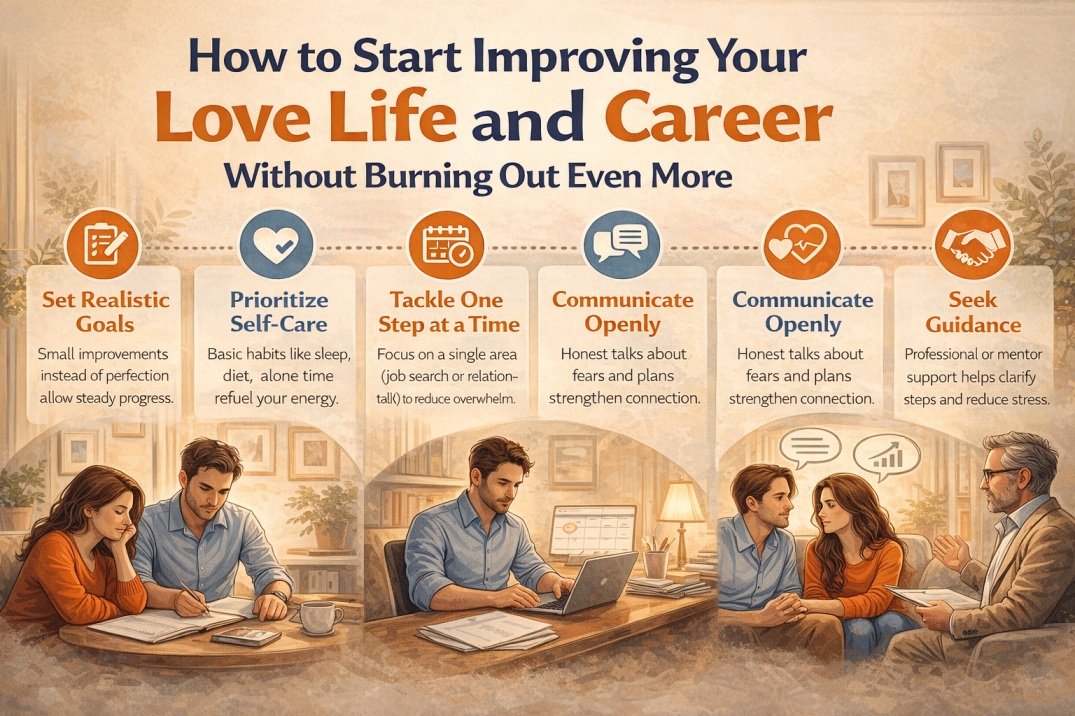
How to Start Improving Your Love Life and Career Without Burning Out Even More
Whether you are a man or a woman in your 30s feeling like you have failed in marriage, career, or life, it is okay to feel this way. Many people go through phases where things fall apart before they come together again.
Some people achieve stability in their 20s, some in their 30s, some in their 40s, and even later. There is no single timeline for success or happiness.
Below, we will give you a clear, step-by-step plan to stabilise yourself, repair or rethink your relationship, and start getting your career back on track in a realistic way.
Psychological Stabilisation
Restore Your Emotional Energy Before Making Major Decisions
Before trying to fix your marriage or career, rebuild your emotional strength. Clear decisions are hard to make when your mind is already drained.
Reduce digital overload. Avoid excessive social media scrolling, especially reels and short videos. Algorithms often keep showing relationship conflicts, success comparisons, or “life failure” content because it holds attention. Watching this repeatedly for months can make your mind feel heavier, even if your real situation is not that extreme.
Keep your life simple for a while. Follow a fixed sleep routine, eat on time, and include some physical movement daily, even a short walk helps regulate mood and stress. Focus only on essential tasks instead of trying to solve everything at once.
As mental noise reduces and your body gets basic stability, emotional energy gradually starts returning. From that state, decisions become clearer and less reactive.
Separate Temporary Collapse From Permanent Failure
In your 30s, sudden changes can disrupt life quickly. A woman may relocate after marriage, leave her job, and struggle to restart in a new city. A man may feel stuck in a low-pay role, no-growth job, or a period of unemployment.
Even if this phase has lasted only a few months, it can feel as if everything has permanently fallen apart.
During this phase, it is common to interpret a temporary setback as a lifelong failure. Thoughts like “My life is ruined” or “I’ll never recover from this” can take over, even though the situation has not lasted that long. The problem is not just the circumstance, but the conclusion your mind draws from it.
It is important to consciously challenge this thinking. A difficult phase does not define your entire future. Many careers restart after relocation, gaps, or slow periods. Separating “what is happening right now” from “what my life will always be” helps reduce hopelessness and opens space for practical steps forward.
Reduce Constant Self-Comparison With Others Who Seem “Ahead”
In your 30s, it is very easy to feel left behind when you see friends or relatives doing well, stable jobs, growing income, children, homes, or a seemingly happy marriage. When you are struggling, these comparisons can feel painful and personal.
But you are only seeing the visible part of their lives. You do not see their pressures, conflicts, debts, health issues, or insecurities. Constant comparison keeps your mind focused on what you lack instead of what you can rebuild.
Reducing exposure to these triggers, whether social media, family discussions, or internal comparison, helps protect your emotional stability. Your timeline does not have to match anyone else’s for your life to move forward.
Behavioural Reset
Rebuild Basic Daily Functioning Before Chasing Big Goals
Start with practical steps. Update your resume, learn relevant skills online, and begin applying for jobs regularly. Treat the process as numbers, not personal rejection, if you attend many interviews, some will eventually convert.
Work on your relationship at the same time, but slowly. Improve communication, ask what changes would help, and focus on small visible efforts instead of trying to fix everything at once. Consistent, simple actions create progress in both career and love life.
Interrupt Avoidance Gently Instead of Waiting to “Feel Ready”
When things feel overwhelming, it is natural to keep postponing tasks, applying for jobs, replying to messages, having important conversations, or making decisions. Waiting to feel confident or motivated first often leads to longer delays.
Start before you feel ready, but keep the step small. Send a few applications, make one call, complete one pending task, or initiate a short conversation instead of a long emotional discussion. Action reduces anxiety more effectively than overthinking.
Momentum builds through movement, not perfection. Even small actions signal to your mind that you are not stuck, which gradually reduces avoidance and increases confidence.
Stop Letting Uncertainty Control Your Entire Day
When the future feels unclear, the day can get consumed by worry about money, work, or the relationship. Hours pass with overthinking but little progress.
Make a simple plan for the day anyway. Set time for job search, skill learning, responsibilities, and rest, even if results are not immediate. Staying engaged in purposeful tasks reduces helplessness and brings back a sense of control.
Relationship Pathways
If You Are Still in Conflict, Lower Escalation Before Trying to Repair Everything
For men struggling in career, repeated questions about money or progress can feel like constant criticism. Some wives may show frustration or disappointment, which makes the husband shut down or avoid talking. Instead of arguing, give small updates about what you are doing and step away from conversations that turn blaming.
For women facing career problems, some husbands may become distant, impatient, or less supportive. This can feel hurtful and lonely. Instead of reacting emotionally, clearly say what you need, support, patience, or less pressure. In both cases, reducing blame and keeping communication calm prevents the conflict from getting worse while you rebuild your situation.
If the Marriage or Relationship Has Ended, Focus on Healing Rather Than Immediate Replacement
After separation or divorce, there is often pressure to “move on quickly” or prove that life is back on track. Some people rush into new relationships to escape loneliness, fear, or social judgment, but this usually carries unresolved pain forward.
Give yourself time to stabilise emotionally and rebuild independence first. Focus on regaining routine, financial stability, and self-confidence. Healing does not mean forgetting the past; it means reducing its control over your present decisions.
Entering a new relationship from a calmer and stronger state increases the chances of a healthier connection rather than repeating the same patterns.
Relearn Trust and Emotional Safety Before Entering a New Relationship
After a difficult marriage or breakup, many people become cautious about getting close again. You may doubt people’s intentions, fear being hurt, or feel unsure about your own judgment. This is a protective response, not a personal flaw.
Take time to rebuild trust slowly. Start with low-pressure interactions, observe how people behave over time, and do not rush emotional or physical closeness. Pay attention to how safe and respected you feel, not just how attached you become.
A healthy relationship is built on consistency and emotional safety, not urgency. Moving slowly helps you choose more carefully and reduces the risk of repeating painful experiences.
Move Toward Connection Gradually if Closeness Feels Difficult
After months of stress or conflict, many people stop feeling comfortable with closeness. You may avoid deep conversations, physical affection, or spending quality time together because it feels awkward, forced, or emotionally tiring.
Instead of pushing yourself to suddenly “be normal,” rebuild connections in small ways. Spend short, neutral time together, talk about everyday topics, or do simple activities without pressure to fix the relationship.
Gradual contact helps reduce tension and rebuild familiarity. Comfort usually returns step by step, not through one big emotional effort.
Career & Skill Rebuilding
Prioritise Financial Stability and Workability First
When you are under pressure, waiting only for the “perfect” job can keep you stuck longer. It is often better to focus on work that brings income and routine, even if it is not ideal or aligned with long-term goals.
Temporary roles, part-time work, freelance tasks, or lower-stress jobs can reduce financial anxiety and rebuild confidence. Earning something is psychologically very different from earning nothing.
Once stability returns, you can plan your next career move more calmly. A stable base makes growth possible, whereas prolonged instability drains energy and options.
Rebuild Confidence Through Small Demonstrable Competencies
Confidence usually returns through action, not waiting. Completing courses, certifications, projects, or even small freelance tasks shows visible proof that you can still learn and perform. These achievements, however small, counter the feeling of being stuck or incapable.
Choose skills that are practical and in demand rather than overly ambitious goals that may overwhelm you. Each completed step builds momentum and improves how you present yourself in applications and interviews.
Over time, these small competencies rebuild both professional value and self-belief, making larger opportunities feel more attainable.
Allow Yourself to Change Direction Without Seeing It as Starting From Zero
Sometimes the previous career path may no longer be practical due to relocation, market changes, health, or personal priorities. Many people resist shifting direction because it feels like all past effort will be wasted.
In reality, most skills transfer in some form, communication, problem-solving, discipline, technical knowledge, or experience working with people. You are not starting from zero; you are starting from experience.
Being open to related fields or new paths can shorten recovery time and reduce frustration. Flexibility often leads to opportunities that rigid plans would miss.
Sustainable Progress
Start With the Area That Feels Slightly More Manageable
When everything feels broken, trying to fix all areas at once can freeze you. Instead, begin with the part of life that feels even a little more controllable, such as job search, daily routine, health, or communication.
Early progress in one area creates momentum and reduces helplessness. As stability improves there, it becomes easier to address the other areas without feeling overwhelmed.
You do not need perfect balance immediately. Forward movement in one domain often lifts overall confidence and energy.
Measure Progress by Stability and Functioning, Not Speed
Recovery in your 30s is rarely fast. If you judge yourself only by how quickly results appear, a new job, full income, or a perfect relationship, you may feel discouraged even while improving.
A better measure is stability. Are you functioning more consistently? Managing daily responsibilities better? Handling conversations with less conflict? These changes indicate real progress, even if external results take time.
Focusing on functioning rather than speed reduces pressure and helps you stay engaged long enough for meaningful outcomes to develop.
Your 30s Are Not Too Late, This Can Still Become a New Beginning
Many people believe that if life is not settled by the early 30s, they have missed their chance. In reality, this decade is often when major corrections happen, career changes, relocations, separation from unhealthy relationships, or rebuilding after setbacks.
You now have more life experience, clearer priorities, and a better understanding of what does not work for you. These factors often lead to more stable decisions than those made earlier under pressure or idealism.
Starting again may feel slow and uncertain, but it is far from impossible. Many people build stronger careers and healthier relationships in their mid-30s and beyond once they move past comparison and focus on practical steps forward.
When to Seek Professional Help
If you have been feeling overwhelmed, exhausted, or unable to function for months despite trying to cope on your own, professional support can help you stabilise faster. Persistent sadness, anger, anxiety, sleep problems, loss of interest in daily life, or ongoing conflict that you cannot resolve are signs that outside guidance may be needed.
Therapy provides a neutral space to organise your thoughts, process emotions, and develop practical strategies for both career stress and relationship difficulties. Speaking with an online psychologist can help reduce mental overload, while structured support for marriage issues can improve communication and decision-making.
If you prefer privacy and convenience, you can consult an online psychologist from LeapHope for mental stress or take online marriage counselling for relationship and marital concerns. Getting timely support can prevent the situation from worsening and help you regain stability step by step.
FAQs
I’m 31, married but jobless, with no career. Why do I feel like I’ve completely failed in life?
Feeling like you’ve completely failed in life at 31 while married but jobless usually comes from pressure, comparison, and loss of financial role, not from actual worth. When work stops, confidence drops, and tension in marriage can increase, making the situation feel personal and permanent even if it is temporary.
I’m in my 30s with no job, no savings, and no clear direction. Is it too late to turn things around?
Being in your 30s with no job, no savings, and no direction does not mean it is too late. Many people rebuild stability in their 30s or later. Progress usually starts with small practical steps toward income, skills, and routine rather than waiting for a perfect plan.
I’m unemployed and living with my parents in my 30s. Does this mean I’ve failed as an adult?
Being unemployed and living with parents in your 30s often reflects financial or career circumstances, not personal failure. Many adults return home during difficult phases to reduce expenses and stabilise before moving forward again.
I compromised my career because of depression or personal issues. Can I still rebuild?
Compromising your career due to depression or personal issues does not end your future. Recovery, skill rebuilding, and gradual re-entry into work are common paths people take after difficult periods.
My partner resents me for not progressing professionally. What should I do?
If your partner resents you for not progressing professionally, the tension is usually driven by fear about stability and future security. Calm communication about your efforts and realistic plans, along with reducing blame, can help ease the situation. Counselling can also help if resentment is strong.
I feel like my life is a complete failure. Why can’t I stop thinking this way?
Feeling like your life is a complete failure and not being able to stop thinking it often happens when stress, exhaustion, and disappointment build up for months. Your mind gets stuck in negative loops. As stability, routine, and support improve, these thoughts usually become less intense and less frequent.
External Support Resources
If you feel you need immediate information, guidance, or crisis support, these trusted resources can help:
- National Mental Health Helpline (India) — Kiran: https://www.mohfw.gov.in
- Tele-MANAS Mental Health Helpline (India): https://telemanas.mohfw.gov.in
- WHO Mental Health Resources: https://www.who.int/health-topics/mental-health
- NIMH (National Institute of Mental Health): https://www.nimh.nih.gov