
A 29-year-old newly married man recently shared something in a counselling session that many introverts quietly struggle with.
He said, “I love my wife, but I feel overwhelmed by how social married life has become. She enjoys visiting relatives, talking to everyone, and attending family gatherings. I go sometimes, but after a while I feel completely drained. When I say no, it creates tension between us.”
Soon he began asking himself uncomfortable questions.
Is something wrong with me for not enjoying these social situations?
Why does my partner seem to enjoy something that exhausts me?
And why do I sometimes start overthinking or doubting things even when nothing is actually wrong in the relationship?
These questions are surprisingly common in marriages where one partner is more introverted and the other is naturally social.
From a psychological perspective, this combination is not unusual and it is not a problem by itself. In fact, many introvert–extrovert couples build strong and balanced relationships. However, when their social needs and expectations are very different, misunderstandings can slowly appear.
In this article, we will explore why introverts sometimes feel overwhelmed in marriage, why expectation mismatches happen, why trust doubts can appear even when nothing is wrong, and how introverted partners can navigate these situations without losing their natural personality.
Is an Introvert–Extrovert Marriage Good or Bad Psychologically?
Many men and women ask:
- Should an introvert marry an extrovert?
- Will our marriage work if we are so different?
- How will we manage daily life together?
From a psychologist’s perspective, this combination is not a problem by itself. Many healthy marriages include partners with very different social personalities.
What matters is understanding how each partner experiences energy and connection.
Key psychological factors
Different energy patterns
- Introverts recharge through quiet time and smaller interactions.
- Extroverts recharge through conversation and social activity.
Attachment style
- Secure: comfortable with closeness and personal space.
- Anxious: needs more reassurance and shared interaction.
- Avoidant: may withdraw when pressure increases.
Different emotional processing
- Introverts process feelings internally first.
- Extroverts process feelings through talking.
Because of these differences, what feels normal for one partner may feel overwhelming for the other. But when couples understand these patterns, introvert–extrovert marriages often become well-balanced relationships.
Why Introverts Feel Like They Are Suffering in Marriage
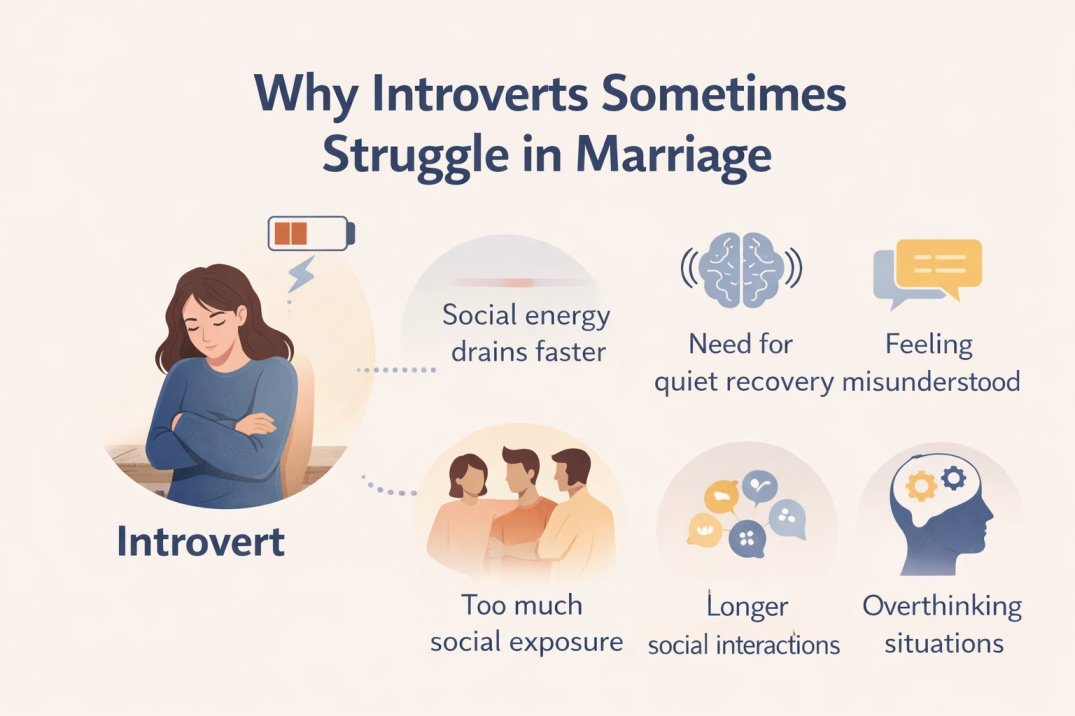
For many introverts, the tension comes from living in a rhythm that does not match how their mind naturally works.
Common internal experiences include:
- Mental overload – Too many interactions, conversations, and social expectations without enough quiet processing time.
- Unspoken expectations – Introverts often expect their partner to sense their limits without having to explain them.
- Feeling emotionally exposed – A socially expressive partner may share thoughts, plans, or relationship details more openly than the introvert feels comfortable with.
- Loss of internal space – Introverts need mental privacy to think, reflect, and reset. When life feels constantly interactive, this space disappears.
- Self-doubt – Instead of questioning the situation, introverts often question themselves:
“Why can’t I handle this like my partner does?”
Over time, these internal pressures can make introverts feel like they are the one suffering in the marriage, even when the real issue is simply two different psychological rhythms living together.
Research discussed by the American Psychological Association explains how these traits shape the way people experience social environments and relationships.
Where Introverts Often See Expectation Mismatch in Marriage
Introverts usually don’t reject social life. The friction starts when how they experience situations and how their partner behaves feel misaligned.
Key areas where they often see mismatch:
Social energy timing
- They may enjoy gatherings but only for a while.
- When they feel drained, they expect their partner to pause, sit with them, or leave together.
- If the partner keeps socialising or asks them to stay active, it feels exhausting.
Conversation depth
- They look for conversations about ideas, plans, growth, or meaning.
- If most conversations stay casual or routine, they may feel their deeper side is not engaged.
Quiet personal time
- They expect uninterrupted time to think or reset.
- Teasing, joking, or constant engagement during that time quickly irritates them.
Lifestyle rhythm
- They prefer a slower, calmer routine.
- When the partner prefers frequent outings or constant activity, the pace feels mismatched.
Social media behaviour
- Occasional sharing feels fine.
- But when outings start revolving around posts, photos, or visibility, the experience can feel forced.
Personal boundaries
- They often keep clear distance with people outside the relationship.
- When the partner is more socially open or physically expressive with others, it can feel uncomfortable.
When these expectations are not aligned, introverts start seeing the relationship as out of sync with how they believe a partnership should work.
Why Introverts Sometimes Develop Trust Issues In Marriage
After repeated expectation mismatches, some introverts begin questioning the relationship, even when nothing inappropriate is happening.
Common triggers include:
- Different social openness
When a partner interacts very freely with others, introverts may start wondering whether the relationship boundaries are the same for both. - Emotional depth mismatch
If their partner does not match the same emotional depth in conversations, introverts may quietly wonder, “Are they sharing that depth somewhere else?” - Long social media use or calls
Spending a lot of time chatting online or on calls can feel confusing. Introverts may think, “What is so important there that takes this much attention?” - Internal overthinking
Introverts naturally replay situations in their mind, which can turn small uncertainties into trust questions.
In most cases, these doubts are not about real betrayal, but about difficulty understanding their partner’s behaviour and intentions.
5 Ways to Handle Expectation Mismatch and Trust Issues in an Introvert–Extrovert Marriage
An introvert–extrovert marriage is usually not a weakness. In many cases, these differences bring balance, one partner adds depth and reflection, while the other brings openness and social connection.
The key is learning how to understand your partner’s needs while explaining your own clearly, so personality differences become a source of growth rather than tension.
Understand Your Social Energy Limits
As an introvert, you usually have a clear social energy limit. First understand where that limit is and use your energy during the most meaningful part of the gathering, so you don’t miss the important moments.
Don’t force yourself to match every activity. Enjoy the event in your own way, while also respecting that your extroverted partner may enjoy dancing, joking, talking, and staying socially active.
It also helps to plan ahead. You can ask your partner to include you during key moments and allow small breaks so you can recharge. Share the meaningful parts together, conversations, photos, memories, without turning your comfort level into strict rules your partner must follow.
Share Your Communication Style and Needs
Introverts often feel things deeply and notice details others may miss. Because of this, they may start believing their way of seeing life is the “right” depth a relationship should have. Sometimes this leads to quietly pushing their ideas onto their partner.
Remember, your partner has lived a life too and carries their own experiences. Instead of correcting their perspective, try to see the world through their experiences. What do they enjoy? Why does it matter to them?
At the same time, share what feels meaningful to you. Explain why certain conversations or small emotional moments, even something like their smile, feel important.
Don’t try to act perfectly or prove whose way is better. Approach the relationship like an explorer, curious about each other’s inner world.
Experience Your Partner’s World for a Limited Time
Introverts often see social spaces as noisy or draining, but extroverts usually experience them very differently. For them, these environments are where ideas flow, friendships grow, and opportunities appear.
Notice how your partner stays relaxed in these moments, how they start conversations easily, connect with people, and keep relationships alive. Their wider circle can also become a source of support, information, and unexpected opportunities in life.
Spending some time in that space helps you understand how they see value in connection and networks, even if you don’t want to stay there for long. When you experience this side of their world, it becomes easier to appreciate the strengths they bring into the relationship.
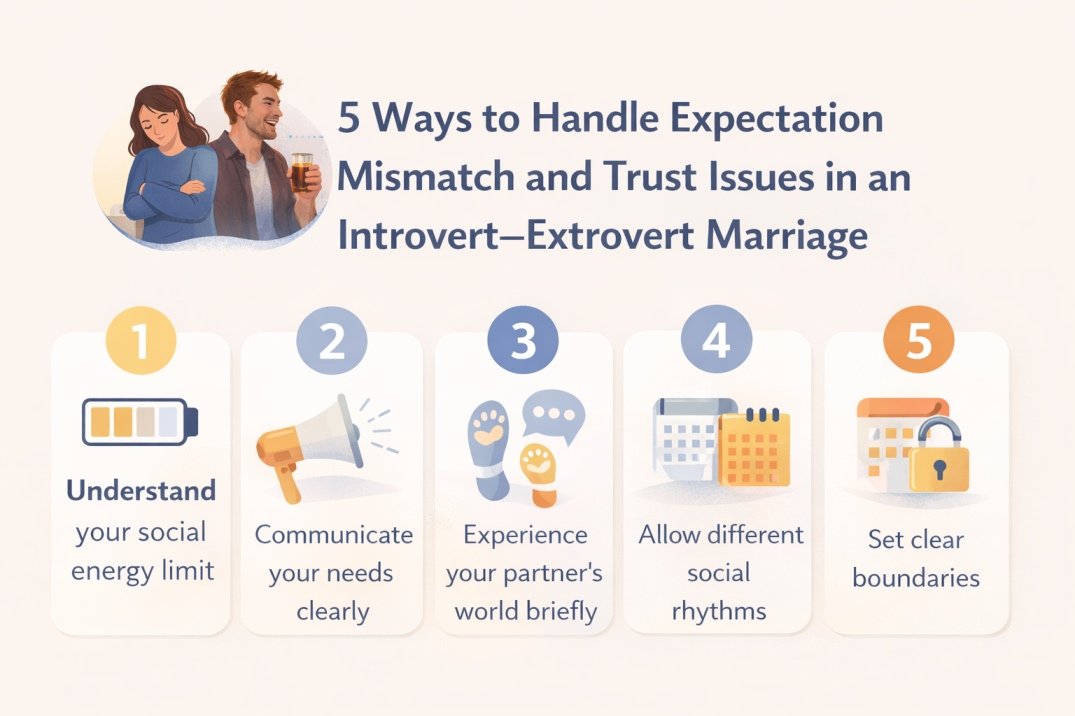
Allow Both Partners to Enjoy Social Life Differently
An introvert–extrovert marriage works best when both partners accept that they don’t have to enjoy social life in the same way. One may prefer quieter interactions, while the other may enjoy staying longer, meeting more people, and keeping the energy going.
Instead of forcing each other to match the same pace, allow flexibility. Sometimes you may join for a while and step away, while your partner continues enjoying the moment. This freedom prevents resentment and helps both partners stay comfortable in their natural rhythm.
Have Clear and Spoken Boundaries in Marriage
Many introverts keep boundaries quietly in their mind and assume their partner will naturally follow them. In reality, boundaries only work when they are spoken clearly and respectfully.
Discuss what feels comfortable for both of you, social behaviour with others, time spent online, personal space, or how much openness you prefer in public settings. When boundaries are openly understood, they reduce unnecessary doubts and help both partners feel secure in the relationship.
Final Thoughts
An introvert–extrovert marriage is rarely the real problem. Most tension comes from unspoken expectations, misunderstood behaviour, and different ways of experiencing social life.
When both partners learn to recognise these differences, communicate their needs clearly, and respect each other’s natural rhythm, the relationship often becomes stronger rather than strained.
If you find yourself repeatedly struggling with expectation mismatches, communication gaps, or trust doubts, speaking with a professional can help bring clarity to the situation.
At LeapHope, our online marriage counselling sessions help couples understand each other’s emotional patterns, communication styles, and relationship needs in a safe and supportive space.
FAQs
Can an Introvert and Extrovert Have a Successful Marriage?
Yes. An introvert and extrovert can have a very successful marriage. They simply experience social life differently. When both partners understand each other’s energy levels and respect those differences, the relationship often becomes balanced and strong.
Why Do Introverts Feel Overwhelmed in Marriage Sometimes?
Introverts can feel overwhelmed when daily life involves too much interaction, conversation, or social activity without enough quiet time. They usually need personal space to recharge their mental energy.
Why Do Introverts Sometimes Develop Trust Doubts in a Relationship?
Introverts tend to think deeply about situations. When something feels unclear, like very open social behaviour or long online conversations, they may start questioning it even if nothing inappropriate is happening.
How Can Introverts Handle Expectation Mismatch in Marriage?
Introverts can handle expectation mismatch by clearly explaining their social limits, discussing boundaries with their partner, and allowing both people to enjoy social life in different ways.
When Should Couples Consider Marriage Counselling?
Couples should consider counselling when the same misunderstandings keep repeating, communication becomes difficult, or trust concerns start affecting the relationship. Professional guidance can help both partners understand each other better.