Many people around 19 feel unmotivated, anxious, unsure of themselves, or even worthless despite appearing “normal” on the outside. This often happens during the transition into adulthood, when expectations increase, but identity, confidence, and direction are still developing. It does not mean you are weak, lazy, or beyond help.
At the start of a counselling session, a 19-year-old student quietly said:
“I have low self-confidence. I doubt myself all the time. I give up easily. Social situations stress me out. Exams make me anxious. My mind is full of negative thoughts. I feel unworthy, unmotivated, and scared to face challenges.”
From the outside, he looked like a typical student managing studies and daily life. Inside, he felt exhausted, lost, and deeply unsure of himself.
Around the late teens and early twenties, especially between 18 and 22, many young people experience a similar internal struggle. Decisions about the future feel urgent, comparison with others becomes constant, and the pressure to “figure life out” can feel overwhelming.
If you recognise yourself in these feelings, this is normal, nothing broken. To understand why this happens, this article helps to look at what you may actually be feeling beneath the surface.
What You’re Really Feeling at 19 (And What’s Causing Them)
If you’re a 19-year-old student, boy or girl, constantly feeling empty, purposeless, useless, and unmotivated, let’s first understand your environment, what you’re feeling, and why.
A Constant Sense of Emptiness or Numbness
At 19, your mind is under constant pressure, even if your day looks normal. You are thinking about studies, future, expectations, and how others see you.
When stress stays for a long time, your brain tries to protect you by dulling emotions. Instead of feeling everything, you start feeling less.
Small daily things, criticism, comparison, uncertainty, lack of control, quietly build up inside. You may not react outwardly, but your mind keeps absorbing it.
Over time, this can lead to numbness. You are not exactly sad or happy, just blank, tired, and emotionally switched off.
Self-Doubt That Never Fully Switches Off
If you’re a student around 17 to 22, your life is full of pressure to perform while you are still figuring yourself out. Exams, career choices, family expectations, and competition make you feel that every decision matters, so your mind keeps checking whether you are good enough.
Growing up in the social media age makes this worse. You see boys and girls your age becoming influencers, earning money online, getting internships, or excelling in studies, and it can feel like everyone else is moving ahead while you are standing still. Even if their lives are only partially real, your brain treats it as proof that you are falling behind.
Because your future feels uncertain and mistakes seem costly, your mind becomes extra alert to criticism, rejection, and comparison. It keeps replaying conversations, decisions, and small errors, trying to prevent failure.
Over time, this turns into constant self-questioning that never fully switches off, making you hesitate, overthink, and trust yourself less, even in simple situations.
Fear About the Future That Feels Overwhelming
Around 17 to 22, you are standing at a point where life is about to change, but nothing feels stable yet. School structure is fading, adult responsibilities are approaching, and there is no clear roadmap telling you what to do next.
Your mind senses this uncertainty as danger. Humans naturally feel safer when the path ahead is predictable, so when everything feels open-ended career, finances, independence, relationships, your brain stays tense and alert.
You may also feel pressure to make “right” decisions too early, as if one wrong step could ruin everything. This makes ordinary choices feel heavy and risky instead of exciting.
As a result, your body carries a constant background anxiety. Even when you are not actively thinking about the future, the worry sits underneath, making it hard to relax, focus, or feel fully present in the moment.
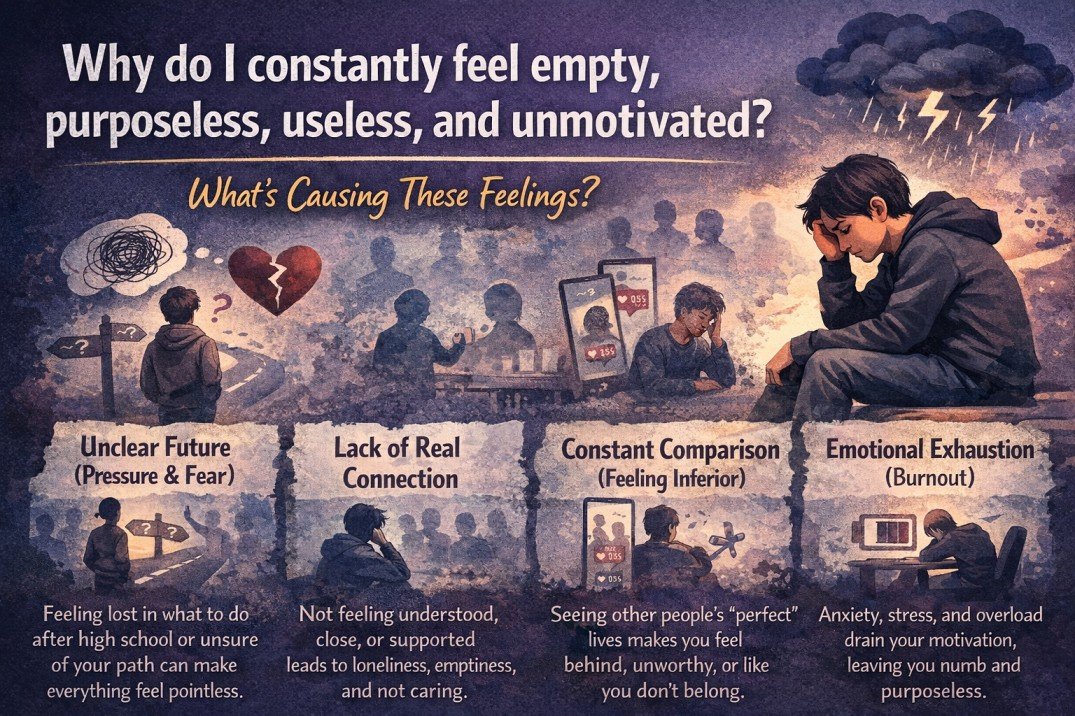
Loneliness Even When You’re Around People
Today’s social life can feel fast, shallow, and unpredictable. Friendships sometimes form around convenience, status, or benefit, and can change quickly. You may see people gossiping, backstabbing, using someone’s weakness, or moving on as soon as something better appears.
Dating can feel unstable too, quick attachments, quick breakups, cheating, or emotional distance, which makes trust harder.
As you begin to notice how people behave behind the scenes, you may become more guarded. Even if you have friends, a boyfriend, or a girlfriend, a part of you holds back because you are unsure who is truly safe to trust.
Instead of openly connecting, you start protecting yourself. You share less, observe more, and keep your real thoughts private. Over time, this creates isolation from the inside, you are surrounded by people, yet emotionally alone because you no longer feel fully secure being yourself.
Mental Exhaustion Without Doing Much
At this age, your brain is rarely at rest. Even when your body is not doing much, your mind may be running nonstop, thinking about studies, future, relationships, money, appearance, expectations, and what others think of you.
Modern life adds constant stimulation. Notifications, short videos, endless scrolling, and information overload keep your brain active without giving it real rest. You may feel busy all day but not satisfied or refreshed.
Stress that is never fully released also builds up quietly. Small worries, pressure to succeed, lack of clear direction, and emotional strain consume mental energy in the background.
As a result, you can feel drained, unfocused, and tired even after a normal day. It is not physical tiredness; it is cognitive and emotional overload, which makes simple tasks feel harder than they should.
Why This Age Feels So Overwhelming: The Psychology of Being Around 19
Around 19, life changes quickly. You move from a structured routine to making your own choices. People expect you to decide your future, even if you are not ready. At the same time, your brain and identity are still developing. This can make you feel confused, pressured, or unsure about yourself.
Common psychological pressures at this age:
- Still figuring out who you are
- Pressure to choose a career or life path
- Loss of routine after school
- More freedom but less support
- Comparing yourself to others
- Changing friendships and loneliness
- Strong emotions and mood swings
- Low or unstable confidence
- Worry about the future
- Fear of failure or falling behind
Many young people feel lost during this stage. This does not mean something is wrong with you. It means you are going through a major life transition.
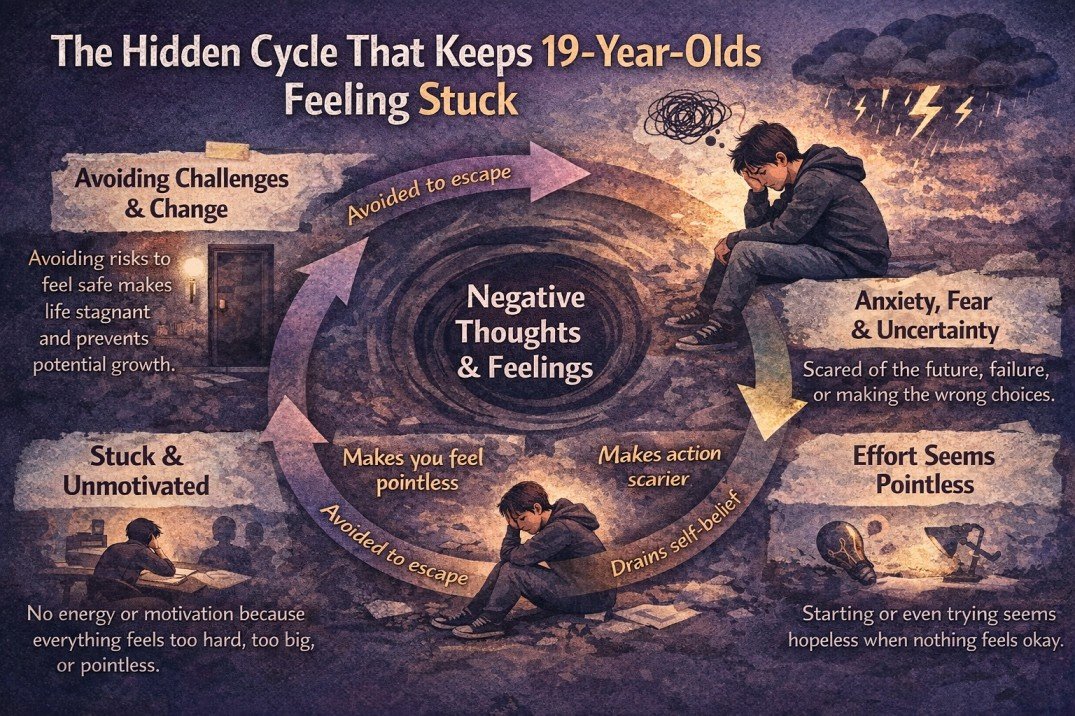
The Hidden Cycle That Keeps You Feeling Stuck
Many students around this age are not stuck because they lack ability, but because their brain has shifted into protection mode. When stress, uncertainty, or fear of failure stays high, the mind focuses on avoiding discomfort rather than moving forward.
The problem is that what protects you in the moment can quietly keep you trapped over time.
Anxiety Leads to Avoidance
Anxiety acts like an internal alarm. When something feels risky, a task, decision, or social situation, your brain signals danger. Avoiding it immediately reduces the discomfort, which teaches your brain that avoidance works.
Avoidance Creates Guilt and Shame
The relief is temporary. Soon you remember what you didn’t do, which creates guilt. If this happens repeatedly, the feeling deepens into shame, where you start believing the problem is you, not the situation.
Shame Damages Confidence
Shame makes you doubt your ability to cope. Your brain starts assuming future challenges will also go badly, reducing your belief that you can handle things effectively.
Low Confidence Fuels Negative Thoughts
With less confidence, your mind becomes more critical and cautious. It begins predicting mistakes, rejection, or failure even before anything happens.
Negative Thoughts Drain Motivation
When your brain expects a bad outcome, effort feels pointless. Motivation drops because the reward no longer seems worth the risk, leaving you feeling stuck even though you want to move forward.
Why You Feel Unmotivated Even When You Want to Change
Many students around this age truly want to improve, study better, look better, be confident, fix their life, but feel unable to act. This is often because their environment constantly sends pressure from all sides. Exams, career worries, dating, appearance, grooming, social expectations, and comparison create a feeling that you must improve everything at once.
Social media makes this heavier. You see people your age looking fit, stylish, successful, socially active, or already earning, which quietly raises your standards for what “normal” should be. Instead of motivating you, it can make change feel overwhelming and never enough.
Past experiences also shape your mindset. If you have faced criticism, rejection, poor results, or embarrassment, your brain remembers those feelings and tries to avoid repeating them. Wanting change then clashes with fear of discomfort.
Over time, your mind becomes overloaded. There are too many areas to fix, too many expectations to meet, and no clear starting point. When everything feels urgent, the brain often shuts down effort altogether, leaving you stuck between wanting change and not having the energy or clarity to begin.
Why You May Feel Deeply Unworthy or “Not Good Enough”
Today’s world expects a lot even from a 19-year-old. You are not only supposed to study well, but also look confident, be socially active, build skills, stay fit, understand money, plan a career, and present a “put-together” life online. It can feel like you are being evaluated from every direction at once.
Many young people feel pressure to grow up faster than they are ready for. You may be asked to make serious decisions about your future while still depending on family, still learning basic life skills, and still trying to understand yourself.
There is also an unspoken expectation to appear strong and independent. Admitting confusion, fear, or struggle can feel like failure, so you keep pushing yourself even when you feel lost inside.
When the gap between what is expected and what you currently feel capable of becomes too wide, your mind can interpret it as personal inadequacy. Instead of seeing unrealistic demands, you start believing that you are the problem.
Over time, this pressure can quietly turn into a deep sense that you are not enough, even though the real issue is how much is being demanded from you at such an early stage of life.
How to Start Changing Your State Without Overwhelming Yourself
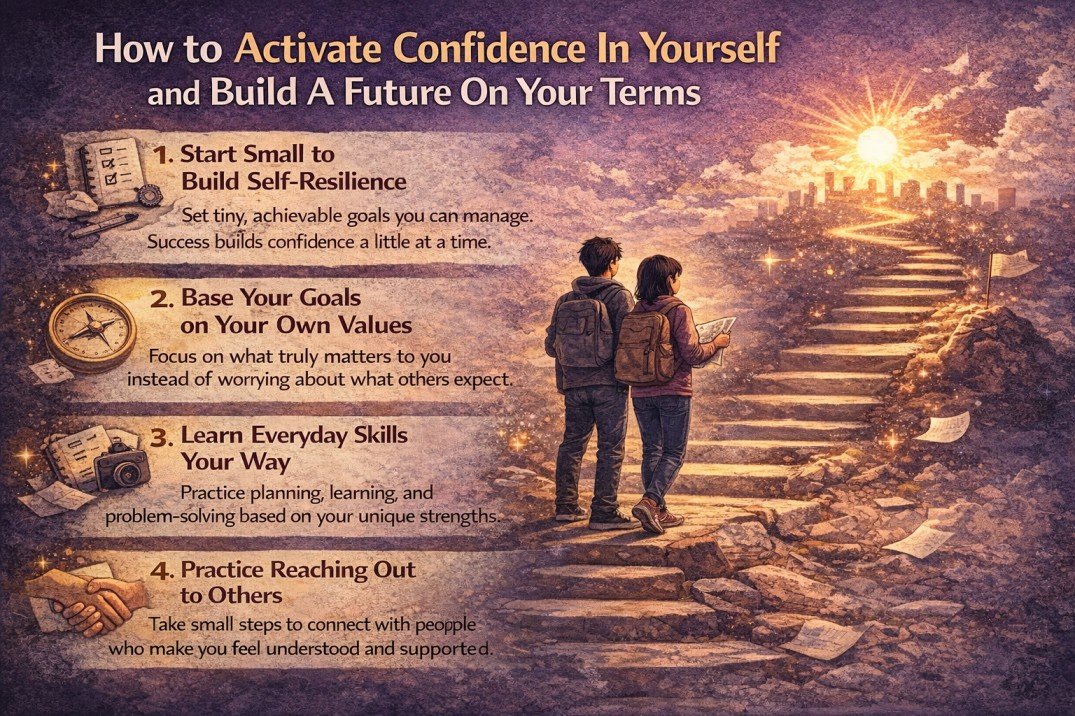
When you feel stuck, trying to fix your entire life at once will only increase pressure. A better approach is to stabilise a few basic areas first so your mind and body have the energy to function.
Stabilise Your Body Before Fixing Your Life
Go to bed and wake up at roughly the same time daily, even if sleep is imperfect. Get sunlight within an hour of waking, eat proper meals instead of skipping or snacking all day, and move your body for at least 15–20 minutes (walk, stretch, or light exercise). These actions regulate your nervous system and improve mental clarity.
Reduce Comparison and Mental Noise
Limit social media to specific times instead of constant scrolling. Unfollow accounts that make you feel inferior or anxious. Keep your phone away during study or sleep time. Reducing digital noise lowers background stress and improves focus.
Take Very Small, Achievable Actions
Choose one priority per day, not ten. Study one chapter, complete one assignment section, clean one small area, or send one important message. Finishing something concrete rebuilds confidence and momentum.
Rebuild Safe Human Connection
Talk to one person you trust, a friend, sibling, parent, mentor, or counsellor. It does not have to be a deep conversation; even regular check-ins or spending time together reduces isolation and emotional load.
Practice Self-Compassion Instead of Self-Attack
Notice harsh self-talk such as “I’m useless” or “I always fail,” and replace it with factual statements like “I’m struggling right now, but I’m trying.” This reduces shame and prevents emotional shutdown, making it easier to keep going.
Small, practical steps done consistently are far more effective than sudden bursts of effort. Stability comes first; progress follows.
How Confidence Actually Builds (Not the Way Social Media Claims)
Confidence is not something you wait to feel, it develops through repeated real experiences. Most people become confident by doing things while unsure, not by eliminating fear first.
- Confidence comes from action: Taking steps despite discomfort teaches your brain you can handle situations.
- Small wins reshape self-image: Finishing tasks and keeping promises to yourself builds trust in your abilities.
- Discomfort signals growth: Feeling nervous or awkward usually means you are stretching beyond familiar limits.
- Repetition builds familiarity: What feels scary at first becomes normal with practice.
- Confidence is quiet stability: It is the belief that you can cope even if things don’t go perfectly.
When to Ask for Professional Help
If these feelings are strong, long-lasting, or affecting your studies, sleep, or daily life, it may be time to talk to a professional. You do not need to wait for things to become severe.
- Persistent sadness, anxiety, or emptiness
- Loss of motivation affecting studies or responsibilities
- Frequent panic or inability to cope with stress
- Sleep problems, appetite changes, or constant fatigue
- Feeling isolated with no one safe to talk to
- Hopeless thoughts or loss of direction
A trained professional can offer a private, non-judgmental space and practical ways to manage what you are going through.
If in-person support is difficult, you can consult an online clinical psychologist at LeapHope, where qualified experts provide structured guidance through secure sessions. Seeking help is a practical step toward stability, not a sign of weakness.
Feeling Lost at 19 Does Not Mean Your Future Is Lost
Being confused or directionless at 19 is far more common than it appears. Most people do not have a clear path yet, even if they seem confident from the outside.
Life can change faster than it feels right now. By your mid-20s, many people find themselves in a completely different place, financially, emotionally, and in relationships, often far ahead of where they once feared they would be.
Struggling now is not wasted time. It builds resilience, skills, and self-understanding that last far longer than quick success based on trends or shortcuts. External achievements can shift suddenly, but inner capability stays with you.
Your situation may feel uncertain, but it is temporary. Keep learning, keep moving forward, and trust that this phase is shaping a stronger version of you, one that will later be grateful for surviving it.
Final Thoughts
If you are struggling at 19, it does not mean you are weak, flawed, or destined to fail. It means you are going through a difficult stage of growth that many people experience but rarely talk about openly.
You do not have to solve everything immediately. Small steps, time, support, and self-understanding can gradually change how you feel and how your life unfolds.
Most importantly, you are not alone in this experience, and you are not beyond hope. Even if it doesn’t feel like it now, things can improve, often in ways you cannot yet imagine.
FAQs
Why do I feel empty, purposeless, useless, and unmotivated at 17 or 19?
If you feel empty and unmotivated at 17 or 19, it usually means you are overwhelmed, unsure about your future, or lacking emotional connection, not that you are useless. This age brings pressure to figure life out while you are still developing confidence and identity, which can make everything feel pointless.
Is it normal to feel extremely alone even when I have people around me?
Yes, it is normal to feel alone even when people are around you. Emotional loneliness happens when you don’t feel understood, safe to open up, or truly connected, not just when you physically have no one.
Why do I have no motivation even though I want to change my life?
If you want to change but have no motivation, your brain may be exhausted from stress, anxiety, or overthinking. When everything feels overwhelming, the mind shuts down effort to protect you, which makes starting feel almost impossible.
I don’t know what to do with my future and it scares me. What should I do?
If your future scares you, start by focusing on small next steps instead of trying to solve your whole life. Exploring interests, building basic skills, and gaining experience gradually reduces fear and brings clarity over time.
Why does my confidence disappear in school or social situations?
Confidence often drops in places where you feel judged or evaluated. Anxiety can make you overaware of yourself, so you feel small or incapable even though your abilities haven’t actually changed.
When should I get professional help for anxiety, loneliness, or hopelessness?
You should consider professional help if anxiety, loneliness, or hopelessness lasts for weeks or months, affects your daily life, or makes you withdraw from people and activities. Getting support early can make recovery much easier.