Last Updated on March 29, 2026
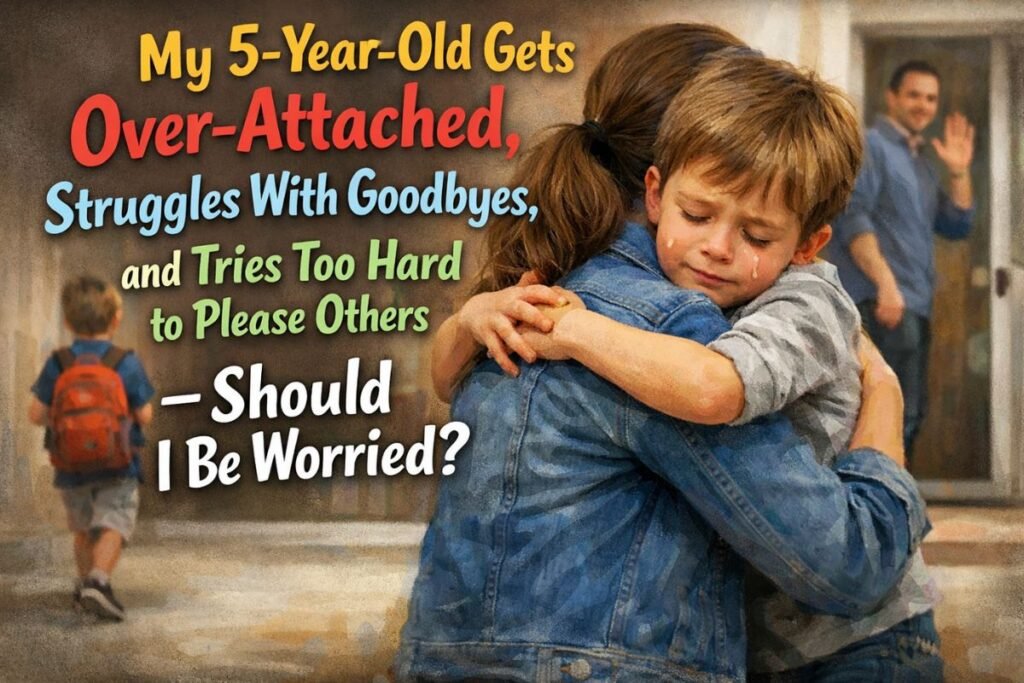
It usually doesn’t start as a big concern.
Your 5-year-old hesitates a little longer at the school gate, holds your hand tighter than before, or asks, “You’ll come back, right?” You reassure them, they settle, and the day moves on.
But then you begin to notice a pattern. The goodbyes don’t get easier. At home, your 5-year-old tries very hard to behave, avoids doing anything wrong, and looks at you for approval more often than before.
This is where many parents pause and wonder, “Is this just a phase, or is something else going on?”
At age 5, children are not just attached, they are becoming emotionally aware. A 5-year-old starts to notice reactions, approval, and the possibility of getting things wrong, but still depends heavily on closeness to feel secure. So when that sense of safety feels uncertain, even slightly, it can show up as clinginess, difficulty with goodbyes, and trying too hard to please.
This behaviour is not random, and it is not attention-seeking. It usually reflects how your child is experiencing safety, connection, and acceptance at this stage.
Understanding what sits underneath this pattern helps you respond in a way that actually builds confidence, instead of unknowingly reinforcing the anxiety.
The Problem: What You’re Seeing in Your 5-Year-Old
With a 5-year-old, this usually shows up in small, repeated moments rather than one big behaviour.
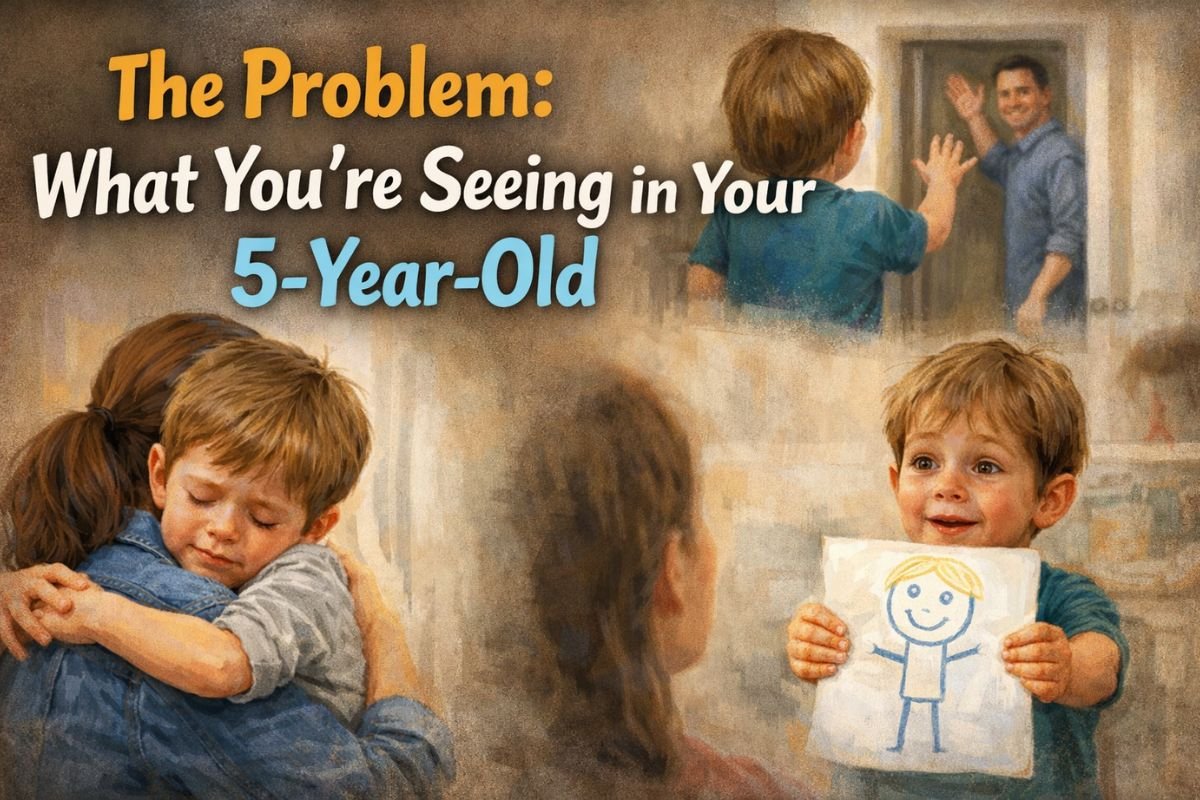
You may notice that your 5-year-old:
- Cries, freezes, or resists during goodbyes, even in familiar places like school
- Holds on physically, not wanting to let go easily
- Asks the same reassurance questions again and again
- Struggles to stay or play independently without checking for you
- Tries very hard to behave “perfectly” to avoid correction or disapproval
In many cases, these behaviours happen together. The same 5-year-old who finds separation difficult may also be the one who is unusually careful, overly polite, or constantly watching your reaction.
This is what makes it confusing for parents. It doesn’t look like typical misbehaviour. Instead, it looks like a child who is trying too hard, staying too close, and needing a bit more emotional certainty than expected for their age.
At 5, these patterns are often subtle but consistent, and they tend to appear most during transitions, like school drop-offs, social situations, or moments when your child feels unsure about your response.
This stage is closely linked to how children understand emotions by age, where a 5-year-old begins to notice approval and emotional responses more clearly.
What This Means Psychologically at Age 5
At age 5, your child is going through an important emotional shift. A 5-year-old is no longer just reacting to situations, they are beginning to think about how others see them.
This is the stage where approval starts to matter.
Your 5-year-old may not say it directly, but internally they are trying to understand:
- “Will you come back when you leave?”
- “Am I still loved if I make a mistake?”
- “What do I need to do to feel safe?”
Because emotional regulation is still developing, these questions don’t stay as thoughts, they show up as behaviour. Clinging during goodbyes, needing reassurance, and trying hard to please are all ways a 5-year-old manages that uncertainty.
At the same time, imagination is strong at this age. A small separation can feel much bigger internally. Waiting feels long. Uncertainty feels uncomfortable. So your child tries to reduce that discomfort in two ways, by staying close, and by behaving in a way that keeps connection secure.
This is why a 5-year-old can seem both dependent and overly careful at the same time. It’s not about being difficult. It’s about trying to feel emotionally safe in situations that feel unpredictable to them.
These behaviours are not random, they often reflect why children express emotions through behaviour, especially when they cannot explain what they feel.
The Solution: How to Help Your 5-Year-Old Feel Secure Without Increasing Dependence
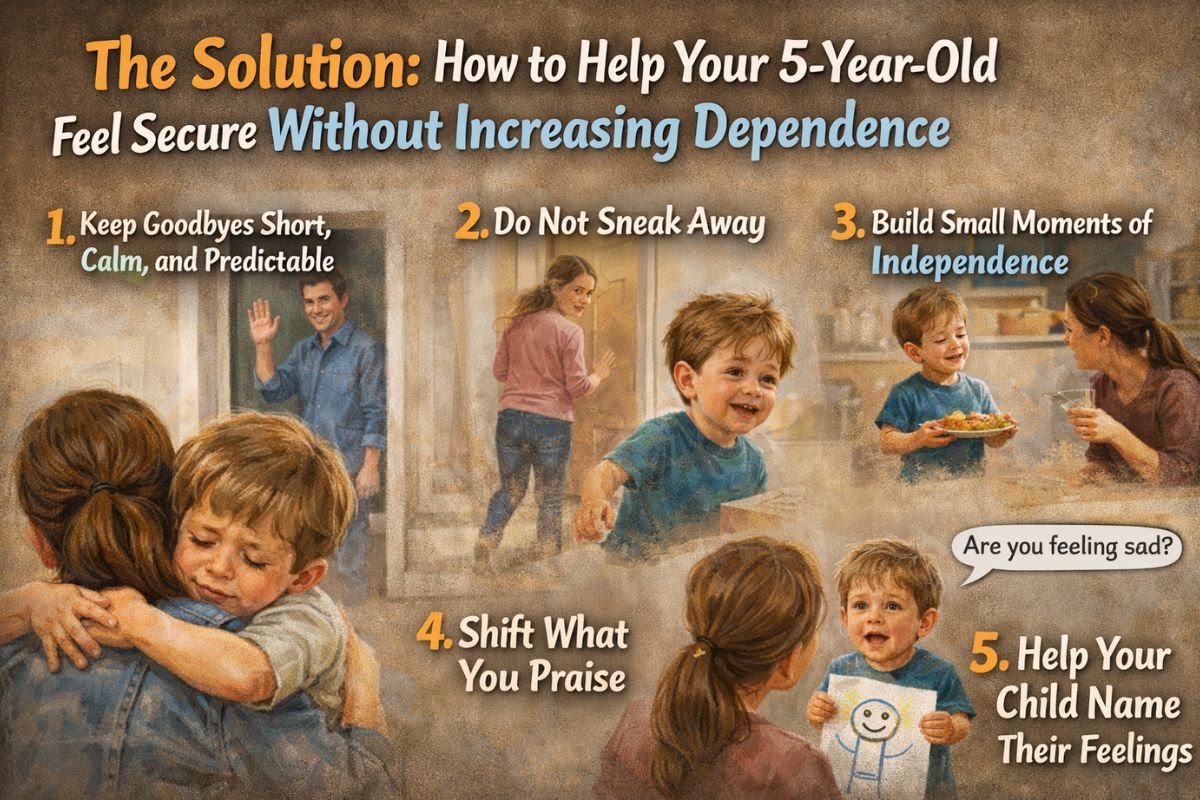
Keep Goodbyes Short, Calm, and Predictable
For a 5-year-old, the goodbye moment is not just about separation, it’s about how safe that separation feels. When goodbyes become long, emotional, or inconsistent, your child starts focusing more on the fear than the routine.
What helps instead is predictability. Use the same short pattern every day, a hug, one clear sentence, and leaving without hesitation. For example, “I’ll be back after school. You’re safe here.” When your response stays the same, your 5-year-old slowly stops scanning for danger in that moment.
It may not reduce tears immediately, but over time, it reduces anxiety because the situation becomes familiar and expected.
Do Not Sneak Away
It can feel tempting to leave quietly when your 5-year-old is distracted, especially if goodbyes are emotional. But when a child realises you’ve disappeared without warning, it creates a deeper sense of uncertainty.
A 5-year-old begins to think, “If they can leave without telling me, how do I know when they’ll go?” This increases clinginess, not reduces it.
Saying goodbye clearly, even if it leads to tears, actually builds trust. Your child learns two important things, you leave, and you come back. That repeated experience is what creates emotional security over time.
Build Small Moments of Independence
Independence at this age doesn’t come from pushing your child away, it comes from helping them feel safe without constant closeness.
Start very small. Ask your 5-year-old to play alone for 5–10 minutes while you stay nearby. Gradually increase the distance or time as they become comfortable. The key is to let them experience success in being on their own, without overwhelming them.
When a 5-year-old realises, “I can stay okay even when Mum or Dad is not right next to me,” confidence builds naturally.
Avoid sudden or forced independence, it often backfires and increases anxiety.
In some cases, this pattern may reflect hidden anxiety in children, especially when behaviour looks “good” on the surface but is driven by fear.
Respond Calmly Instead of Repeating Reassurance
When your 5-year-old keeps asking, “Will you come back?” or “Are you sure?”, it can feel natural to keep reassuring them again and again.
But repeated reassurance can unintentionally signal that there is something to worry about.
Instead, answer once in a calm, confident tone. Then gently shift attention or stay steady without adding more explanation. Your emotional stability teaches your 5-year-old that the situation is safe.
At this age, children don’t just listen to words, they absorb your confidence.
Shift What You Praise
If your 5-year-old is trying too hard to please, constantly behaving perfectly or avoiding mistakes, it’s important to look at what they are being reinforced for.
When praise is only given for being “good,” quiet, or obedient, a child may start believing that love depends on performance.
Instead, begin praising:
- Effort (“You tried that on your own”)
- Expression (“I’m glad you told me how you feel”)
- Curiosity (“You asked a good question”)
This helps your 5-year-old understand that they are valued not just for pleasing others, but for being themselves.
Help Your Child Name Their Feelings
A 5-year-old feels emotions strongly but often doesn’t have the language to understand them. When feelings are unclear, they come out as behaviour, like clinging, crying, or over-pleasing.
You can help by simply naming what you see:
- “You feel nervous when I leave”
- “You wanted me to stay longer”
This does two things. It makes your child feel understood, and it helps organise their emotions internally.
Over time, a 5-year-old who can recognise and name feelings becomes less overwhelmed by them, and that naturally reduces anxious behaviour.
Understanding when to be concerned about a child’s emotional health can help you decide whether your 5-year-old needs additional support.
Reducing People-Pleasing Without Shaming Your 5-Year-Old
When a 5-year-old starts trying too hard to please, the behaviour is usually quiet and consistent. They agree quickly, avoid saying no, and watch your reaction before responding. This is less about manners and more about avoiding disapproval.
Instead of focusing on stopping the behaviour, shift what your child learns from your responses.
If your 5-year-old always agrees or stays overly careful, do not reinforce only that pattern. Notice and respond when they express a different opinion, even briefly. A simple, calm response to disagreement shows that saying “no” does not affect your connection.
Be mindful of linking behaviour with approval. If attention or praise comes mainly when your 5-year-old is “good,” they begin to rely on that pattern. Keep your response steady even when they are not trying to impress.
Give small, real choices during the day. Let your 5-year-old decide between options and follow through without correction. This builds a sense of control that is not based on pleasing others.
When mistakes happen, keep your reaction neutral and predictable. A strong reaction increases caution. A steady response reduces the need to get everything right.
Over time, your 5-year-old stops relying on approval to feel secure, and the need to please begins to reduce naturally.
When to Seek Professional Support for Your 5-Year-Old
If your 5-year-old’s behaviour stays intense despite consistent support at home, it may need closer attention.

You should consider professional support if your 5-year-old:
- Has strong distress during separation that does not reduce over time
- Avoids school, activities, or social interaction regularly
- Shows frequent physical symptoms like stomach aches before separation
- Constantly seeks reassurance and struggles to feel settled
- Becomes overly fearful of making mistakes or doing something wrong
Also notice the duration. If these patterns continue for several weeks or months without improvement, it is less likely to settle on its own.
At this stage, support is not about labelling your 5-year-old, it is about understanding what they are feeling and helping them build emotional security in a structured way.
Early guidance can prevent these patterns from becoming long-term anxiety, and helps your 5-year-old feel more confident in everyday situations.
Final Thought
What you’re seeing in your 5-year-old is not random behaviour. The clinginess, the difficulty with goodbyes, and the need to please are all connected to one thing, how safe and secure your child feels in moments of separation and evaluation.
At age 5, children are still learning that love stays the same, even when distance, mistakes, or uncertainty come in. Until that feels stable, they stay closer, try harder, and look for reassurance.
This does not mean something is wrong with your 5-year-old. It means they are in a stage where emotional security is still being built.
Your role is not to remove the behaviour quickly, but to respond in a way that makes your child feel steady over time. When your responses stay calm, predictable, and accepting, your 5-year-old slowly stops relying on closeness and approval to feel secure.
That is when independence begins to develop naturally, without force.