

Reviewed by: Aradhana Gambhir
Sometimes money problems in a marriage are not really about money. They are about secrecy.
Maybe your spouse suddenly hides bank notifications, avoids talking about spending, opens a credit card you did not know about, or keeps making financial decisions without telling you. At first, these things may seem small. But over time, they can slowly break trust in the relationship.
Financial infidelity happens when one partner hides important money matters from the other. This can include secret debt, hidden spending, private accounts, or lying about finances. For many couples, the emotional pain comes from the dishonesty, not just the money itself.
Today, financial secrecy can happen through payment apps, online shopping, digital wallets, hidden subscriptions, gambling apps, or private transactions that are easy to hide. If the secrecy keeps happening even after serious conversations, it can become a pattern of repeated financial infidelity.
Below are some of the most common signs of financial infidelity in a relationship.
What Is Financial Infidelity?
Financial infidelity happens when one partner hides important money matters from the other. This can include secret debt, hidden credit cards, private bank accounts, lying about spending, or making big financial decisions without telling their spouse.
Having personal spending money is not the problem. The real issue is secrecy and dishonesty around money inside the relationship.
10 Signs Your Spouse May Be Guilty of Financial Infidelity
1. They Hide Bank Accounts, Credit Cards, or Loans
Some people secretly keep old bank accounts, hidden savings, or large amounts of money their spouse never knew existed, even during serious financial struggles in the marriage.
Others hide credit cards with heavy spending that was never discussed or explained. Their partner may have no idea what was purchased, how much debt exists, or where the money actually went.
In some marriages, a husband or wife may claim an old student loan, personal loan, or credit card debt was already paid off. Later, their partner discovers the balance is still active and much larger than they were told.
2. They Lie About Spending
Some spouses regularly hide what they spend money on or lie about how much something actually cost. A purchase may be described as “not that expensive” when the real amount was much higher.
In some marriages, money quietly disappears through online shopping, gambling apps, subscriptions, gaming, food delivery, or private purchases that were never discussed openly. Some partners also secretly send money to family members, siblings, or relatives without telling their spouse, especially when the amounts become large or frequent.
Over time, repeated dishonesty about spending can damage trust and make a partner feel confused about where the money is actually going.
3. They Accumulate Debt Without Telling You
Some people secretly build up large debt without their spouse knowing. This may include hidden credit card balances, gambling losses, personal loans, buy-now-pay-later payments, or debt from online spending that slowly grows over time.
In many marriages, the partner only discovers the problem after collection calls, loan applications, missed payments, or serious financial stress. Sometimes the debt has already reached a level that affects savings, future plans, or even the family’s financial stability.
4. They Hide Financial Notifications or Statements
Some spouses start hiding banking alerts, deleting payment notifications, or keeping financial emails away from their partner. They may suddenly change passwords, remove shared access, or turn off account visibility that was previously open in the relationship.
In many cases, this behaviour starts after hidden spending, debt, or financial activity begins building up. Over time, the secrecy itself can become just as damaging as the money problem.
5. They Make Big Financial Decisions Without You
Some spouses make major financial decisions without discussing them with their partner first. This may include taking loans, making risky investments, buying expensive items, purchasing property only in their own name, or secretly sending large amounts of money to someone else.
In a healthy marriage, major financial decisions are usually discussed together. When one partner repeatedly makes these choices in secret, it can create feelings of betrayal, exclusion, and loss of trust.

6. Money Keeps Disappearing From Shared Accounts
You may start noticing money disappearing from shared accounts without a clear explanation. This can include repeated cash withdrawals, unknown bank transfers, missing savings, or payments your spouse cannot properly explain.
Sometimes the amounts are small at first. Over time, the missing money becomes harder to ignore, especially when the explanations stay vague or keep changing.
7. They Become Defensive About Money Conversations
Some spouses become unusually defensive whenever money is discussed. Simple questions about spending, debt, savings, or bank activity may quickly turn into arguments, avoidance, anger, or complete shutdown.
Stress around money is common in many marriages. But constant defensiveness combined with secrecy can sometimes point to hidden financial problems or dishonesty in the relationship.
8. They Exclude You From Financial Access
Some spouses slowly remove their partner from important financial information or access. This may start with changed passwords, hidden account details, blocked banking access, or refusing to share updates about savings, debt, investments, or major expenses.
Over time, one partner may take control of financial decisions while the other is left unaware of what is happening with the family’s money. In serious cases, a husband or wife may not even know how much debt exists, where savings are kept, what accounts are active, or how bills are being paid.
This kind of financial secrecy can create a deep sense of helplessness and betrayal, especially when financial transparency existed earlier in the marriage.
9. Their Financial Story Does Not Add Up
Sometimes the numbers and explanations simply stop making sense. Your spouse may say they are struggling financially while still spending heavily, hiding purchases, or moving money in ways they cannot clearly explain.
Income details may stay vague, savings never seem to grow, bills keep increasing without explanation, or important financial information changes every time you ask about it.
Over time, these inconsistencies can create confusion and suspicion that important parts of the financial reality are being hidden.
10. Repeated Financial Infidelity: The Secrecy Continues Even After You Talk About It
In some marriages, the biggest warning sign is not the first financial secret. It is the fact that the hiding continues even after serious conversations about trust and honesty.
A spouse may promise to stop hiding spending, share account access, or be honest about debt, but new lies, hidden transactions, private accounts, or unexplained financial activity keep appearing.
When this happens repeatedly, it may be a pattern of repeated financial infidelity rather than a one-time financial mistake. Over time, this can seriously damage trust and emotional safety in the relationship.
Financial Infidelity vs Financial Abuse
Financial infidelity and financial abuse are not always the same thing, but both can seriously damage a relationship.
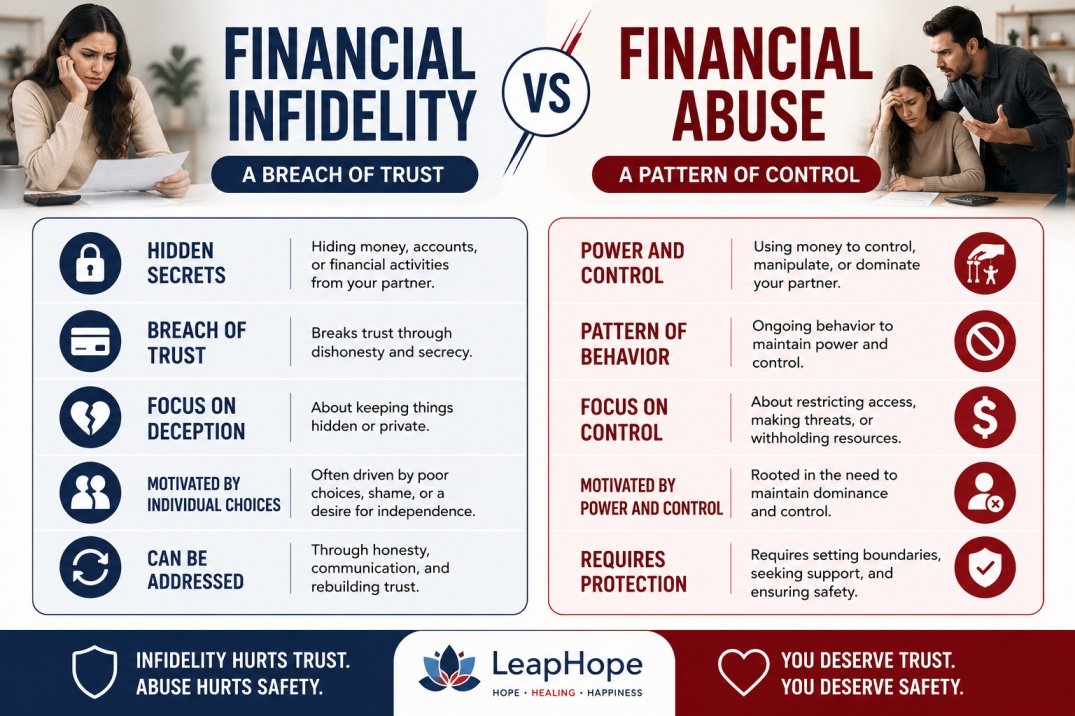
Financial infidelity usually involves secrecy and dishonesty around money. This may include hidden debt, secret spending, private accounts, lying about finances, or making major financial decisions without a partner’s knowledge.
Financial abuse is more about control. One partner may control the money, restrict access to bank accounts, closely monitor spending, prevent the other person from working, or make them financially dependent.
In some relationships, both can happen together. A spouse may hide money while also controlling the other partner’s access to financial information or decisions. Over time, this can create fear, confusion, loss of independence, and serious emotional stress.
What To Do If You Suspect Financial Infidelity
- Focus on the facts first. Finding hidden debt, secret spending, or financial dishonesty can be deeply upsetting. Try to understand what has actually happened before reacting to assumptions.
- Look for patterns. One unexplained purchase is different from repeated financial infidelity involving ongoing lies, hidden debt, secret accounts, or changing explanations.
- Have one direct conversation. Explain what you discovered and ask clearly about the financial activity you do not understand.
- Talk about the broken trust too. For many couples, the problem is not only the amount of money involved. It is discovering that important financial information was deliberately hidden.
- Get support if the pattern continues. If financial dishonesty keeps happening or every conversation turns into conflict, consider marriage counseling or financial therapy. Professional support can help couples work on communication, accountability, transparency, and trust.
When to Seek Couples Therapy
Couples therapy may be worth considering when:
- money conversations repeatedly turn into arguments, avoidance, or emotional shutdown
- your spouse continues hiding spending, debt, accounts, or other financial activity after the issue has already been discussed
- repeated financial infidelity has made it difficult to trust what you are being told
- financial stress is beginning to affect your mental health, emotional connection, or marriage stability
Financial infidelity can also be connected with stress, shame, anxiety, compulsive spending, or wider relationship problems. Understanding what is driving the secrecy can be important if both partners want to repair the relationship.
At LeapHope, we provide online therapy for emotional and psychological struggles, along with online marriage counseling for couples dealing with financial conflict, broken trust, and relationship stress.
Final Thoughts
Financial infidelity can quietly damage trust, emotional safety, and connection in a marriage. In many relationships, the secrecy hurts as much as, or more than, the money itself.
If it becomes a repeated pattern, promises alone may not rebuild trust. Honest communication, accountability, and consistent financial transparency are important if the relationship is going to recover.
FAQs
What is repeated financial infidelity?
Repeated financial infidelity is a pattern of hiding debt, spending, accounts, transfers, loans, or other financial activity after the issue has already been discussed. It shows that the problem is not one financial mistake, but ongoing secrecy and dishonesty around money.
What are the signs that your spouse is lying about money?
Signs include hidden credit cards or loans, unexplained withdrawals, secret accounts, deleted banking notifications, changing explanations about money, undisclosed debt, and spending that does not match what your spouse tells you. Repeated inconsistencies are a strong sign that important financial information is being hidden.
Is financial infidelity the same as financial abuse?
No. Financial infidelity is hiding or lying about money. Financial abuse is using money as a form of control, such as restricting access to bank accounts, preventing a partner from working, taking their income, controlling every purchase, or deliberately making them financially dependent.