
Last Updated on February 19, 2026
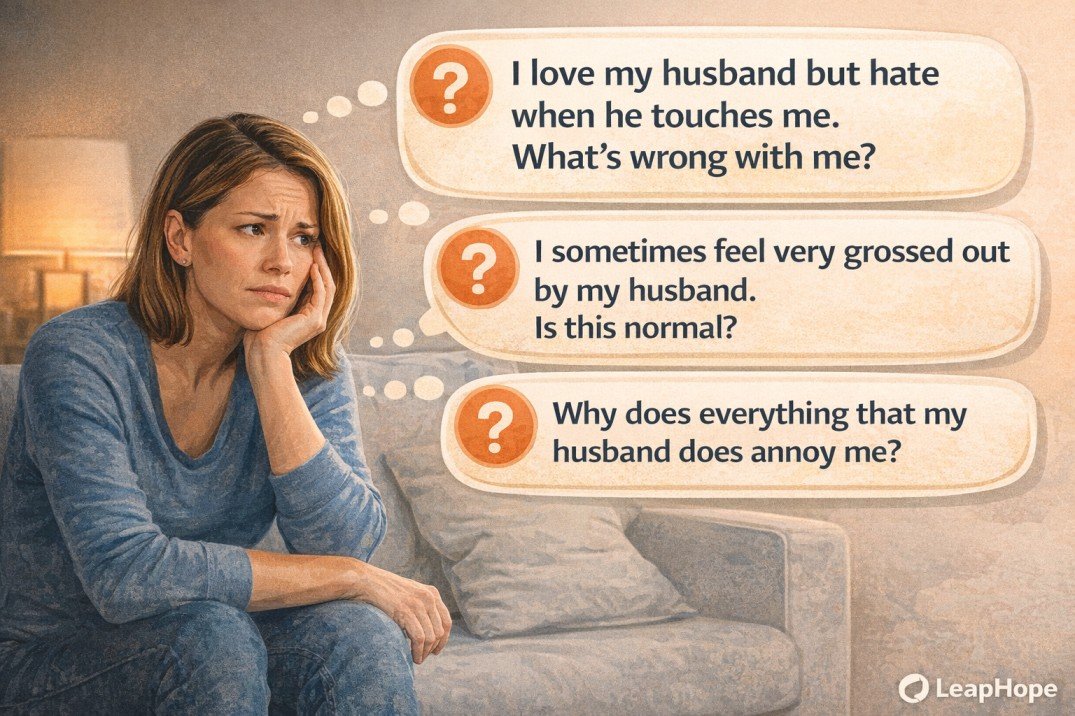
Why does your husband’s touch make you want to move away instead of closer?
For many women, this feeling starts small. You stop enjoying hugs. You tense up when he comes near. You let it pass without saying anything. Over time, the reaction becomes stronger, and your body pulls back before you even think about it.
This usually doesn’t happen overnight. It builds when discomfort keeps getting ignored. Maybe you felt emotionally alone for a long time. Maybe you were touched when you didn’t want to be. Maybe you kept adjusting yourself to avoid conflict. After a while, your body stops cooperating, even if your mind is still trying to hold the marriage together.
Feeling disgusted does not mean you are broken or heartless. It often means your body has reached a limit that words never express. This article looks at why you feel disgusted when your husband touches you, by naming the real reasons this reaction develops, without sugar-coating or blame.
What Does Feeling “Disgusted” by Your Husband Actually Mean?
What does it mean when your husband’s touch triggers a physical pushback instead of comfort?
When physical closeness happens without emotional readiness, the body often reacts before words do. This is why boundaries around touch matter more than people admit, as explained in this piece on the do’s and don’ts of physical intimacy in marriage.
- It usually does not mean you dislike your husband as a person.
The reaction is about closeness, not character. - Disgust is different from low interest or tiredness.
Low interest feels neutral. Disgust feels sharp. Your body tightens, pulls away, or reacts before you decide to. - This response often develops when you have gone along with touch you were not emotionally ready for.
Even small moments of forcing yourself add up over time. - Many women experience this after staying quiet to avoid conflict.
When saying “no” feels unsafe or inconvenient, the body starts saying it instead. - Once touch becomes linked to pressure or emotional mismatch, the body learns to protect itself.
That protection shows up as irritation, aversion, or outright disgust.
Why This Feeling Often Appears Suddenly (Even If Love Is Still There)
Why does it feel like this started all at once?

- Most of the time, it didn’t start suddenly.
You adjusted, ignored, or brushed things off for a long time. The body noticed even when you didn’t. - Discomfort builds quietly.
Being talked over, feeling emotionally alone, or going along with things you didn’t want does not create an immediate reaction, but it stays stored. - The mind keeps making excuses.
You tell yourself it’s normal, manageable, or not worth a fight. The body doesn’t negotiate the same way. - Physical closeness exposes what words hide.
Touch is where emotional mismatch becomes impossible to ignore. - Love doesn’t cancel out this response.
You can care about your husband and still feel your body pull away from him.
Why Your Body Reacts Before Your Mind Understands
Many women feel confused because they still “care” about their husband, yet their body recoils from touch. This disconnect happens because the nervous system reacts faster than conscious thought.
When emotional safety erodes over time, whether through criticism, emotional neglect, repeated conflict, or pressure around intimacy, the body begins to register touch as stress rather than comfort. The brain’s threat detection system becomes more alert. Even if there is no immediate danger, your body may tense, pull away, or feel a wave of disgust.
Disgust, psychologically, is a protective emotion. It evolved to keep us away from what feels unsafe, contaminated, or boundary-violating. In relationships, it can surface when your emotional boundaries have been crossed repeatedly, even in subtle ways.
This does not mean your husband is a “bad person.” It means your nervous system has started associating closeness with emotional strain.
Your body is not overreacting. It is communicating.
Is This Low Desire, Sexual Aversion, or Emotional Shutdown?
Not all intimacy struggles are the same. It helps to differentiate.
Low desire usually feels neutral. You may not crave sex, but you are not repulsed by it. With the right context, desire may return.
Sexual aversion feels stronger. There may be tension, dread, irritation, or disgust specifically around touch or sexual initiation. Your body may tighten before you consciously decide how you feel.
Emotional shutdown feels different again. You might feel numb, detached, or indifferent. The relationship feels distant overall, not just sexually.
Many women confuse these states and blame themselves for “losing libido.” But when disgust is present, it is rarely just about hormones. It is often about unresolved emotional dynamics inside the marriage.
Understanding which state you are in helps determine what kind of repair is needed. Hormonal changes require medical support. Emotional aversion requires relational repair. Shutdown requires reconnection at a deeper level.
15 Reasons Why You Feel Disgusted When Your Husband Touches You
When emotional presence fades, physical closeness often follows the same path. Many couples notice this shift long before they name it, especially when intimacy starts fading in marriage without a clear reason.
1. Unspoken Resentment
This often starts with small things. A comment that hurt. A moment where you felt dismissed. You chose not to react because it felt easier to stay quiet. One time becomes many.
Those feelings don’t vanish. They sit in the background. When your husband touches you, your body remembers what your mouth never said. The touch doesn’t feel neutral anymore. It feels connected to all the irritation you kept inside.
The disgust is not about that hug or that moment. It is about how long you have been carrying things alone.
2. Feeling Emotionally Ignored for Too Long
When your feelings are brushed off again and again, something shifts inside. You may still talk, manage the home, or share daily life, but emotionally, you stop expecting to be met.
Touch in this state can feel wrong. Your body reacts because closeness is happening without an emotional connection. Instead of comfort, it feels empty or irritating.
This isn’t about needing constant attention. It’s about what happens when emotional presence is missing for too long and physical closeness keeps happening anyway.
3. Being Touched When You Were Not Ready
This does not have to mean force. Often, it is much quieter than that. A hug when you were upset. A sexual advance when you were tired or emotionally off. Moments where you went along because saying no felt uncomfortable.
When this happens repeatedly, the body starts preparing itself in advance. It tightens. It pulls back. Over time, touch becomes something to endure, not receive.
The disgust is your body trying to prevent another moment where your comfort comes second.
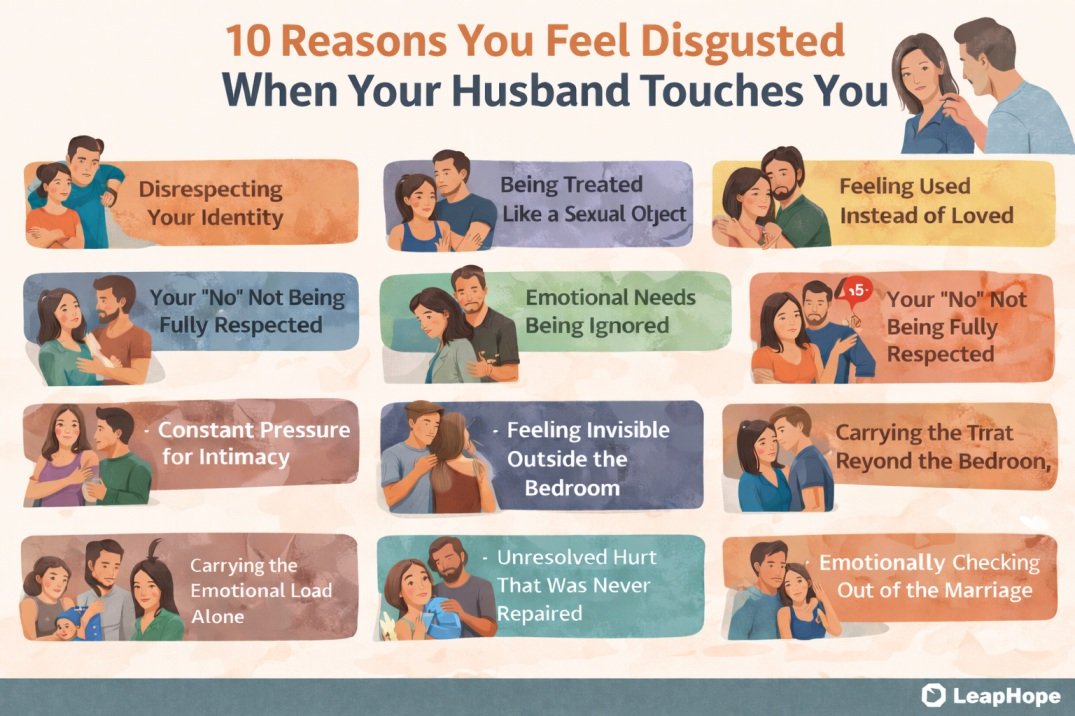
4. Sex Starting to Feel Expected, Not Chosen
When intimacy turns into something assumed, the meaning of touch changes. You may sense that affection is leading somewhere you are not ready for, so your body goes on alert.
Instead of warmth, you feel pressure. Instead of closeness, you feel obligation. Over time, even a simple touch can trigger irritation because it no longer feels optional.
Disgust often grows when your body feels it has lost the right to choose.
5. Loss of Respect After Repeated Behaviour
Respect doesn’t disappear after one incident. It wears down slowly. Repeated broken promises, careless words, or behaviour that keeps hurting you can change how you see your husband over time.
When respect drops, touch often feels wrong. Your body reacts because closeness no longer matches how you feel inside. Even if love is still there, attraction struggles to survive without respect.
The disgust is your body responding to that mismatch. Some couples assume the solution is excitement or novelty, but reconnecting emotionally works very differently than quick fixes suggested in popular advice. That misunderstanding is explored further in ways to build connection again.
6. Carrying the Emotional Load Alone
When you are the one holding everything together, something shifts. You remember appointments, smooth over conflicts, manage feelings, and keep things running. Your husband may not even notice how much you carry.
In this state, being touched can feel unfair. Your body reacts because you are already stretched thin, and closeness feels like another demand rather than support.
The disgust comes from exhaustion, not from a lack of care.
7. Touch Without Emotional Presence
Touch feels different when the person isn’t really there. Your husband may be physically close, but emotionally distracted, distant, or disconnected.
In those moments, your body notices the gap. The touch feels mechanical or empty, not comforting. Over time, that emptiness turns into irritation.
Disgust shows up when your body keeps being asked to accept closeness without feeling met.
8. Saying Yes to Avoid Conflict
Sometimes you agree to touch or intimacy because saying no feels like it will create tension. You don’t want an argument. You don’t want sulking or distance. So you go along with it.
Your body remembers those moments. Even if your mind tried to keep things calm, your body felt pushed. After a while, it stops cooperating.
The disgust is your body setting a boundary that words never did.
9. Feeling Seen Only as a Wife, Not as a Person
When most interactions revolve around roles, wife, mother, caretaker, something important gets lost. You stop feeling like an individual with your own inner life.
In this place, touch can feel reduced. It reminds you of a role you’re stuck in, not a connection you chose. Your body reacts because it wants space, not more expectations.
The disgust comes from feeling erased, not from a lack of affection. When the underlying pattern changes, closeness can slowly feel safer again. This doesn’t mean forcing passion, but understanding how connection rebuilds, something discussed in these marriage romance tips.
10. Emotional Betrayal That Was Never Repaired
Betrayal is not only about affairs. It can be secrecy, choosing others over you, breaking trust repeatedly, or dismissing something that mattered deeply to you.
When this kind of hurt is brushed past instead of addressed, it stays alive inside. Touch can trigger that memory, even if you try not to think about it.
The disgust shows up because your body hasn’t felt safe again, even if daily life has moved on.
11. Past Uncomfortable Sexual Experiences Within the Marriage
Not every uncomfortable experience gets named or talked about. Sometimes you felt rushed. Sometimes you felt pressured. Sometimes you went along even though something inside you didn’t agree.
If those moments were never acknowledged or repaired, your body keeps the memory. Later, when your husband touches you, that old discomfort comes back without warning.
The disgust is your body trying to avoid repeating something it never felt okay about in the first place. Many long-term marriages struggle not because people stop caring, but because the relationship structure no longer supports emotional safety, which is also reflected in the keys to a lasting marriage.
12. Fear of What Saying “No” Might Lead To
Sometimes the reaction isn’t about touch itself, but about what refusing it might cause. An argument. Silence. Guilt. Emotional distance. You may have learned that saying no comes with consequences.
When this fear sits in the background, your body stays tense. Touch starts to feel like pressure, not choice. Even before anything happens, your body pulls away.
The disgust appears because your body is trying to avoid a situation where your needs feel unsafe to express.
13. Burnout From Caregiving or Motherhood
When your body is constantly needed by others, children, family, and work, there is very little left that feels like it belongs to you. You are touched all day, asked for things all day, and depended on all day.
In that state, touch from your husband can feel like one more claim on your body. Not because he is doing something wrong in that moment, but because you are already empty.
The disgust comes from overload, not rejection.
14. Disgust That First Turned Inward
Sometimes the discomfort did not start with your husband at all. It started with how you felt about yourself. Changes in your body, exhaustion, shame, or feeling disconnected from who you used to be can quietly build.
When you don’t feel at ease in your own body, touch can feel exposing. That discomfort often gets projected outward, and your husband becomes the focus of it.
The disgust is less about him and more about how far you feel from yourself.
15. Staying in the Marriage While Emotionally Checking Out
Sometimes you don’t leave, but you also stop arriving. You do what needs to be done. You keep things functioning. Inside, you feel distant and flat.
When emotional presence fades, the body follows. Touch starts to feel intrusive because you are no longer fully there with the relationship. Your body reacts before your mind admits how disconnected you feel.
The disgust shows up when you are still staying, but no longer participating from the inside.
When This Reaction Is Temporary And When It Isn’t
How do you know whether this will pass or keep getting stronger?
- This can be temporary when it is tied to a specific phase.
Exhaustion, postpartum changes, grief, or a short period of emotional strain can make touch feel uncomfortable for a while. When rest, emotional repair, or circumstances change, the reaction often softens. - It is less likely to pass when the feeling has been present for a long time.
If disgust has lasted months or years and keeps growing, it usually means something deeper has not been addressed. - Avoidance is an important sign.
If you start avoiding shared spaces, sleep, or situations where touch might happen, the reaction is no longer mild or situational. - Another marker is emotional numbness.
When irritation turns into indifference and you stop wanting closeness at all, the issue is no longer just about physical touch.
Research from The Gottman Institute shows that unresolved resentment can significantly impact physical intimacy.
What People Often Get Wrong About Feeling Disgusted by Their Husband
These misunderstandings keep many women stuck longer than necessary.
- “This means I don’t love him anymore.”
Disgust is about safety and limits, not a clear measure of love. Many women still care deeply while their body pulls away. - “If I ignore it, it will settle on its own.”
Disgust rarely fades when it is pushed down. Ignoring it usually makes the reaction stronger and more automatic. - “I should force myself so things don’t get worse.”
Forcing closeness often teaches the body that it has no choice. That almost always increases aversion, not connection. - “Other couples go through this too, so it’s normal.”
Some discomfort is common. Ongoing disgust is not something to brush off just because the marriage looks fine from the outside. - “Talking about this will break the marriage.”
What quietly damages closeness is not the truth itself, but how long it stays unspoken.

When Couples Therapy Helps and When Individual Therapy Is Better
Therapy can be helpful, but only when the real issue is addressed honestly.
Couples therapy works best when:
- Both partners are willing to reflect.
- There is emotional safety in the room.
- Neither partner is dismissing or minimising the problem.
- There is a shared desire to rebuild connection.
However, individual therapy may be more appropriate if:
- You feel unsafe expressing your truth in front of your husband.
- There has been emotional betrayal or coercion.
- You are unsure whether you want to stay in the marriage.
- Your disgust feels tied to deeper personal history or past trauma.
Sometimes the first step is not “fixing the marriage,” but understanding your own internal experience without pressure.
If You’re Afraid to Talk About This at All
What if you can’t bring yourself to say this out loud?
- Many women stay silent because they fear the reaction.
Anger, guilt, denial, or being told they are overthinking it keeps the words stuck. - Silence often feels safer than explaining something you barely understand yourself.
When you don’t have clear language yet, staying quiet can feel like the only option. - Not talking doesn’t mean you’re avoiding the truth.
It often means you are still trying to understand what your body is responding to. - The risk is not in waiting.
The risk is in assuming this will resolve without being acknowledged at all.
Final Thoughts
Feeling disgusted when your husband touches you is not a random flaw or something you imagined. It is your body reacting to a pattern that has been going on for a while. Ignoring it, pushing past it, or blaming yourself usually makes the reaction stronger.
This feeling does not demand an immediate decision about your marriage. It does ask for honesty, first with yourself, then with what you are willing or not willing to tolerate anymore. The sooner this reaction is understood, the more choices you still have in how things move forward. For some women, disgust appears after trust has been shaken in ways that were never fully addressed. The emotional fallout of that kind of breach is explored here: emotional fallout after betrayal.
FAQs
Why do I feel disgusted when my husband touches me?
Feeling disgusted during your husband’s touch often develops after prolonged emotional hurt, resentment, unmet needs, or feeling unheard. Over time, your nervous system may associate physical closeness with emotional pressure, stress, or lack of safety instead of comfort and connection.
Is it normal to feel repulsed by your husband?
Yes, it is more common than people openly admit, especially in long-term marriages where emotional distance or unresolved conflict exists. Feeling repulsed usually indicates underlying relational strain rather than a personal flaw or abnormal reaction.
Does this mean I don’t love my husband anymore?
Not necessarily. Disgust is usually linked to emotional safety, trust, and unresolved tension rather than the absence of love. Many people continue caring deeply for their partner while struggling with physical aversion rooted in accumulated emotional discomfort.
Can this feeling go away on its own?
In most cases, persistent aversion does not disappear without reflection or change. When the underlying emotional causes remain unaddressed, the body’s protective response often stays the same or gradually becomes stronger.
Should I force intimacy to fix this?
No. Forcing intimacy often increases emotional resistance and reinforces negative associations with touch. Rebuilding safety, communication, and emotional connection is typically more effective than pushing physical closeness before underlying issues are addressed.