“I think I was emotionally neglected as a kid. I probably have avoidant attachment too. And low self-worth.
I’m quite self-aware. I think a lot. But I don’t really feel things properly. Or I don’t know what I’m feeling.
I’m trying to build my life right now. But it’s been emotionally hard. Lately I feel anxious. Low for no clear reason. Like there’s a lot inside that I haven’t processed.
I just want to understand myself better. And learn how to connect with my emotions. And express them… instead of keeping everything inside.”
– Said a 31-year-old during a therapy session
Many men and women reach their 30s feeling exactly this way. Life may look stable on the outside, yet something inside feels unclear or unsettled. They function, but don’t feel fully connected.
For some, these struggles are linked to real experiences like emotional neglect or attachment difficulties. For others, constant exposure to psychology content online can lead to self-diagnosis and confusion. New terms, reels, and videos can make normal struggles feel like something deeply wrong.
Instead of assuming one explanation, it is more helpful to explore what is actually driving the difficulty to feel, connect, or experience fulfilment. Emotional numbness and disconnection can have multiple causes. Let’s see what advice a clinical psychologist at LeapHope offers.
Do You Feel You Were Emotionally Neglected as a Child? Let’s Look Carefully
You may notice you don’t react the way others do. Good things happen, but you don’t feel much. Bad things happen, and you either shut down or overthink for days.
Work feels draining even when you are doing well. Relationships feel confusing, especially when people want closeness. You may pull away, stay quiet, or feel irritated without knowing why.
Sometimes family interactions still leave you feeling small or unheard. Your parents may still argue, dismiss your feelings, or focus only on practical things. You leave conversations feeling heavy, guilty, or strangely empty.
You might also notice you handle everything alone. Asking for help feels uncomfortable. Even when people care, you don’t fully trust it or don’t know how to receive it.
After seeing videos or reading online, you start wondering if this goes back to childhood. Nothing “terrible” happened, but something feels missing. You begin to question whether your emotional needs were ignored more than you realised.
What Childhood Emotional Neglect Actually Means According to a Psychologist
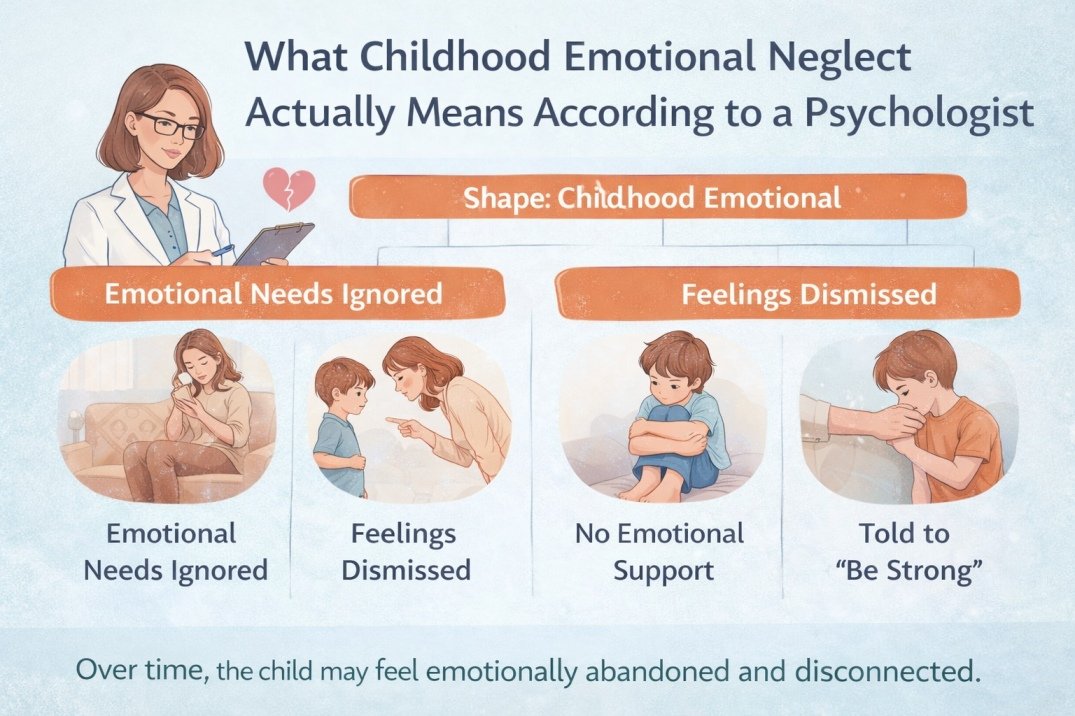
Childhood emotional neglect means your emotional needs were not noticed, understood, or supported while you were growing up. It does not require abuse or dramatic events. Many people experience it in families that looked normal from the outside.
Your physical needs may have been met, but your inner world was mostly handled alone. When you were upset, scared, confused, or overwhelmed, there was little comfort, guidance, or space to talk. Over time, you learned to ignore feelings or deal with them by yourself.
Childhood emotional neglect often looks like this:
- Your feelings were dismissed or minimised. You may have heard “stop crying,” “it’s nothing,” or “be strong.”
- You were provided for materially but not emotionally. Food, school, and safety were there, but emotional support was limited.
- Your family focused on solving problems, not understanding feelings. Practical help replaced emotional connection.
- You were the “easy,” “mature,” or “independent” child who did not need much.
- You were praised for coping alone, not for expressing needs or vulnerability.
- Nothing obviously traumatic happened, so your memories feel ordinary or blurry.
- You often felt unseen, unheard, or alone with your problems, even in a full house.
- No one taught you how to understand, express, or regulate emotions.
How Attachment Style Plays a Role in Emotions and Feelings
Attachment style affects how you respond to closeness, conflict, and emotional situations. It does not decide whether you have feelings. It mainly shapes how safe emotions feel and how you handle them.
In your 30s, this often becomes more noticeable. By now, you may have gone through multiple relationships, disappointments, or trust breaks. Work pressure, family responsibilities, and long-term stress leave little time to process what you feel.
Avoidant tendencies often involve pushing feelings aside in the moment. Staying busy with work, social plans, or daily tasks helps keep emotions under control. Many people simply do not get quiet time to reflect.
Later, when you are alone, those feelings may surface. You may replay conversations, feel regret, or question your reactions. Processing happens privately, often at night or during rare quiet moments.
Your response can also change depending on the person. With someone you feel safe with, you may open up easily. With others, you may stay distant or emotionally flat.
Different patterns struggle in different ways:
- Avoidant tendencies: Feelings are delayed or handled alone.
- Anxious tendencies: Feelings are intense and hard to calm.
- Fearful or mixed tendencies: You want closeness but also fear getting hurt.
- Secure tendencies: Emotions are usually manageable but can still be disrupted by burnout or loss.
By this stage of life, many people are also emotionally tired. Repeated stress from work, relationships, or family conflict can dull emotional responsiveness. When you are constantly coping, there is little energy left for reflection.
Attachment style can contribute to difficulty processing emotions, but it is rarely the only cause. Life experience, exhaustion, and lack of personal time often play an equally strong role. Emotional struggles in your 30s usually come from a combination of past patterns and present pressures.
Psychology-Based Reasons You Struggle to Process Feelings and Emotions in Your 30s
By now, you may have recognised whether childhood emotional neglect or attachment patterns apply to you. But emotional struggles rarely come from a single cause. Most people around 30s are dealing with a mix of past experiences and present pressures.
Let’s look at the other factors that may be contributing to this struggle.
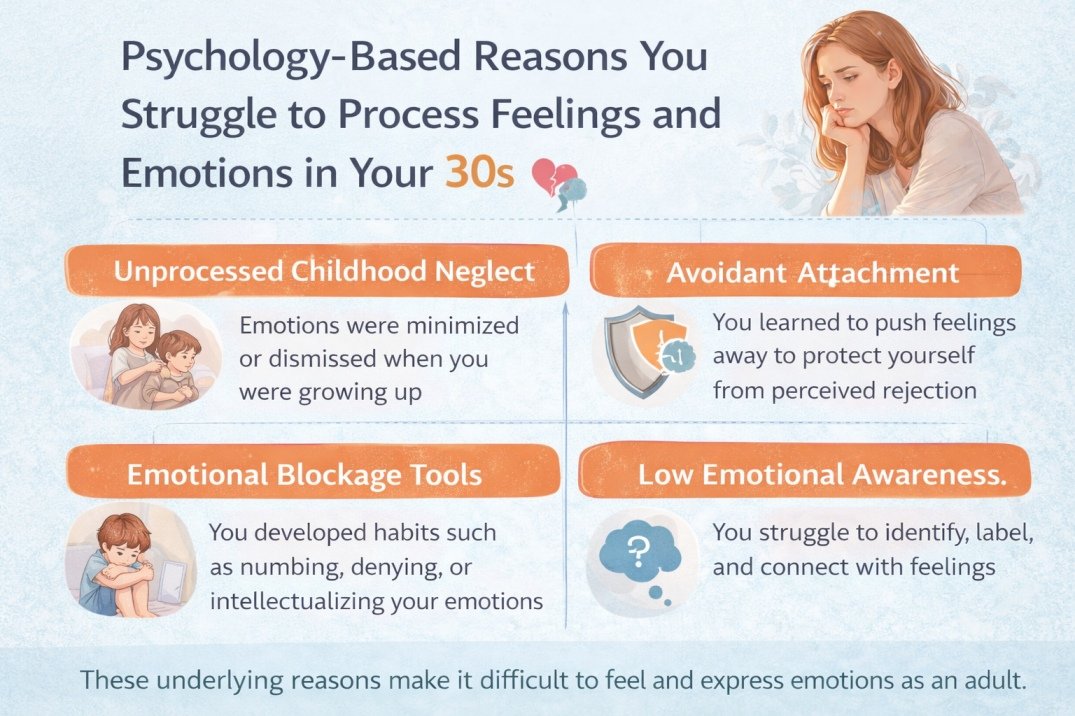
You Were Never Taught How to Identify or Express Emotions
In many families, emotions were not discussed. Parents were busy managing work, money, responsibilities, or their own stress. They may have cared, but emotional guidance was not something they knew how to give.
When you were upset, the focus was on fixing the problem, not understanding how you felt. You were expected to adjust, stay strong, or not add pressure. Over time, you learned to handle feelings quietly.
You might notice this now:
- You struggle to name what you feel beyond “stressed” or “tired.”
- Emotional conversations make you uncomfortable or blank.
- You prefer solving problems instead of talking about feelings.
- You worry about being a burden if you open up.
- You learned early to manage things alone.
No one may have intended this. It was simply what the situation allowed. Without being shown how to understand emotions, many adults reach their 30s still unsure how to process them.
Chronic Stress Keeps Your System Focused on Survival
For many people, this is one of the biggest reasons emotions feel distant. After college, life quickly fills with work, financial pressure, relationships, or caregiving. There is little time to sit with how you feel.
Even if you were dating or married, stability often mattered more than emotional processing. Deadlines, bills, and responsibilities took priority. Your mind learned to focus on tasks, not feelings.
By your 30s, things may look stable outside. But your system is trained for survival, not reflection. You may realise you no longer remember what genuine, relaxed emotions feel like.
You might notice this as:
- You feel flat even during good moments.
- Stress feels normal, calm feels unfamiliar.
- Happiness fades quickly.
- You do not know what you truly want emotionally.
- Quiet time feels uncomfortable.
This is not weakness. It is long-term overload.
Constant Digital Stimulation Blocks Emotional Awareness
When most of your free time is spent on your phone, your brain gets used to fast, shallow stimulation. You see intense emotions on screens all the time, but you are not actually living them. Real experiences can start to feel muted in comparison.
When something meaningful happens in real life, your mind may not be ready to engage fully. Instead of feeling deeply, you feel flat, distracted, or unsure what you are supposed to feel. The moment passes before it sinks in.
Constant switching between apps, videos, and tasks also prevents emotions from settling. Feelings need quiet time to register. Without that space, they remain vague or disappear quickly.
You may only notice them later, when everything is finally quiet. Or sometimes not at all. This can leave you confused about why you cannot connect to important moments.
You Default to Thinking Instead of Feeling
When something emotional happens, your mind jumps in immediately. You analyse what happened, why it happened, and what to do next. It feels more useful than sitting with the feeling itself.
This is common in people who have had to stay strong, perform, or solve problems for years. Thinking keeps you in control. Feeling can feel messy, slow, or unsafe.
You may notice you can explain your situation clearly but still feel numb inside. Others say “talk about how you feel,” and you do not know what to say. Your brain is active, but your emotions feel distant.
Over time, this habit makes real emotional processing harder. You live in your head while your body carries the stress. The feelings are there, but they never fully surface or release.
Modern Relationships Can Be Emotionally Destabilising
Many relationships today move very quickly. You may share deeply, spend intense time together, and feel emotionally close within a short period. Then communication drops, commitment becomes unclear, or the person pulls away.
This creates emotional confusion more than clean heartbreak. There is no clear ending, no closure, just uncertainty. Your mind keeps trying to understand what changed.
Repeated experiences like this can make your system guarded. You may stop trusting your own feelings or hesitate to invest emotionally again. Even stable relationships can feel fragile after enough unpredictable ones.
Over time, this instability can dull emotional responsiveness. You protect yourself by staying cautious, detached, or less expressive. It becomes harder to relax into closeness or feel secure in connection.
Fear of Rejection or Burdening Others Suppresses Needs
Many people learn this from real experiences. When you shared feelings in the past, they may have been dismissed, mocked, ignored, or later used against you in arguments. Over time, you learn it is safer not to open up.
Both men and women experience this. Men may be expected to stay strong and silent. Women may be labelled emotional or difficult. Gradually, you start filtering what you say or stop sharing altogether.
Even in close relationships, vulnerability can feel risky. You worry your honesty might create conflict or be remembered later in a weak moment. So you keep things inside and deal with them alone.
By your 30s, this becomes automatic. You suppress feelings before they fully form. This makes it harder to feel and process emotions in a natural way.
Emotions do not disappear, but they stay buried. They show up indirectly as irritability, withdrawal, anxiety, or quiet exhaustion. You are reacting, but not truly processing what you feel.
Loneliness Without True Emotional Connection
You may have coworkers, family, friends, and a partner, yet still feel alone inside. Interactions often stay practical or surface-level. Sharing deeper thoughts starts to feel unsafe.
Workplaces change, people leave, and trust feels temporary. Family conversations may come with expectations instead of understanding. Friends become busy with their own lives.
A partner may be the only person you open up to, but conflicts can damage that safety. Hurtful words or broken confidences make you more guarded. You start sharing less, even when you need support.
When there is no place to speak honestly every day, feelings stay inside. Over time, it becomes harder to feel and process emotions fully. Your mind learns to dismiss them and keep functioning.
Extreme Self-Reliance Makes Support Feel Unnatural
If you started building your life early, you may have handled most challenges alone. There was not always someone available to guide, protect, or share the load. You went through successes and setbacks largely by yourself.
This is especially common for elder children, both men and women. They are often expected to be responsible, mature, and dependable from a young age. Over time, independence stops being a skill and becomes an identity.
By your 30s, asking for help can feel unnatural. You are used to solving problems quietly and moving forward. Even when overwhelmed, reaching out may feel uncomfortable or unnecessary.
Without sharing, emotions stay internal. It becomes harder to feel and process emotions fully because everything is carried alone. You keep functioning, but rarely feel supported.
Burnout and Exhaustion Dull Emotional Signals
This is especially common in people with high-responsibility roles. Founders, leaders, and deadline-driven professionals rarely switch off completely. Work follows you everywhere, even into evenings, weekends, and personal time.
Today’s work culture blurs boundaries. Calls, messages, and decisions continue from home, during meals, or late at night. Your mind stays active long after the workday should end.
Chronic exhaustion reduces emotional clarity. You focus on tasks, not feelings, because that is all your energy allows. Even important personal moments can feel muted.
Over time, you may notice flatness, irritability, or loss of enthusiasm. It becomes harder to feel and process emotions because your system is constantly drained. Rest never lasts long enough for recovery.
Unprocessed Experiences Are Surfacing Now
Much of this may have happened in your 20s. Difficult relationships, breakups, cheating, disrespect, career struggles, or unstable phases often occur during those years. At the time, the focus is on surviving, moving forward, and building a life.
Marriage, parenthood, relocation, or personal losses may also have been handled quickly. There was little space to pause and process what you felt. Emotions were pushed aside so progress could continue.
Now in your 30s, life may be more stable externally. With fewer immediate crises, your mind begins revisiting what was left unfinished. Old feelings surface because they were never fully processed.
You may experience anxiety, sadness, irritability, or mood shifts without a clear present cause. It becomes harder to feel and process emotions because they carry residue from multiple past experiences. Your reaction is not only about today.
Signs You May Be Experiencing Emotional Numbness Rather Than Lack of Emotion
If you are struggling to feel and process emotions, numbness is often the reason. Your system reduces emotional intensity so you can keep functioning. This makes it harder to access, understand, or release what you feel.
Numbness usually develops after long periods of stress, disappointment, overload, or suppressed feelings. Instead of processing emotions as they arise, your mind dampens them. You feel less in the moment, but nothing is fully resolved.
This can show up as:
- Feeling flat or detached even when something important happens
- Difficulty crying or releasing feelings when you want to
- Low motivation or reduced enjoyment of things you used to like
- Brain fog and mental exhaustion that dull emotional clarity
- Feeling disconnected from your body or physical sensations
- Irritability replacing sadness or hurt
- Withdrawing from people because interaction feels draining
- Going through daily life on autopilot
- Shutting down emotionally during conflict or pressure
When this happens, emotions do not disappear; they stay unprocessed. Over time, this creates the feeling that you cannot feel deeply or understand yourself. In reality, your system is protecting you from overload, not erasing your emotional capacity.
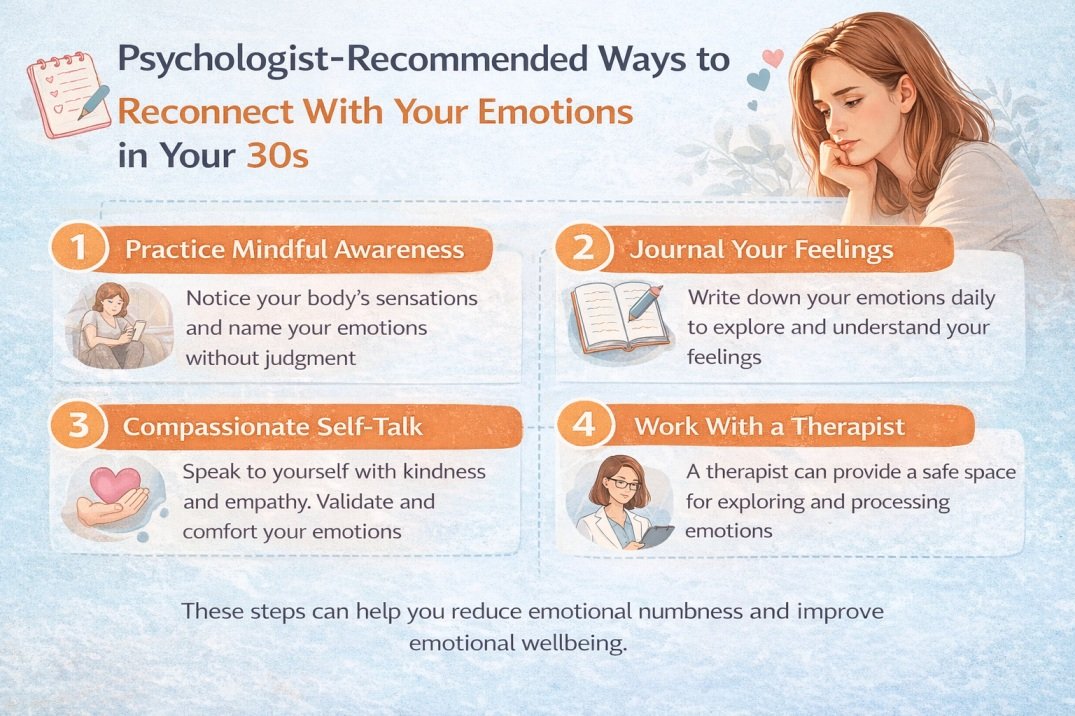
Psychologist-Recommended Ways to Reconnect With Your Emotions
If you relate to these signs, your ability to feel and process emotions is not gone. It is suppressed by stress, overload, and long-term coping patterns.
Reconnection takes time, not force. When your system feels safer and less overwhelmed, emotions begin to return naturally.
The goal is to create space for feelings, not push them out.
Create Small Moments of Emotional Space in Your Day
Set aside a few minutes each day with no phone, music, or distractions. Use this time to simply notice and feel your emotions instead of pushing them aside. Even short pauses allow feelings to register.
Do not analyse or try to fix anything. Stay with whatever you feel and let it pass naturally. This helps your mind relearn how to feel and process emotions.
Consistency matters more than duration.
Start With Body Awareness, Not Overthinking
Pay attention to physical sensations during the day. Notice tension in your shoulders, heaviness in your chest, or restlessness in your body. Emotions often appear in the body before they become clear thoughts.
Pause and stay with the sensation for a moment. Breathe slowly and let your body relax where possible. This helps you feel emotions without needing to analyse them.
Regular body awareness makes it easier to feel and process emotions in real time.
Expand Your Emotional Vocabulary Gradually
Try to name your feelings more precisely during the day. Move beyond words like “fine,” “stressed,” or “tired.” Ask yourself what is actually underneath those labels.
Use simple, specific words such as frustrated, disappointed, uneasy, hopeful, or overwhelmed. You can do this silently or write it down. There is no need to share it with anyone.
The more accurately you name emotions, the easier it becomes to feel and process them.
Reduce Emotional Overload First
Limit phone use at key times. Avoid screens for at least one hour before sleep. Start your day without immediately checking your phone.
Keep meals screen-free. Do not watch TV or scroll while eating. Let your mind slow down naturally.
Avoid filling every free moment with reels or short videos. Allow some quiet or boredom. This creates space to feel and process emotions.
Allow Safe Emotional Expression
Use private ways to express what you feel. Write in a journal, type notes on your phone, or speak your thoughts out loud when alone. There is no need to organise or censor it.
You can also use tools like the ChatGPT voice feature to talk freely and initiate a conversation. Speaking out loud helps clarify feelings and reduces internal pressure. It can be easier than sharing with someone immediately.
Creative outlets such as music, drawing, or quiet activities can also help emotions move safely. The goal is expression, not performance.
Regular private reflection helps emotions surface and be processed without fear of judgment.
Rebuild Trust in Connection Slowly
Start with your partner, if you have one. Share any unresolved moments you have been holding inside. They may not even remember it, while you have carried it for years.
Try rebuilding connection with your parents at your own pace. If there was emotional neglect or hurt, acknowledge it without forcing confrontation. Sometimes they did not know how to give emotional support because they were never shown how themselves.
Reach out to friends as well. Send a message, suggest meeting during free time, or restart regular contact. Small, consistent interactions rebuild trust more than intense conversations.
Over time, these steps help you feel safer with people again. As trust grows, it becomes easier to open up and feel and process emotions in connection, not just alone.
Learn to Notice Your Needs Without Judging Them
Pay attention to what you need in different situations. Rest, space, reassurance, clarity, or support are normal human needs. Notice them without immediately dismissing or criticising yourself.
Avoid labelling your needs as weakness, selfishness, or inconvenience. Treat them as useful signals about what is happening inside you. You do not have to act on every need right away.
Simply recognising your needs helps you feel and process emotions more clearly. Awareness comes before change.
Stabilise Daily Rhythms
Maintain consistent sleep and wake times as much as possible. Prioritise regular meals instead of long gaps followed by overeating. Small daily routines help your body feel predictable and safe.
Include some physical movement each day, even light walking or stretching. Movement releases tension and improves emotional balance. It does not have to be intense to be effective.
When basic rhythms are stable, your system has more capacity to feel and process emotions clearly.
Understand Your Attachment Style and Move Toward Security
Learn how you typically respond to closeness, conflict, and emotional situations. Notice patterns such as withdrawing, overthinking, needing reassurance, or avoiding difficult conversations. Awareness helps you choose different responses instead of reacting automatically.
Practice small secure behaviours. Communicate needs calmly, stay present during discomfort, and allow supportive people to be there for you. Security develops through repeated safe experiences, not sudden change.
Over time, these shifts make it easier to trust, connect, and feel and process emotions in a balanced way.
Consider Professional Support for Deeper Work
If patterns feel deeply rooted or difficult to change alone, professional support can help. Attachment-focused or trauma-informed therapy provides a safe space to explore experiences at your own pace. A trained psychologist can guide you without judgment.
You can consider working with an online clinical psychologist at LeapHope if you prefer professional support from home. Structured sessions help you understand patterns, build emotional skills, and process experiences that are hard to access by yourself. Support is tailored to your pace and comfort.
Therapy is not only for crisis situations. Many people seek it for clarity, healing, and personal growth. With the right guidance, it becomes easier to feel and process emotions in a stable way.
When To Look for Professional Psychological Help
People in their late 20s, 30s, and even 40s often seek support during periods of transition or emotional strain. Both men and women may struggle silently while managing work pressure, relationships, family responsibilities, or major life decisions. Therapy can help when functioning continues but inner stability does not.
Consider speaking with a psychologist if you notice:
- Persistent numbness, emptiness, or disconnection that does not improve
- Anxiety or low mood affecting sleep, concentration, or daily tasks
- Repeated relationship patterns that cause distress
- Feeling stuck despite self-help efforts
- Difficulty forming or maintaining close emotional bonds
- Intrusive memories or unresolved past experiences
- A strong desire to understand yourself more deeply
Therapists do not simply give advice. Depending on your needs, they may use attachment-focused, trauma-informed, or emotion-focused approaches. Sessions often involve understanding patterns, building emotional skills, and processing experiences in a safe, structured way.
Therapy is not only for crisis situations or severe problems. Many high-functioning adults use it for clarity, healing, and personal growth. Seeking support is a proactive step, not a sign of weakness.
Final Thoughts
If you have been struggling to feel and process emotions, it does not mean something is wrong with you. Many capable, responsible adults carry more inside than others realise. On the outside, life continues. Inside, things can feel unclear or heavy.
Emotional skills are not something you either have or don’t. They grow with awareness, time, and the right kind of support. You are not defined by a label or by how you learned to cope earlier in life.
Change rarely happens overnight. But as you start paying attention to yourself with less judgment, emotions begin to make more sense. With time, both self-connection and trust in others can return.
FAQs
Can childhood emotional neglect show up only in adulthood?
Childhood emotional neglect can become noticeable only in adulthood. Many people realise it later when relationships deepen, responsibilities increase, or life slows down enough to reflect. It often surfaces when emotional demands exceed the coping patterns learned in childhood.
Why do I feel emotionally numb but not depressed?
Emotional numbness without depression usually means your system is overloaded or protective. You may function normally but feel flat, detached, or disconnected inside. This is often a stress or coping response rather than a mood disorder.
Can avoidant attachment change after 30?
Avoidant attachment can change after 30. Attachment patterns are learned responses, not fixed personality traits. With awareness, safe relationships, and intentional effort, many people gradually become more secure.
Is emotional numbness a trauma response?
Emotional numbness can be a trauma response. The brain reduces emotional intensity to protect you from overwhelm. This allows functioning to continue even when underlying feelings remain unresolved.
Do I need therapy if I am functioning normally?
Therapy is not only for people who are unable to function. Many high-functioning adults seek therapy for clarity, emotional growth, or relationship improvement. Wanting to feel better is a valid reason to seek support.
How long does it take to reconnect with emotions?
Reconnecting with emotions takes different amounts of time for different people. Some notice small changes within weeks, while deeper shifts may take months. Consistent effort and emotional safety matter more than speed.
Can high stress alone cause emotional disconnection?
High stress alone can cause emotional disconnection. When pressure is constant, the brain prioritises survival and reduces emotional processing. Once stress decreases, feelings often return gradually.