Last Updated on February 1, 2026
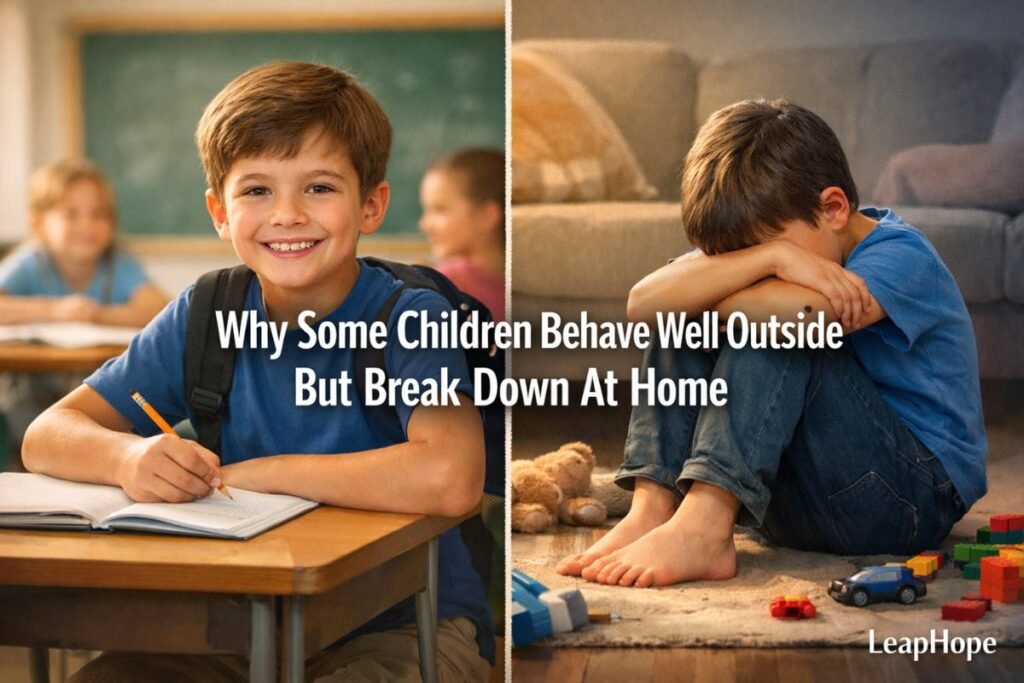
Your child’s teacher says they’re calm, polite, and doing fine.
Outside the house, everything seems under control.
Then they come home.
The smallest thing can set them off. Tears, anger, silence, or complete exhaustion. You’re left wondering how the same child can hold it together all day and fall apart with you.
You start questioning yourself.
Is something wrong at home?
Are you missing signs of stress?
Or is this just how children release everything they’ve been holding in?
In a world where children are expected to cope early and parents are expected to read every emotional signal perfectly, this pattern can feel confusing and worrying.
This article looks at why some children behave well outside but break down at home, and what those moments are really trying to tell you.
Why Do Some Children Act So Different at Home?
This is one of the most confusing parts for parents. Outside, your child seems to manage just fine. At home, it’s like everything they’ve been holding in suddenly spills out.
Why parents usually feel confused by this
You’re getting mixed messages. School says your child is doing well. Friends or relatives see a calm, polite version of them. Then at home, you see meltdowns, anger, or a complete shutdown.
It can make you doubt your own experience. You start wondering if you’re overreacting, or if others just aren’t seeing the full picture.
Why does this behaviour feel personal to parents
Because it happens with you. Not with teachers. Not with friends. With you.
That can hurt. It can feel like you’re doing something wrong, or that your child is choosing to behave this way at home. Many parents quietly ask themselves if their child feels less safe with them.
Most of the time, the opposite is true.
Home is often the place where children finally feel safe enough to let go. The behaviour isn’t about disrespect. It’s about release.
What Is My Child Actually Holding In All Day?
When children are outside the home, a lot is expected of them, even if no one says it out loud.

Why do children work hard to “behave” outside
At school or in public, children are constantly managing themselves. They’re following rules, listening, waiting their turn, and trying not to stand out. They’re reading the room, watching adults’ reactions, and adjusting their behaviour to fit in.
For many children, this takes effort. Even when they seem calm, they’re using a lot of energy to hold themselves together.
What children don’t always show in public
Outside the home, children often hide feelings like worry, confusion, embarrassment, or tiredness. They may not feel comfortable showing these emotions in front of teachers or peers.
So they keep going. They push through. They tell themselves to “be good” or “not make a fuss,” even when things feel hard inside.
By the time they get home, there’s nothing left to hold it all in. What you see then isn’t a new emotion. It’s everything that’s been building up all day.
Why Home Becomes the Place Where Emotions Spill Out
For many children, home isn’t where behaviour gets worse. It’s where effort finally stops.
Why does home feel emotionally safer
At home, children don’t have to perform. They don’t have to follow as many rules, impress anyone, or keep themselves in check every minute. They know the people there already care about them.
That safety matters. It’s often the first place a child feels allowed to relax emotionally.
Why do emotions come out all at once
When a child has been holding things in all day, emotions don’t come out gently. They rush out. What looks like a sudden meltdown is often hours of pressure releasing at once.
A small request, a tired body, or a simple “no” can be enough to tip everything over. It’s not about that moment. It’s about everything before it.
What parents often misread here
From the outside, it can look like your child is choosing to lose control at home. In reality, home is where they finally don’t have to hold it together anymore.
The breakdown isn’t a sign of disrespect. It’s often a sign that your child trusts this space enough to let their guard down.
Is This Bad Behaviour or Emotional Exhaustion?
When a child breaks down at home, it’s easy to label what you see. Rude. Defiant. Overreacting. But often, what looks like bad behaviour is a child who’s simply run out of energy.
How emotional overload shows up
Emotional exhaustion doesn’t always look quiet. It can look loud and messy. Sudden anger, tears over small things, refusing to listen, or completely shutting down. When children don’t have the words for what they’re feeling, behaviour often does the talking. We’ve explained this more in why children express emotions through behaviour.
Your child isn’t thinking clearly in these moments. They’re tired, overwhelmed, and no longer able to manage feelings the way they did earlier in the day.
Why logic and discipline don’t work in these moments
When emotions are overflowing, reasoning doesn’t land. Explaining rules or consequences at that point often makes things worse, not better.
That’s because the part of the brain needed to listen and reflect isn’t really available when a child is emotionally exhausted. They need calm before they can handle correction.
What parents often feel instead
Parents often feel frustrated here. You might think, “They were fine all day, why are they doing this now?” Or “They know better.”
What’s usually happening is not a lack of effort, but a lack of emotional fuel. Your child has used it all up outside, and home is where the crash happens.
Why This Happens More Often in Certain Children
Not every child breaks down at home in the same way. Some children are more affected by the effort of holding themselves together all day.

Why are sensitive children are more impacted
Some children notice everything. Sounds, moods, expectations, changes in tone. They feel things deeply and process them internally. Even when they’re quiet or well-behaved, a lot is happening inside.
By the time they get home, that constant processing catches up with them. What you see then isn’t weakness. It’s fatigue.
Why “good” or high-achieving children struggle at home
Children who try hard to do the right thing often put extra pressure on themselves. They don’t want to disappoint teachers or stand out. They keep pushing, even when they’re tired or stressed.
Home becomes the only place where they don’t feel watched. The emotions they’ve been managing all day finally come out there.
Why this pattern is easy to miss
Because these children look fine to everyone else. They follow rules. They meet expectations. There are no complaints from outside.
So when they fall apart at home, it feels confusing and unfair. But often, it’s not a behaviour problem. It’s the cost of holding it together for too long.
How This Pattern Looks at Different Ages
The way children break down at home changes as they grow. The reason underneath is often similar, but how it shows up can look very different.
Why do young children melt down after school or outings
Young children have very little emotional reserve. Being “good” outside takes a lot out of them. By the time they get home, they’re tired, hungry, and overwhelmed. Emotional understanding changes as children grow, which is why this behaviour can look different at different ages. You can read more in how children understand emotions by age.
That’s why you often see crying, tantrums, or clinginess right after school or social activities. It’s not about misbehaviour. It’s about a child who has reached their limit.
Why do school-age children release emotions at home
School-age children are better at holding things together. They understand rules, expectations, and consequences. They try hard to manage themselves during the day.
At home, emotions may come out as irritability, snapping over small things, refusing to cooperate, or sudden emotional reactions in the evening. The effort of staying in control all day finally catches up.
Why teenagers shut down or snap at home
Teenagers often carry emotional pressure that they don’t talk about. Social stress, expectations, self-doubt, and constant comparison can build up quietly.
At home, this may show up as silence, short answers, defensiveness, or anger over small issues. It can look like attitude or distance, but often it’s a sign of emotional overload rather than lack of care.
At every age, the breakdown usually isn’t about the home. It’s about finally having a place where the child doesn’t have to hold everything in.
What Parents Often Misunderstand About This Behaviour
When a child breaks down at home, it’s easy to draw the wrong conclusions. Not because parents don’t care, but because the behaviour feels confusing and personal.
“They’re doing this on purpose”
This is a common thought, especially when the behaviour only shows up at home. It can feel like your child is choosing to lose control with you. This pattern is easy to misread, especially when behaviour only shows up at home. We’ve explored this more in how parents misread child emotional development.
Most of the time, it’s not intentional. Your child isn’t planning the breakdown. They’re reacting after holding themselves together for hours. Home is where the effort stops.
“They should cope better by now”
Parents often tell themselves that their child is old enough to handle things differently. After all, they manage fine outside.
What’s easy to miss is that coping all day takes energy. Emotional control isn’t unlimited. Even children who seem capable can run out by the time they get home.
“This means something is wrong at home”
When breakdowns only happen with you, it can raise a painful question. Does my child feel unsafe here?
In most cases, the opposite is true. Children usually fall apart where they feel safest. The behaviour isn’t a sign that home is the problem. It’s often a sign that home is the place where they can finally let go.
When This Pattern Is Normal — And When It Starts Feeling Heavy
Not every breakdown at home means something is wrong. Many children go through this phase at different points. The difference often shows up in how long it lasts and how much it affects daily life.
When behaviour settles with rest and connection
For many children, things ease once they’ve rested, eaten, or spent some quiet time with you. The emotions pass. By the next day, they’re back to their usual self. For families caring for a disabled child, emotional load can build up even faster. We’ve shared more about this experience in caring for a disabled child.
These moments can be tiring, but they don’t linger. The child recovers, and the pattern doesn’t take over family life.
When breakdowns keep repeating
Sometimes, the release doesn’t really release anything. The same meltdowns happen day after day. Even weekends don’t seem to help. Your child feels tense most evenings, and small things keep tipping them over.
You may notice sleep issues, constant irritability, or a child who seems emotionally drained more often than not.
Why parents usually sense this shift first
Most parents feel this before they can explain it clearly. It’s not panic. It’s a quiet sense that something isn’t easing the way it used to.
That feeling matters. It doesn’t mean you need to jump to conclusions, but it’s worth slowing down and paying attention to patterns rather than isolated days.
How Parents Can Respond Without Making It Worse
When your child breaks down at home, it’s hard not to react quickly. You’re tired too. You want the noise to stop, the tension to ease, and the evening to move on. That’s human. But how you respond in these moments can either help emotions settle or add more pressure.
Why staying calm matters more than saying the right thing
You don’t need perfect words. In fact, too many words can make things harder. When a child is emotionally exhausted, they’re not in a place to listen or explain.
What helps most is your tone and presence. A calm voice, fewer questions, and slowing the moment down can help your child’s body settle before their mind can.
Why does connection help more than correction here
When a child has spent the whole day holding it together, they don’t need more rules in that moment. They need to feel safe enough to let go.
That might look like sitting nearby, keeping things simple, or giving them time to decompress before talking about anything. Limits still matter, but connection usually needs to come first.
Why these moments are hardest at the end of the day
Evening breakdowns often happen when everyone is running low. Your child is tired. You’re tired. Patience is thinner on both sides.
Knowing this doesn’t make it easy, but it can help you see the pattern for what it is. Not a failure. Not bad behaviour. Just a child who has reached their emotional limit and needs help coming back down.
When Outside Support Can Help
Sometimes, even when you understand what’s happening, things don’t ease on their own. You’re patient. You’re present. Still, the same pattern keeps coming back.
That doesn’t mean you’ve failed.

Why some children release emotions more easily with someone else
Children are often very aware of their parents’ stress, even when nothing is said. They may worry about upsetting you or making things harder at home. Because of that, they hold back more than we realise.
A neutral space can feel different. There’s less pressure to behave a certain way. Less fear of disappointing anyone. Some children talk more. Others don’t say much at first, but their emotions begin to settle.
How outside support helps make sense of the pattern
Support isn’t about fixing your child or blaming parenting. It helps slow things down and understand why emotions are building up during the day and spilling out at home.
For parents, it can bring relief and clarity. For children, it can reduce the need to fall apart, because their feelings finally have somewhere to go.
Looking into online child and teen counselling can be one gentle way to support your child when emotional exhaustion starts feeling heavy for everyone.
Final Thought
When your child falls apart at home, it doesn’t mean they’re misbehaving or that you’re doing something wrong. Often, it means they’ve been holding a lot in and finally feel safe enough to let it out.
These moments are hard, especially at the end of a long day. But they’re often less about discipline and more about a child needing help to come down after trying so hard to cope. Many children carry emotional needs they don’t know how to express yet. We’ve written more about this in emotional needs children cannot express.
Noticing that can change how heavy those moments feel, for both of you.
Sometimes a neutral space helps children release what they hold in all day. Exploring online child and teen counselling can be one gentle way to support that process.
FAQ’s
Why is my child so well-behaved at school but difficult at home?
Because school takes a lot of effort. Many children hold their emotions in all day and release them where they feel safest.
Does this mean my child feels unsafe at home?
Usually no. Most children fall apart at home because they feel safe enough to do so, not because something is wrong there.
Why does my child melt down over small things after school?
By the end of the day, emotional energy is low. Small things become the point where everything spills out.
Is my child doing this on purpose?
Most of the time, no. Emotional exhaustion isn’t planned. It happens when a child runs out of energy to cope.
Why doesn’t discipline work when my child breaks down at home?
Because the child isn’t in a state to listen or think clearly. Emotions are taking over in that moment.
Why does my child behave worse with me than with others?
Children usually let go most with the people they feel safest with. That’s often a parent.
Is this a sign of anxiety or stress?
Sometimes it can be, especially if the pattern is intense or doesn’t ease over time. Other times, it’s normal emotional release.
Will my child grow out of this behaviour?
Many children do as their emotional regulation improves. Some need extra support to get there.
How long should after-school meltdowns last?
If they ease with rest and connection, that’s usually normal. If they happen daily with no relief, it’s worth paying attention.
When should I be more concerned?
When breakdowns are constant, getting stronger, or affecting sleep, school, or family life over time.