
Last Updated on September 25, 2026
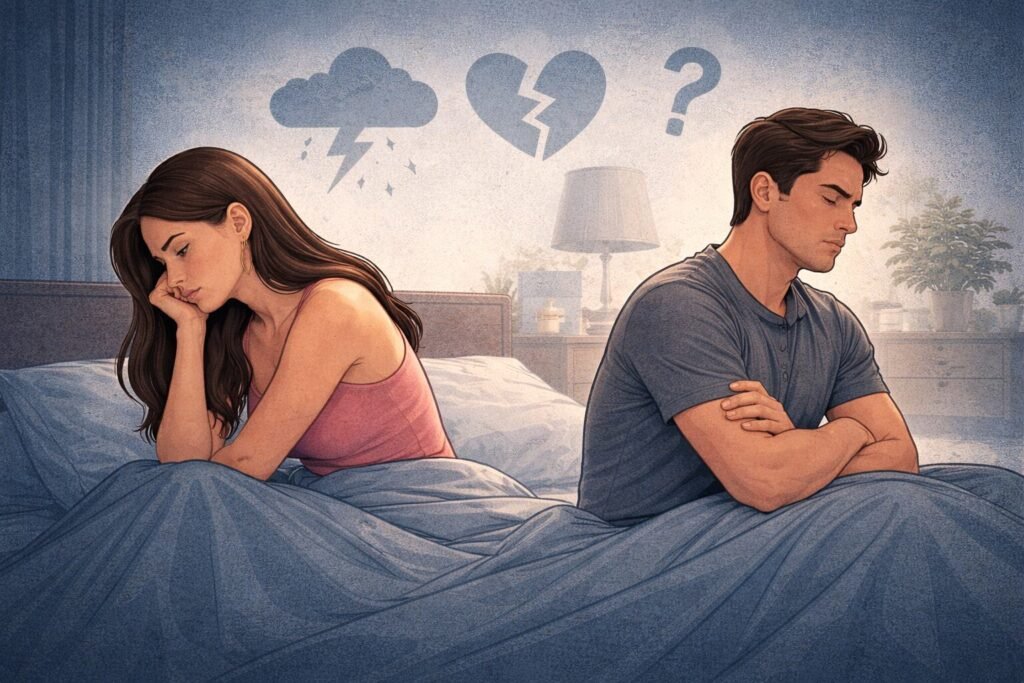
Sex was good. You wanted it, enjoyed it and may have felt close to your partner during it.
Then, shortly afterwards, something changes.
You feel flat. Irritated. Emotionally distant. Maybe you suddenly want to be alone or do not want your partner touching you. Some men describe it simply as: “I got what I wanted, so why do I feel empty now?”
There is no single explanation for this reaction. For one man it may be a postcoital emotional response, while another is dealing with regret, loneliness, sexual shame, relationship problems or a much broader low mood.
The useful question is not only why you feel empty after sex, but when it happens and what else is happening around it.
Could This Be Postcoital Dysphoria?
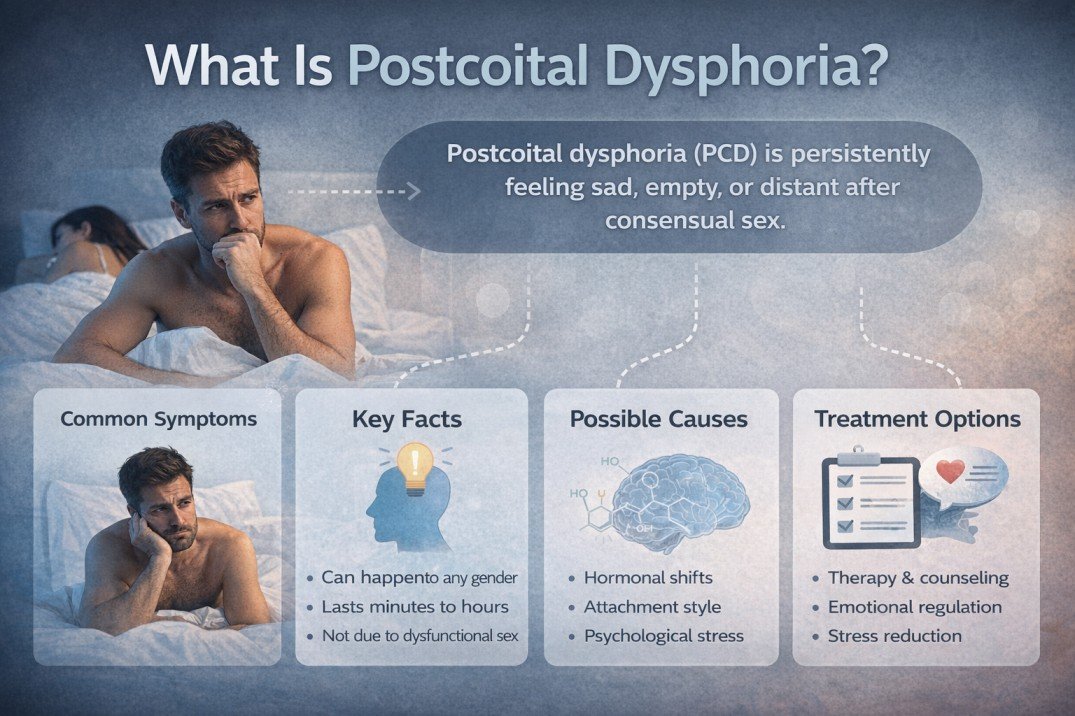
One possibility is postcoital dysphoria (PCD). It refers to negative emotions such as sadness, irritability or tearfulness after otherwise consensual and satisfactory sexual activity.
It has been documented in men. In a study of 1,208 men published in the Journal of Sex & Marital Therapy, 41% reported experiencing PCD at least once, around 20% had experienced it during the previous four weeks, and about 3–4% reported it regularly.
But feeling empty after sex does not automatically mean you have PCD.
Post-sex emptiness can also involve guilt, loneliness, emotional withdrawal, relationship dissatisfaction or broader mental-health concerns. One episode is not enough to tell you which explanation fits.
Sometimes Sex Ends, but the Feeling You Were Trying to Change Is Still There
Think about how you felt before sex.
Were you simply sexually aroused?
Or were you also lonely, stressed, insecure, bored or needing to feel wanted?
Sex can give temporary relief from all of these. For a while, there is stimulation, attention and physical closeness.
Then sex ends and the original feeling returns.
A man may therefore have genuinely enjoyed the sex and still feel:
“I thought this would make me feel better, but I still feel the same.”
This is especially worth examining if you regularly turn towards sex, masturbation or porn when you are stressed, rejected or emotionally low.
Ask yourself:
Was I looking for sexual release, or was I hoping sex would also make me feel wanted, confident, connected or less lonely?
If sexual behaviour has become one of your main ways of managing difficult emotions, Online Emotional Regulation Therapy can help you understand what is happening outside the sexual moment too.
Sometimes It Is Regret, Shame or What Men Call “Post-Nut Clarity”
“Post-nut clarity” is an internet phrase, not a clinical diagnosis.
But some men use it to describe a very specific experience: strong sexual motivation disappears after orgasm and they suddenly look at what just happened very differently.
If this fits you, ask what you actually regret.
Was it sex with someone you did not really want to be with? Casual sex that felt exciting beforehand but empty afterwards? Cheating? Going against your own values? Or shame that appears whenever you are sexual?
These are different issues.
If there is a clear reason you feel guilty after sex, that should not automatically be labelled PCD.
Sometimes the problem is not the emotional drop after orgasm. It is that once the sexual urge has passed, you are left with a decision or situation you do not feel comfortable with.
You Enjoy Sex but Suddenly Want Your Partner Away
Some men feel connected during sex and want distance almost immediately afterwards.
They may not want to cuddle, talk or be touched. Their partner can easily interpret this as rejection.
Do not automatically decide this means you have an avoidant attachment style.
First look at whether the same pattern happens outside sex.
Do you frequently want closeness but then withdraw once relationships become emotionally intimate? Do vulnerable conversations make you uncomfortable? Do you feel safest when you control how close another person can get?
If this pattern appears across your relationships, attachment and vulnerability may be worth exploring.
But if you normally enjoy closeness and this reaction occurs specifically after sex, do not force an attachment explanation onto it.
Look instead at the sexual experience itself: performance anxiety, shame, overstimulation, resentment, unwanted sex or a recurring postcoital emotional reaction may be more relevant.
Does It Happen After Masturbation Too?
This is one of the most useful questions you can ask.
If you experience the same emptiness after masturbation, the reaction becomes harder to explain entirely through your partner or relationship.
Then look at why you were masturbating.
Were you genuinely sexually interested, or were you bored, anxious, lonely or trying to switch off your thoughts?
If sexual stimulation repeatedly gives brief relief followed by the same emotional state, the important issue may be what you are using sexual release to manage.
On the other hand, if masturbation feels completely fine and the emptiness appears only after sex with one particular partner, the relationship or sexual dynamic deserves more attention.
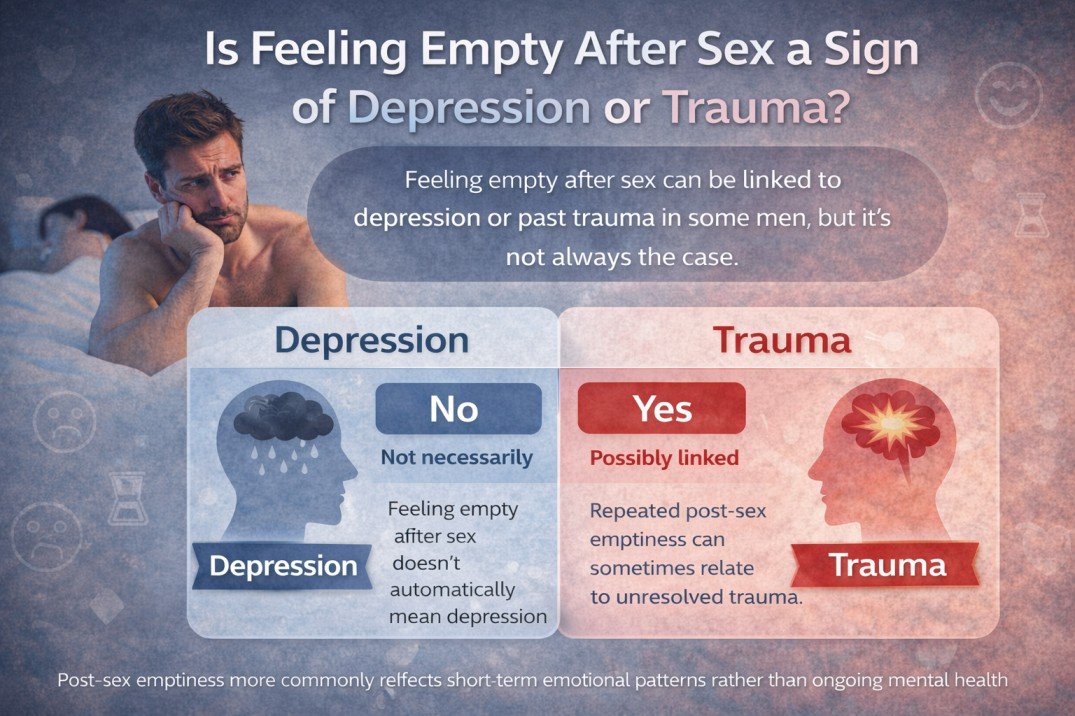
What if You Feel Empty Outside Sex Too?
This is where the direction changes completely.
If you feel normal and interested in life most of the time but occasionally experience a brief emotional drop after sex, that is one pattern.
If you also feel emotionally flat during ordinary life, this may not primarily be a sexual problem.
Pay attention if you have also noticed:
- less interest in hobbies or people
- low motivation
- persistent sadness or numbness
- social withdrawal
- hopelessness
- major changes in sleep or energy
- difficulty enjoying things you previously liked
Sex may simply be one of the moments where a broader problem becomes obvious.
If emotional numbness, low motivation or low mood extend well beyond sex, Men’s Mental Health Counselling may be a more appropriate starting point than focusing only on what happens after orgasm.
Does Feeling Empty After Sex Mean You Don’t Love Your Partner?
Not from this symptom alone.
Look at the pattern.
If the feeling happens after sex with different partners and after masturbation, your current relationship is unlikely to explain the entire problem.
If it happens only with your wife or partner, look more closely at that relationship and the sex itself.
Are you carrying resentment? Has attraction changed? Are you having sex when you do not really want it? Is sex highly performance-focused or emotionally disconnected?
If the feeling mainly happens after casual sex, ask whether you were expecting sex to provide connection, reassurance or relief from loneliness.
And if emptiness is present across the rest of your life, assess that broader emotional pattern first.
The important point is that post-sex withdrawal alone cannot tell you whether you love your partner.
Look at the Pattern Before You Look for a Diagnosis
If this happens repeatedly, you do not need to analyse every sexual encounter in detail.
For a few occasions, notice three things.
Before sex: Were you horny, lonely, stressed, insecure, angry or looking for reassurance?
During sex: Were you actually enjoying what was happening, or were you focused on erection, stamina, orgasm or proving that you were sexually good enough?
After sex: Was the feeling sadness, guilt, irritation, numbness, shame or simply wanting some physical space?
Be precise.
Feeling physically tired after sex is not the same as feeling emotionally empty.
Wanting ten minutes alone is not automatically the same as rejecting your partner.
Feeling ashamed because you cheated is not the same as unexplained sadness after satisfying sex.
The clearer you are about the actual reaction, the easier it becomes to understand what needs attention.
What Can You Do if the Emptiness Keeps Happening?
Start by comparing situations instead of assuming the explanation.
Does it happen:
- with your regular partner?
- after casual sex?
- after masturbation?
- only during highly stressful periods?
- when your mood was already low beforehand?
- after sex you genuinely wanted versus sex you felt expected to have?
Also notice how long the feeling lasts.
A brief emotional dip that passes and causes little distress is different from several hours of sadness, numbness or withdrawal every time you have sex.
If your partner is being hurt by your reaction, talk about it.
You can say you notice yourself becoming emotionally flat after sex and are trying to understand why. That is much better than abruptly withdrawing and leaving your partner to assume they did something wrong.
When the pattern is mainly sexual—post-sex distress, shame, intimacy difficulties, sexual performance concerns or confusing emotional reactions—Online Sex Therapy can help identify what is actually maintaining it.
When Is It Worth Getting Professional Help?
Occasional emotional changes after sex do not automatically require treatment.
Professional help becomes more useful when the reaction happens frequently, is intense, lasts for a long time or begins making you avoid sex.
It also deserves attention if post-sex emptiness is accompanied by persistent anxiety or depression, intrusive memories of unwanted sexual experiences, strong shame, sexual-function problems or growing conflict with your partner.
The right professional depends on what you are seeing.
A sex therapist may be appropriate when the problem is closely linked to sex, intimacy, sexual shame, performance anxiety or post-sex withdrawal.
A psychologist or mental-health therapist may be more useful when low mood, emotional numbness or difficulty enjoying life exists outside sex as well.
A medical assessment may also be appropriate if the change appeared alongside medication changes, erectile or orgasm difficulties, hormonal concerns or other new physical symptoms.
Final Thoughts
Feeling empty after sex does not automatically mean you have postcoital dysphoria. It also does not automatically mean you do not love your partner or have an attachment problem.
The pattern matters more than the label.
Does it happen only with one partner? After masturbation too? Mostly after casual sex? When you were already stressed or lonely? Or is the same emptiness present throughout the rest of your life?
Those answers give you a much clearer direction.
Post-sex emptiness is the symptom. The circumstances around it are what help explain what may actually need attention.