
Last Updated on February 24, 2026
Sexual rejection from a wife or girlfriend hurts deeply for many men because it activates multiple psychological systems at once. It is not only about sex. It touches identity, desirability, emotional security, and relational significance in a single moment.
When a man initiates sex, he exposes interest and closeness. A refusal, even for a valid reason, can interrupt that signal of being wanted.
In clinical work, we see that the emotional brain often interprets sexual rejection as personal rejection. The reaction can include hurt, shame, anger, or withdrawal before rational thinking has time to intervene.
The intensity of the response does not mean the relationship is failing. It reflects how closely sexual acceptance is linked to feeling valued and secure.
Why Does It Hurt So Much When She Says No to Sex?
When a wife or girlfriend says no to sex, the reaction is often immediate. Many men describe a sudden drop in mood, even before they can think through the reason. That shift is not random.
The brain processes rejection using the same neural pathways involved in social pain. In simple terms, being turned down can register similarly to being excluded. The body reacts first, logic comes later.
Sexual initiation also involves exposure. In that moment, desire is visible. When it is not reciprocated, the experience can feel like a brief emotional shock. That is why it feels bigger than just sex.
Some men notice the moment stays in their head for hours. This happens because the mind tries to interpret the meaning of the refusal. It searches for explanation.
Embarrassment is common too. Initiating sex carries risk. When the answer is no, even gently, it can feel like being evaluated and not chosen in that moment.
This cluster of reactions, hurt, mood drop, rumination, and embarrassment, is a fast psychological response to perceived rejection, not a sign of weakness.
Why Do I Feel Rejected as a Man, Not Just Sexually?
Many men are surprised by how quickly sexual rejection affects their sense of self. The thought is not just, “She doesn’t want sex.” It becomes, “She doesn’t want me.”
In clinical practice, we see how early conditioning shapes this reaction. Boys often learn that desirability, performance, and sexual success are markers of competence. Over time, sex becomes tied to identity rather than simply connection.
When a wife or girlfriend turns down sex, the mind can interpret it as a statement about attractiveness or adequacy. That is why some men immediately feel less appealing or question their masculinity.
This is what psychologists call an ego injury. A momentary refusal disrupts a source of validation. If sexual acceptance has become a measure of worth, rejection feels like a verdict rather than a circumstance.
The insecurity that follows is not about libido alone. It reflects how tightly sexual affirmation has been linked to self-esteem.
Why Does Sexual Rejection Feel Like Emotional Distance?
For many men, sex is not only physical. It is one of the clearest signals of closeness. When that signal is interrupted, the emotional meaning can feel larger than the moment.
Some men describe lying next to their wife or girlfriend and suddenly feeling alone. The refusal creates a gap between expectation and connection. Even if she is still physically there, the emotional tone shifts.
“Not tonight” can be interpreted as “not you” because the mind often personalises intimacy cues. When sex has become a primary way of feeling bonded, its absence can feel like withdrawal of closeness.
Different men react differently. Some become anxious and seek reassurance. Others withdraw to protect themselves from feeling exposed again. Both reactions are attempts to regulate discomfort.
The deeper fear is not just about sex. It is about fading attraction and losing relational significance. When intimacy is closely linked to security, a refusal can temporarily feel like emotional distance.
Why Do I Get Angry or Shut Down After Rejection?
In therapy, men often begin by saying, “I don’t know why I got so irritated. She was just tired.” When we slow the moment down, the irritation usually comes after something else.
The first reaction is often a brief sting of hurt or embarrassment. But anger feels more powerful than shame. It protects against feeling exposed. So instead of saying, “That hurt,” the response becomes silence, sarcasm, or argument.
Some men describe going quiet the rest of the night. Others admit they stop initiating for weeks. In sessions, they explain it as, “I just don’t want to feel that again.” This is not punishment. It is avoidance of repeated discomfort.
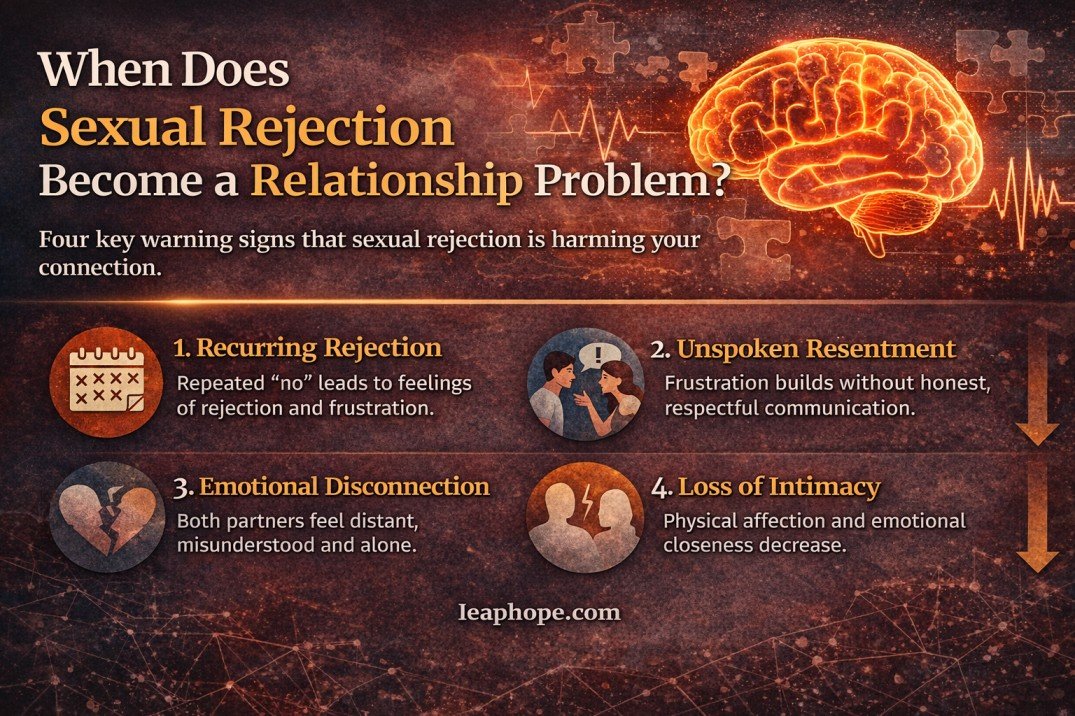
Over time, if refusals feel frequent, frustration can accumulate. The anger is rarely about that one night. It is about the pattern the mind starts building.
Understanding this shift from hurt to defence helps men respond differently. When the underlying feeling is acknowledged, the reaction becomes less explosive and less distancing.
Research shows that social rejection activates similar neural pathways as physical pain, which explains why sexual refusal can feel disproportionately intense.
Why Do I Start Thinking Something Is Wrong?
In therapy, men often say, “I know she was just tired, but my mind went somewhere else.” That “somewhere else” is usually fast and automatic.
After sexual rejection, the brain searches for meaning. It does not like uncertainty. So it fills the gap. The thought can quickly become, “Maybe she’s not attracted to me anymore.”
Some men begin comparing themselves to other men. Others worry she may be interested in someone else. These thoughts are not always based on evidence. They are attempts to explain a sudden drop in validation.
Rejection can temporarily heighten threat sensitivity. Small changes in tone or behaviour may feel significant. This is a cognitive distortion pattern, where the mind magnifies risk after emotional discomfort.
The doubt about the relationship often comes from that amplified thinking. When desirability feels questioned, security feels unstable. The reaction is less about facts and more about how the mind protects against feeling unwanted.
Is Something Wrong With Me for Taking This So Personally?
No, there is usually nothing “wrong” with you. Taking sexual rejection personally is common, especially when sex is closely linked to feeling wanted and valued.
For some men, the reaction is stronger because they are more sensitive to rejection cues. This does not mean they are weak. It means their nervous system responds quickly to perceived disconnection.
If rejection consistently affects your self-esteem, it may reflect a lower baseline sense of worth. In that case, the refusal does not create insecurity, it exposes it.
Sometimes the reaction feels bigger than the moment because it connects to earlier experiences of exclusion or inconsistency. The present trigger activates older emotional memory.
If the response includes persistent low mood, loss of confidence, or ongoing rumination, mood vulnerability may be amplifying the impact.
The intensity of the reaction tells you something about your internal landscape. It is a signal for self-understanding, not self-criticism.
How Can I Handle Sexual Rejection Without Damaging My Relationship?
Sexual rejection becomes destructive not because of the “no,” but because of the meaning attached to it. The goal is not to stop feeling hurt. The goal is to respond in a way that protects both your dignity and the relationship.
Here is the psychological work involved.
1. Regulate before you react.
The first reaction is usually emotional. Do not speak from that state. Pause. Let the nervous system settle. Most relationship damage happens in the first few minutes after refusal.
2. Separate effort from entitlement.
Some men think, “I work hard, I provide, I do so much for her. How can she say no?”
Sex is not a reward system. Contribution does not create sexual obligation. When effort becomes currency, rejection feels like injustice instead of preference.
3. Separate desire from identity.
Her refusal is about her state in that moment, not your worth. If you fuse sex with validation, every “no” will feel like a verdict on you.
4. Communicate the feeling, not the accusation.
Instead of withdrawing or arguing, say:
“I felt a bit rejected just now. I know you’re tired, but I want to understand how we’re doing.”
That keeps vulnerability intact without blame.
5. Stop testing attraction.
Repeatedly initiating just to see if she says yes increases pressure and insecurity. Intimacy cannot grow under evaluation.
6. Address mismatched desire directly.
Desire differences are common in long-term relationships. Couples who talk about frequency, stress, emotional connection, and expectations calmly manage this better than those who avoid it.
7. Watch ego defensiveness.
If your mind moves to pride, competition, or proving something, pause. Ego escalation increases distance and reduces genuine desire.
8. Build non-sexual closeness.
Affection, emotional presence, and shared time maintain connection even when sex is not happening. When intimacy is broader than intercourse, rejection feels less catastrophic.
9. Reflect on patterns.
If the reaction feels extreme or builds resentment quickly, explore why. Is there insecurity? Fear of fading attraction? Unresolved frustration?
10. Seek therapy if the pattern is chronic.
When rejection repeatedly triggers anger, shutdown, suspicion, or deep self-doubt, professional guidance helps unpack identity, regulation, and relationship dynamics safely.
Handling sexual rejection well is a sign of emotional maturity, not passivity. The strength is in responding without turning a moment into a meaning about your worth or her loyalty.
Final Thought
Sexual rejection is rarely just about sex. For many men, it touches desire, pride, and the need to feel wanted. The reaction may be intense, but it reflects emotional meaning, not weakness.
For a wife or girlfriend, saying no is not rejection of the person. It is often about mood, stress, or energy. When both partners understand this difference, conflict reduces.
If rejection is repeatedly creating anger, insecurity, or distance, it deserves attention. Online sex counselling can help couples understand desire differences, emotional triggers, and communication patterns in a structured way.
You do not have to let repeated misunderstandings erode connection. Support is available when the pattern feels bigger than the moment.
FAQs
Why do I keep replaying her refusal in my mind?
Replaying the moment is a form of rumination. When rejection feels emotionally significant, the brain tries to analyse it for meaning. It searches for clues about attraction, security, or future intimacy. The repetition is an attempt to regain certainty after discomfort.
Why does rejection feel heavier when we haven’t had sex in a while?
When sexual frequency is already low, a refusal carries more weight. It is no longer just about that moment. It reinforces a pattern. The emotional impact increases because it confirms an existing gap rather than interrupting a stable rhythm.
Why does repeated sexual rejection slowly change how I see myself in the relationship?
Over time, repeated rejection can alter self-perception. A man may begin to see himself as less desired, less prioritised, or less relevant in the intimate space of the relationship. This gradual shift affects confidence and relational identity.
Why does sexual rejection sometimes make me avoid non-sexual affection too?
After rejection, some men reduce all forms of closeness to protect themselves. Avoiding affection lowers the risk of further vulnerability. It is a defensive strategy, even though it may unintentionally increase emotional distance.
Why does her refusal sometimes reduce my own desire later?
Repeated rejection can suppress libido as a protective adjustment. The mind lowers sexual initiation to prevent future discomfort. This is not loss of attraction. It is conditioned avoidance of emotional risk.
Why do I start overanalyzing small changes in her behaviour after rejection?
After rejection, the brain becomes alert to signs of disinterest. Neutral behaviours can feel meaningful. This heightened scanning is a cognitive response to uncertainty, not necessarily evidence of a deeper problem.