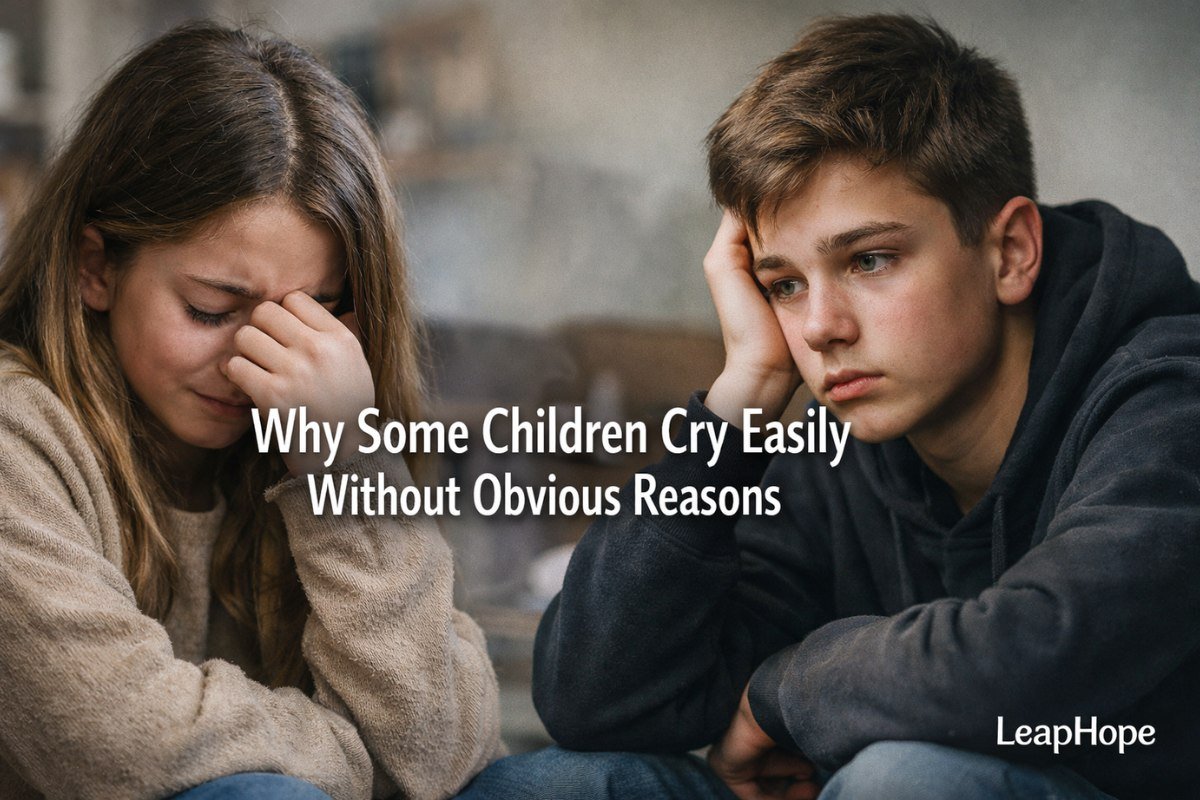
Your child starts crying, and you don’t see a clear reason.
Nothing big happened.
No fight. No fall. No obvious trigger.
Still, the tears come fast and hard.
You ask what’s wrong. They can’t explain it. Or they say, “I don’t know.”
And you’re left standing there, unsure how to help, wondering if you’re missing something important.
In today’s world, parents are often told to look for reasons, solutions, or patterns. But with crying like this, there often isn’t one clear answer. Just a child who feels something deeply and doesn’t yet know how to hold it.
This article looks at why some children cry easily without obvious reasons, what those tears often mean, and how parents can respond without making things heavier for either of you.
When crying happens often and without a clear reason, it can feel confusing and worrying for parents. It’s natural to look for a cause, but many times, the reason isn’t obvious on the surface.
For many children, emotions build quietly. They may be holding in tiredness, stress, or small disappointments through the day. When the body reaches its limit, the release can look sudden, even if the feeling has been there for a while.
That’s why the tears can start over something small or unexpected.
Crying without a clear reason leaves parents with nothing to fix. There’s no problem to solve, no rule to remind, no explanation that fits. When children don’t know how to explain what they feel, emotions often come out through behaviour instead. We’ve explored this further in why children express emotions through behaviour.
This can make you question yourself. Should you comfort? Should you distract? Should you stop the crying? Not knowing what your child needs in that moment can feel heavier than the crying itself.
This is the question many parents quietly ask themselves when the tears don’t seem to match the situation.
Children often carry small stresses without showing them. A hard day at school, trying to behave, feeling rushed, or managing social pressure can all pile up without anyone noticing.
By the time your child cries, the emotion isn’t new. It’s just finally finding a way out.
The trigger you see is rarely the full story. A simple “no,” a small mistake, or a change in plans can be the last drop in an already full cup.
So the crying isn’t an overreaction. It’s a release. Your child isn’t responding only to what just happened, they’re letting go of everything they’ve been holding inside.
Crying isn’t always about sadness. For many children, it’s the easiest way their body knows how to release what’s happening inside.
Sometimes crying is just stress leaving the body. After holding things together for hours, tears become a way to reset. The child may not feel sad in a clear way, just overwhelmed and tired inside.
Once the crying passes, they may seem lighter, calmer, or even fine again.
Some children cry because they need closeness. Not advice. Not explanations. Just reassurance that someone is there.
They may not know how to ask for comfort directly, so crying becomes the signal.
Children can feel many things at once—frustration, worry, tiredness, disappointment—without knowing which one it is. That mix can feel uncomfortable and hard to explain. Many children cry because they’re carrying emotional needs they can’t yet put into words. We’ve written more about this in emotional needs children cannot express.
Crying, in those moments, is less about being upset and more about trying to make sense of feelings that don’t yet have names.
Not all children experience emotions the same way. Some feel things more quickly and more deeply, and that can show up as tears.
Some children notice everything. Tone of voice. Changes in routine. Other people’s moods. They take a lot in, even when they don’t talk about it.
Because they feel things deeply, it doesn’t take much for emotions to overflow. Crying becomes the body’s way of releasing what feels too big to hold inside.
When a child is tired, hungry, or overstimulated, their ability to cope drops quickly. Even small frustrations can feel huge when their emotional energy is low.
In these moments, crying isn’t about weakness. It’s about a child who has reached their limit.
Children who try hard to behave, follow rules, and meet expectations often use a lot of self-control during the day. They hold emotions in so they can manage outside.
At home, where they feel safer, that effort drops. The crying you see is often the release of everything they’ve been holding together for hours.
Crying without an obvious reason doesn’t look the same at every age. What stays the same is the emotion underneath, what changes is how it comes out.
Toddlers feel everything in their body first. They don’t have the words, patience, or control to explain what’s wrong. Hunger, tiredness, frustration, or a small change can all blend together. Emotional understanding develops slowly and looks different at each age, which explains why crying changes as children grow. You can read more in how children understand emotions by age.
At this age, crying is often the only way they can release discomfort. It doesn’t mean something is seriously wrong, it means their system is overloaded.
School-age children are better at holding it together. They understand rules and expectations and try hard to manage themselves. Because of that, they don’t always show stress when it starts.
The crying may show up later, often at home, over things that seem minor. That’s usually because the pressure has been building quietly during the day.
Teenagers often feel emotions very deeply but don’t like showing them. Crying can feel embarrassing or confusing to them. Sometimes tears come out suddenly, followed by withdrawal or silence.
This doesn’t mean they don’t want support. It often means they don’t know how to receive it without feeling exposed or judged.
When a child cries often, it’s natural for parents to try to explain it in ways that make sense. Sometimes those explanations miss what’s really going on.
This thought comes up when the tears feel bigger than the situation. But most children aren’t exaggerating on purpose. They’re responding to how strong the feeling is inside them, not how small the moment looks on the outside.
Calling it drama can make a child feel misunderstood and more alone with their emotions.
Parents often link emotional control to age. So when a child keeps crying, it can feel like they’re falling behind.
Emotional growth doesn’t move in a straight line. Children can be mature in some ways and still struggle with big feelings in others. Crying doesn’t mean they’re not growing, it means they’re still learning how to cope.
Some parents try ignoring the crying, hoping it will fade on its own. For some children, this works. For others, it makes the feelings feel even heavier. Easy crying is often misunderstood as drama or attention-seeking. We’ve explored these misreads in how parents misread child emotional development.
When crying is about release or comfort, ignoring it can make a child feel unseen. The tears may stop in the moment, but the emotion often finds another way out later.
When a child is crying, “calm down” often feels like the quickest response. Parents usually mean well. They want the crying to stop and the moment to pass.
But for many children, those words don’t land the way we hope.
Crying usually starts before thinking does. A child isn’t choosing to feel this way. Their body is already overwhelmed.
When you ask them to calm down, you’re asking them to do something they don’t yet know how to do in that moment. The feeling is louder than any instruction.
Saying “it’s okay” or “nothing happened” is meant to comfort. But if the emotion is still strong, it can feel like the feeling is being brushed aside.
Some children hear it as, “You shouldn’t feel this way.” That can make them cry more or shut down instead.
Often, what helps is time and presence. Staying nearby. Lowering your voice. Letting the feeling move through them without rushing it away.
Once the body settles, words start to make sense again. But before that, calm has to come first.
Not all frequent crying means something is wrong. The difference usually shows up in patterns, not single moments.
For many children, crying eases once they feel close to you, get some rest, or have time to settle. The tears come, the body releases, and then they move on.
These moments can be tiring, but they don’t linger. Your child recovers. The day continues. The crying doesn’t take over family life.
This kind of crying is often part of learning how to handle feelings.
Sometimes the crying doesn’t really resolve anything. It happens often, sometimes daily. Small things lead to big tears, and relief doesn’t last long.
You might notice your child seems more sensitive overall. More tired. More on edge. Even when life is calm, the tears still come easily.
That’s usually when parents feel it in their gut that this is more than just a phase. Not urgent. Not dramatic. Just heavy in a way that doesn’t lift.
When crying happens easily, parents often feel pressure to stop it quickly. The noise is hard. The uncertainty is harder. But the response in these moments can either help emotions settle or add more weight.
You don’t always need to solve anything. Being nearby, staying steady, and letting the crying run its course can help more than explanations or questions. For families caring for a disabled child, emotional load can build up faster and show up through frequent crying. We’ve shared more about this experience in caring for a disabled child.
Many children calm down faster when they feel someone is with them, not trying to change how they feel.
Trying to talk through feelings while a child is crying usually doesn’t work. Their body needs to calm before their mind can listen.
Once the tears ease, even a little, that’s when simple words can help. Before that, less talking often does more.
Parents worry that comfort will encourage more crying or that staying quiet means missing a teaching moment. Those fears are understandable.
But helping a child settle emotionally isn’t the same as rewarding crying. It’s helping them learn that big feelings can pass without being scary or overwhelming.
Sometimes, even when you stay calm, present, and patient, the crying keeps coming back. Not louder, not dramatic, just frequent and tiring for everyone. That can leave parents feeling unsure about what else to do.
Some children feel emotions very strongly but don’t yet know how to make sense of them. Crying becomes the default way their body releases what feels confusing or heavy.
Having support outside the family can help slow things down. It gives the child space to feel without worrying about upsetting anyone at home.
Support isn’t about stopping a child from crying or labelling them as “too sensitive.” It’s about helping them understand what’s happening inside and finding safer ways to release emotions over time.
For parents, it can also bring reassurance. Sometimes just understanding why the crying happens makes it feel less overwhelming.
Exploring online child and teen counseling can be one gentle way to support a child when crying starts to feel heavy and doesn’t seem to ease on its own.
Why does my child cry over very small things?
Because small things are often the last drop. Emotions may have been building quietly for hours before the crying starts.
Is my child too sensitive?
Some children feel things more deeply than others. That doesn’t mean something is wrong, it just means they experience emotions strongly.
Should I stop my child from crying or let it happen?
Crying itself isn’t harmful. For many children, letting the emotion pass with support helps more than trying to stop it quickly.
Why does my child cry more at home than outside?
Home feels safe. Many children hold emotions in during the day and release them where they feel secure.
Does frequent crying mean my child is unhappy?
Not always. Crying can be about tiredness, stress, or overwhelm, not constant sadness.
Why doesn’t reassurance calm my child down?
Reassurance works best after emotions settle. Before that, the feeling can be too strong to hear the words.
Will my child grow out of crying easily?
Many children do as they learn to manage emotions better. Some need more time and support along the way.
Can tiredness or hunger really cause this much crying?
Yes. When emotional energy is low, coping becomes harder and tears come faster.
Should I worry if my child cries every day?
Daily crying that doesn’t ease with comfort or rest is worth paying attention to, especially if it’s increasing over time.
When should I consider extra support?
When crying feels constant, exhausting, and doesn’t seem to help your child feel better afterward.
When a child cries easily, it’s not a sign of weakness or bad behaviour. More often, it’s a sign that their emotions feel bigger than the words they have for them.
You don’t have to stop the tears or understand every reason behind them. Staying calm, present, and patient helps your child learn that big feelings can pass without being scary.
Often, emotions have been building quietly. Crying is how the body releases what the child can’t explain yet.
Yes. Some children feel things more deeply and react faster emotionally.
Comfort usually helps more than trying to stop the crying. Tears often pass once a child feels safe.
Not necessarily. Crying can be about tiredness, stress, or overwhelm, not constant sadness.
Home feels safer. Many children hold emotions in during the day and release them where they feel secure.
Yes. When emotional energy is low, small things can feel much bigger.
Most of the time, no. Crying is usually a genuine emotional response, not a performance.
Many children do as emotional regulation improves. Some need more time and support.
When crying is constant, doesn’t ease with comfort, or affects daily life over time.
By helping them feel safe, understood, and supported as they learn to manage big emotions.
Your child keeps saying their stomach hurts. Or their head. Or their body feels tired…
Your child speaks confidently. They manage school, conversations, and new situations well. From the outside,…
Your child doesn’t look afraid. They go to school. They talk to people. They seem…
Your child used to be calm. Not perfect, but steady. Easy to talk to. Rarely…
Why does it hurt when your wife avoids intimacy? For many husbands, intimacy avoidance feels…
You ask your child how they’re feeling. They pause, look away, and say, “I don’t…